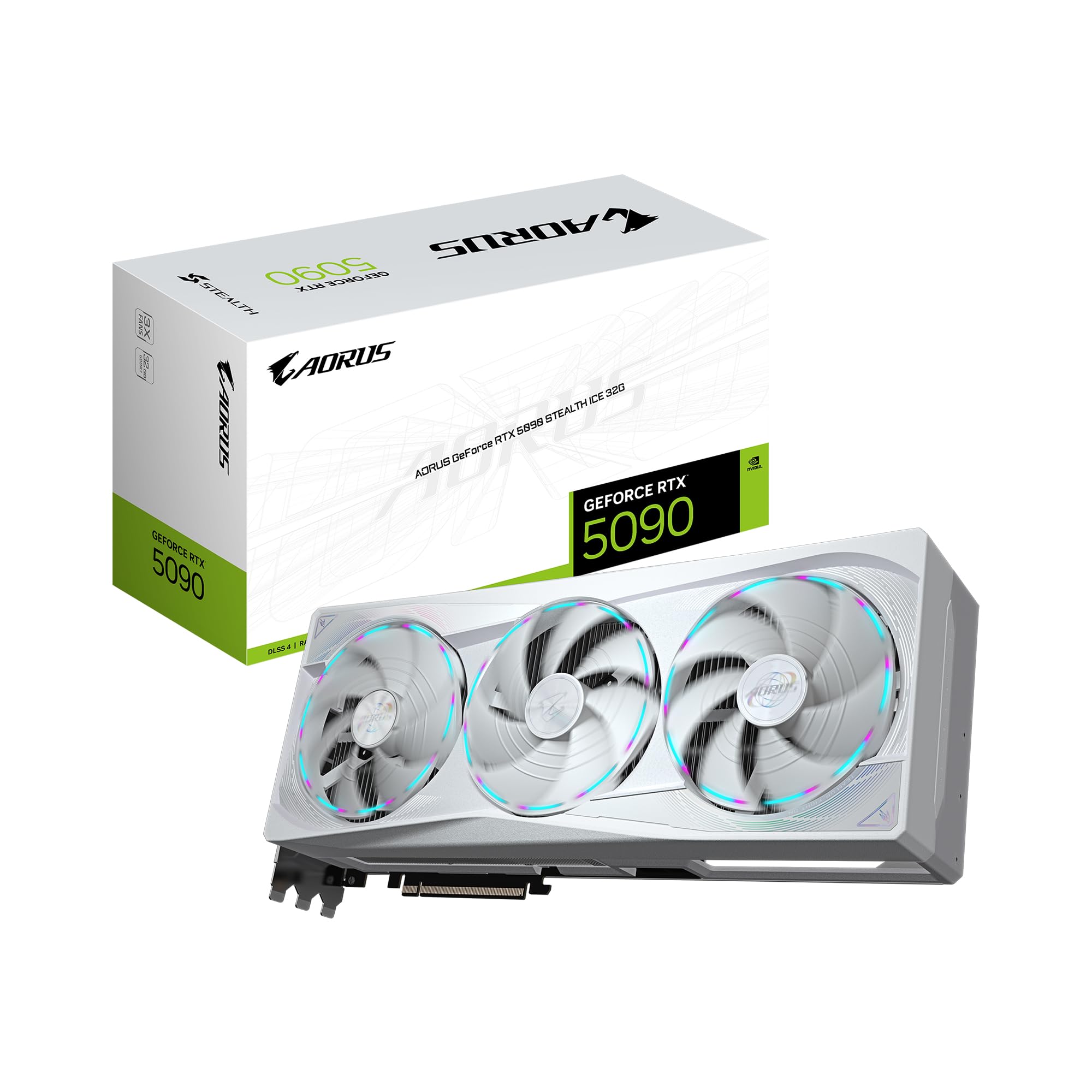
The transition to NVIDIA’s Blackwell architecture in 2026 has fundamentally shifted the conversation from "how many GPUs can we fit" to "how do we keep this rack from melting." While the raw TFLOPS of a GIGABYTE AORUS GeForce RTX 5090 Stealth ICE 32G Graphics Card are impressive, the real challenge for CTOs lies in the silent killers: I/O wait times and thermal throttling. Blackwell rack infrastructure optimization is no longer a luxury; it’s the difference between a high-performance cluster and a very expensive space heater.
Heads up: AI Hardware Hub may earn a commission when you buy through links on this page. We only recommend gear we'd run ourselves.
§The 200GbE Bottleneck: Moving Data at the Speed of Blackwell
In 2026, training large language models (LLMs) or running massive inference pipelines on cards like the PNY Technology VCNRTXPRO6000BQ-PB NVIDIA RTX PRO 6000 Blackwell Max-Q requires a networking fabric that doesn't blink. We’ve moved past the era where 100GbE was sufficient. To feed 96GB of high-speed VRAM across a multi-node cluster, 200GbE (and increasingly 400GbE) is the baseline.
The issue isn't just throughput; it’s RDMA (Remote Direct Memory Access). Without it, your CPU becomes a traffic cop, wasting cycles that should be managing the OS. When you're running heavy-duty enterprise systems like the ASUS Dual AMD EPYC 9004 Series 4U GPU Server, the 200GbE interconnect ensures that data moves directly from the high-density NVMe storage to the H200 or Blackwell GPUs, bypassing the CPU overhead entirely.
§NVMe Storage Density: Feeding the Beast
You can’t train on what you can't load. The I/O requirements for Blackwell-based systems have spiked because the compute is so much faster. If your storage array is still spinning on Gen4 speeds, your BoxGPT AI Workstation is going to spend 30% of its time waiting for the next batch of tokens.
- Gen5 NVMe is Mandatory: For local development, look at systems like the Adamant Custom 12-Core Liquid Cooled Workstation which utilizes high-bandwidth Gen4/Gen5 lanes to keep the RTX 5090 saturated.
- Parallel File Systems: In rack-scale deployments, WEKA or Lustre over NVMe-oF (NVMe over Fabrics) is the standard for 2026.
- IOPS vs. Throughput: High-density I/O isn't just about big sequential reads; it’s about the random IOPS needed for diverse datasets in multimodal AI.
§The Heat Load Reality: Liquid Cooling isn't Optional
The thermal density of a modern Blackwell rack is staggering. We are seeing racks pushing 100kW to 120kW. Traditional air cooling is physically incapable of moving enough CFM (cubic feet per minute) to keep a farm of PNY NVIDIA RTX 6000 ADA or Blackwell units stable under 100% load.
Direct-to-chip (DTC) liquid cooling has become the gold standard. By using a coolant loop to pull heat directly from the GPU die, you reduce the need for massive, noisy server fans. This isn't just about acoustics; it’s about the Total Cost of Ownership (TCO). Lowering the fan speed reduces the "parasitic power" draw of the server itself, allowing that electricity to go toward computation. Check out our latest benchmarks to see how liquid-cooled vs. air-cooled Blackwell systems compare in sustained clock speeds.
§Infrastructure Comparison: Workstation vs. Rack-Mount AI
| Feature | High-End Workstation (Sentinel Non-RGB) | Enterprise GPU Server (ASUS ESC8000A) |
|---|---|---|
| Typical GPU | RTX PRO 6000 Blackwell | H200 NVL / Blackwell HGX |
| Networking | 10GbE / 25GbE | 200GbE / 400GbE InfiniBand |
| Cooling | AIO / Advanced Air | Liquid-to-Liquid / Rear Door Heat Exchanger |
| VRAM Capacity | 96GB - 192GB | 1.1TB+ (Aggregate) |
| Primary Use | Local Model Fine-tuning | Large-scale Pre-training |
§TCO Beyond GPU Benchmarks
When a CTO looks at the budget for a Blackwell deployment, the GPU sticker price—like the $13,522 for a PNY RTX PRO 6000 Blackwell—is only half the story.
The real costs are in the AI workstations furniture: power distribution units (PDUs) capable of handling high amperage, the "grey space" in the data center for chillers, and the specialized networking switches. If you optimize your rack density by using liquid cooling, you can often fit twice the compute in the same floor space, effectively halving your real estate TCO.
§Designing the Data Path
The interplay between storage and networking is where most Blackwell builds fail. If you're building out a cluster using the ASUS Dual AMD EPYC 4U Server, you must ensure your TOP-of-rack (ToR) switch has the backplane capacity to handle simultaneous 200GbE bursts from every node. Anything less, and you'll see your GPU utilization drop to 40-50% during data-shuffling phases.
Small-to-medium enterprises often find better value in "super-workstations." The BoxGPT AI Workstation offers a turnkey solution that bypasses the need for complex rack infrastructure while still providing the massive 96GB VRAM buffer necessary for modern LLMs.
FAQ
Why is 200GbE networking required for Blackwell GPUs?
Blackwell GPUs process data so quickly that standard 10GbE or even 100GbE connections create a significant bottleneck. 200GbE provides the necessary bandwidth to keep the GPU’s VRAM saturated during synchronized training steps across multiple nodes.
Can I run a Blackwell rack with traditional air cooling?
Technically yes, but it is highly inefficient. The power required to run fans at the speeds necessary to cool a 100kW rack is astronomical. Liquid cooling is more compact and significantly reduces the total power consumption of the data center.
Is the RTX 5090 suitable for enterprise AI racks?
The GIGABYTE AORUS RTX 5090 Stealth ICE is excellent for edge AI and high-end workstations. However, for dense server racks, professional cards like the RTX PRO 6000 Blackwell are preferred due to their driver support, blower/liquid-ready designs, and massive VRAM.
§Bottom line
Optimizing Blackwell rack infrastructure isn't about chasing a single spec. It’s an ecosystem play. You need the high-density storage to feed the 200GbE pipe, the networking to distribute the load, and the liquid cooling to keep the whole thing from throttling. If you're building for the 2026 AI landscape, stop looking at individual cards and start looking at the fluid dynamics and data fabric of your entire rack.
For more deep dives into specific hardware, visit our /categories/ai-gpus and /categories/ai-workstations sections.
Heads up: AI Hardware Hub may earn a commission when you buy through links on this page. We only recommend gear we'd run ourselves.