Infrastructure is the invisible ceiling of the Blackwell era. While the arrival of the NVIDIA RTX PRO 6000 Blackwell lineup has redefined what we expect from a single node, scaling these chips into high-density racks creates a physiological crisis for the modern data center. If your networking fabric and storage throughput aren't over-provisioned to match the compute, you aren't running a cluster; you're running a very expensive space heater.
Heads up: AI Hardware Hub may earn a commission when you buy through links on this page. We only recommend gear we'd run ourselves.
§The Blackwell bottleneck: Beyond TFLOPS
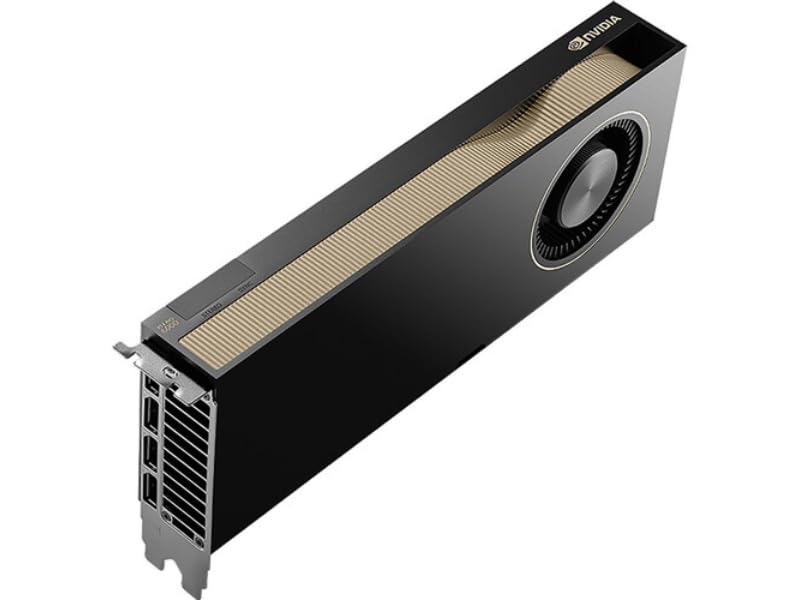
In 2026, the discussion around AI GPUs has shifted. We're no longer just counting CUDA cores; we’re measuring the "Time to First Token" and "Checkpoint Restart" speed. A single PNY Technology VCNRTXPRO6000BQ-PB NVIDIA RTX PRO 6000 Blackwell Max-Q packs 96GB of VRAM. When you pack 32 or 64 of these into a high-density rack, the aggregate memory bandwidth is staggering.
However, the "Blackwell tax" is the massive demand it places on the surrounding infrastructure. To keep these chips fed, you need a balanced diet of:
- 200GbE (or faster) Networking: Anything less leads to high-latency "bubbles" where GPUs sit idle waiting for data across the fabric.
- Direct Liquid Cooling (DLC): Air cooling is physically incapable of dissipating the heat from a fully loaded Blackwell rack without massive, inefficient spacing.
- NVMe Gen5 Throughput: Local caching must keep pace with the 96GB framebuffers to prevent I/O wait times from killing training efficiency.
§Why 200GbE is the new 100GbE
We've officially hit the wall where 100GbE links are the primary cause of GPU starvation in multi-node training. For enterprises deploying the BoxGPT AI Workstation for local development or moving toward full rack-scale deployments, the fabric is the backbone.
With 96GB of VRAM per card, the datasets being swapped in and out are gargantuan. A 200GbE non-blocking fabric ensures that RDMA (Remote Direct Memory Access) can function at its peak, allowing one node to access the memory of another without involving the CPU. This is critical for scaling LLMs where the model weights themselves span across dozens of GPUs.
§The NVMe synchronization crisis
Storage is often the forgotten pillar of Blackwell rack infrastructure optimization. Consider this: a rack with 64 Blackwell-class GPUs can ingest data faster than most legacy SANs can serve it.
Transitioning to NVMe Gen5 is non-negotiable. Modern systems like the Adamant Custom 12-Core Liquid Cooled Workstation utilize 8TB NVMe Gen4/Gen5 SSDs to ensure that the 32GB or 96GB of VRAM on the GPU is never waiting for a disk read. In a rack environment, this translates to a "Storage Over Fabric" (NVMe-oF) requirement to ensure the pipeline stays saturated.
§Liquid cooling: From luxury to survival
If you're still planning on air-cooling a 100kW rack, you're planning for failure. Blackwell's power density is such that air as a medium simply cannot carry heat away fast enough. Liquid cooling—specifically Direct-to-Chip (DTC)—is required to keep the PNY NVIDIA RTX PRO 6000 Blackwell Max-Q within its thermal envelope.
The TCO (Total Cost of Ownership) math has changed. While the initial CapEx for liquid cooling is higher, the OpEx is lower because you:
- Eliminate the massive power draw of industrial-scale fans.
- Can run higher coolant temperatures, allowing for "warm water cooling" which uses ambient air for heat exchange rather than energy-intensive chillers.
- Increase hardware longevity by preventing the thermal cycling that kills silicon over time.
§Infrastructure comparison: Legacy vs. Blackwell-Ready
| Feature | Legacy AI Cluster (Ampere/Ada) | Blackwell-Optimized Rack |
|---|---|---|
| Primary GPU | NVIDIA A100 80GB | RTX PRO 6000 Blackwell (96GB) |
| Networking | 100GbE / InfiniBand HDR | 200GbE / 400GbE / InfiniBand NDR |
| Storage Standard | NVMe Gen4 Centralized | NVMe Gen5 + NVMe-oF Distributed |
| Cooling Method | High-Velocity Air / Rear Door Heat Exchanger | Direct-to-Chip Liquid Cooling |
| Power Density | 15kW - 30kW per Rack | 60kW - 120kW+ per Rack |
§Balancing the local and the cloud
Not every workflow requires a 100kW rack immediately. For many ML engineers, the path to Blackwell starts with an AI Workstation. Using a system like the Cloud Ninjas Iron Bull AI Workstation allows for local prototyping with the same architectural benefits—such as the massive 256GB of ECC RAM and 32GB VRAM available on the RTX 5090—before deploying to a liquid-cooled enterprise cluster.
However, once you jump to professional-grade hardware like the ASUS ESC8000A-E12P, the infrastructure needs scale exponentially. Even though that server uses the H200 NVL, it serves as a blueprint for the thermal and networking density required for the Blackwell generation. Check our latest benchmarks to see how these configurations hold up under real-world LLM finetuning.
§Bottom line
Optimizing for Blackwell isn't about buying the fastest GPU; it's about building a cage that can contain it. If your 200GbE fabric isn't ready and your liquid cooling loops aren't pressure-tested, your investment in Blackwell silicon will yield diminishing returns. Focus on the plumbing—networking, storage, and cooling—and the TFLOPS will take care of themselves.
FAQ
How much power does a full Blackwell rack require?
Expect a high-density Blackwell rack to pull between 60kW and 120kW. This requires specialized power distribution units (PDUs) and often a transition to 415V or 480V power to the rack to keep amperage manageable.
Can I run the RTX PRO 6000 Blackwell in an air-cooled chassis?
While the PNY NVIDIA RTX PRO 6000 Blackwell Max-Q can be air-cooled in sparse workstation configurations like the BoxGPT AI Workstation, we do not recommend it for high-density rack deployments where cards are stacked closely together.
Is 200GbE enough for 96GB VRAM GPUs?
200GbE is the current baseline for efficient scaling. For training runs involving more than 16 nodes, many enterprises are already looking toward 400GbE to maintain the 1:1 ratio of compute to networking bandwidth required to minimize GPU idle time.
Heads up: AI Hardware Hub may earn a commission when you buy through links on this page. We only recommend gear we'd run ourselves.