By now, the performance metrics of the Blackwell architecture are common knowledge, but the brutal reality of deploying these chips at scale remains a logistical gauntlet for CTOs. To unlock the full potential of a Blackwell rack, you cannot treat compute, networking, and storage as isolated silos; they are now a singular, symbiotic organism. If your 200GbE fabric or Gen5 NVMe arrays aren't perfectly tuned to the thermal and IOPS requirements of liquid-cooled nodes, you aren't just losing clock cycles—you’re bleeding TCO through inefficient power usage and thermal throttling.
Heads up: AI Hardware Hub may earn a commission when you buy through links on this page. We only recommend gear we'd run ourselves.
§The Blackwell thermal wall and the liquid cooling mandate
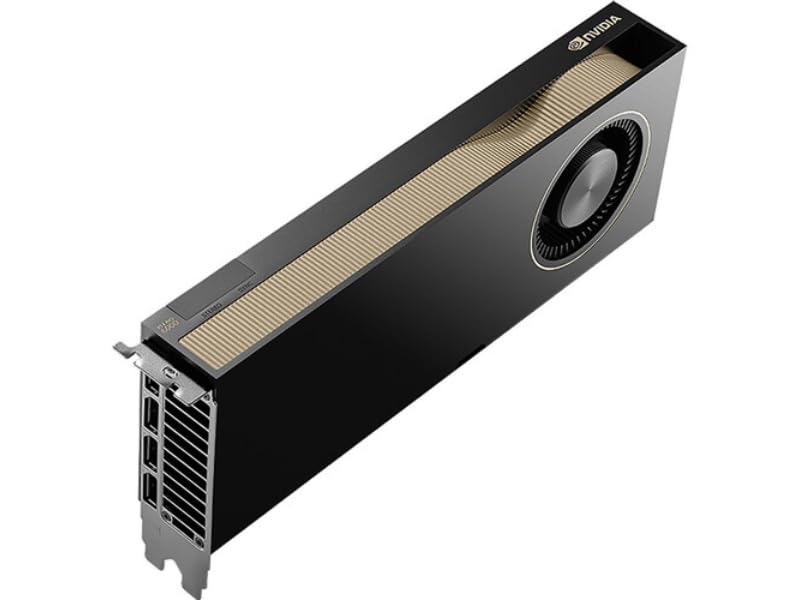
The transition to Blackwell marks the definitive end of air-cooled dominance in the enterprise data center. While workstation-grade cards like the PNY Technology VCNRTXPRO6000BQ-PB NVIDIA RTX PRO 6000 Blackwell Max-Q Workstation Graphics Card offer incredible density for local development, the rack-scale enterprise deployments require a fundamental shift toward Direct-to-Chip (D2C) liquid cooling.
When you pack dozen of Blackwell GPUs into a single rack, the heat flux exceeds what traditional CRAC units can handle efficiently. Liquid cooling isn't just about preventing a shutdown; it’s about maintaining a consistent thermal envelope that keeps the GPU Boost clocks stable. For a strategic audit, look at the delta between your coolant inlet temperature and the GPU junction temperature. A mismatch here leads to "micro-throttling," where the PNY Technology VCNRTXPRO6000BQ-PB or its server-grade counterparts drop frequency just enough to desync the parallel training job, causing a cascade of idle time across the entire fabric.
§200GbE networking: The circulatory system of the cluster
In 2026, 100GbE is a bottleneck. For Blackwell-based clusters, 200GbE is the minimum entry point to ensure that the "All-Reduce" operations in distributed training don't leave your GPUs sitting idle. The ratio we look for is 1:1 parity between GPU throughput and network injection bandwidth.
If you are running enterprise-grade systems like the ASUS Dual AMD EPYC 9004 Series 4U GPU Server (ESC8000A-E12P), the integration of ConnectX-7 or equivalent 200GbE/400GbE adapters is mandatory. Without it, the "Tail Latency"—the slowest packet in a collective communication group—becomes the deciding factor in your training time.
Why networking impacts thermal efficiency
It sounds counterintuitive, but slow networking makes your rack run hotter for longer. If a training job takes 20% longer due to network congestion, those liquid pumps and cooling towers are running for an extra 20% of the time. In the age of Blackwell rack infrastructure optimization, reducing job completion time (JCT) is the most effective way to lower your overall PUE (Power Usage Effectiveness).
§Gen5 NVMe storage: Feeding the beast
High-performance compute is a vanity metric if your storage backend can't feed the GPUs. Blackwell architectures, specifically those utilized in workstations like the BoxGPT AI Workstation, RTX PRO 6000 Blackwell, depend on PCIe Gen5 NVMe arrays to eliminate IO-wait states.
- Training Data Loading: Large datasets must be streamed from NVMe to VRAM. With the 96GB buffer on the PNY RTX PRO 6000 Blackwell Max-Q, the "pre-fetch" needs to be nearly instantaneous.
- Checkpointing: In large-scale clusters, saving model weights (checkpointing) can take minutes. Gen5 storage cuts this by 50% compared to Gen4, reducing the window where GPUs are consuming idle power.
- Local Caching: AI workstations like the Sentinel Non-RGB RTX PRO 6000 utilize triple NVMe arrays to ensure that even while one model is training, data ingestion for the next epoch is happening in the background without bus contention.
§Benchmarking the generations: 2026 Comparison
| Architecture | Representative GPU | VRAM | Interconnect Std. | Cooling Preference |
|---|---|---|---|---|
| Blackwell (New) | NVIDIA RTX PRO 6000 Blackwell | 96GB | PCIe Gen5 / 200GbE+ | Liquid / Max-Q Air |
| Ada Lovelace | PNY NVIDIA RTX 6000 ADA | 48GB | PCIe Gen4 / 100GbE | Air |
| Ampere | A100 80GB Graphics Card | 80GB | PCIe Gen4 / 100GbE | Data Center Air |
§Maximizing VRAM utilization vs. IOPS
One common mistake in Blackwell rack infrastructure optimization is over-investing in compute while under-investing in the "memory fabric." The 96GB of VRAM found in the PNY RTX PRO 6000 Blackwell Max-Q allows for much larger batch sizes. However, larger batch sizes require more aggressive IOPS from your storage array.
When auditing your infrastructure, check for the "Stall Ratio." If your GPUs are at 100% utilization but your power draw is fluctuating, they are likely waiting for data from the NVMe drives or the 200GbE fabric. In systems like the Sentinel Non-RGB RTX PRO 6000, which pairs 128GB of DDR5 with the latest Blackwell silicon, the bottleneck shifts heavily to how fast the storage controller can move data from the 3x4TB SSDs into the system memory and subsequently into the GPU's GDDR7.
§TCO and the operational "Hidden Tax"
For CTOs, the TCO of a Blackwell cluster isn't just the $13,522 sticker price of a PNY RTX PRO 6000 Blackwell. It’s the operational tax of the infrastructure.
- The Cooling Tax: Traditional air-cooled racks capped out at 15-20kW. Blackwell racks can easily push 60-100kW per rack. If you haven't budgeted for RDx (Rear Door Heat Exchangers) or CDUs (Coolant Distribution Units), your Blackwell investment will underperform from day one.
- The Networking Tax: Moving from 100GbE to 200GbE often requires new optical transceivers and switches. However, failing to make this jump results in a "Communication Overhead" that can eat up to 30% of your total compute time on models with over 100 Billion parameters.
- The Lifespan Tax: Heat is the enemy of longevity. Proper liquid-cooled Blackwell rack infrastructure optimization can extend the usable life of your GPUs by maintaining a consistent, lower operating temperature, reducing the failure rate of the HBM3e/GDDR7 memory modules.
FAQ
Why is liquid cooling required for Blackwell but not Ada Lovelace?
While high-end Ada cards like the PNY NVIDIA RTX 6000 ADA are efficient at 300W, Blackwell's transistor density and the wattage required for 96GB of high-speed memory push the thermal density beyond what's manageable with standard heatsinks in high-density rack configurations. Liquid cooling allows for more consistent performance and higher rack density.
Can I run Blackwell GPUs on PCIe Gen4 motherboards?
Yes, but you shouldn't. The Blackwell architecture is designed for PCIe Gen5 speeds. Using an older standard will severely throttle the communication between the CPU and the NVIDIA RTX PRO 6000 Blackwell, particularly during large data transfers or when using GPUDirect Storage.
Does 200GbE networking actually improve AI model accuracy?
Not directly, but it improves experimental velocity. Faster networking means more training runs in less time. This allows your team to iterate on hyperparameters and architecture more frequently, which does lead to better model accuracy over the life of the project.
§The Bottom Line
The shift to Blackwell is more than a GPU upgrade; it’s a data center transformation. To see a real return on investment, you must balance the compute power of the PNY RTX PRO 6000 Blackwell Max-Q with a 200GbE networking fabric and Gen5 NVMe storage. Whether you are deploying local dev nodes like the BoxGPT AI Workstation or massive clusters based on the ASUS ESC8000A-E12P, the infrastructure is the limit of your capability. Audit your cooling, upgrade your fabric, and feed the beast.
Heads up: AI Hardware Hub may earn a commission when you buy through links on this page. We only recommend gear we'd run ourselves.