The race for AI supremacy has shifted from the chip design lab to the data center floor. As we move deeper into 2026, the discussion for CTOs has evolved beyond simply acquiring compute to solving the massive thermal and IO bottlenecks that threaten to derail ROI. Real Blackwell Rack TCO Efficiency isn't found in a spreadsheet of teraflops; it’s hidden in the synergy between high-density NVMe storage, 200GbE networking, and the transition to liquid-cooled infrastructure.
Heads up: AI Hardware Hub may earn a commission when you buy through links on this page. We only recommend gear we'd run ourselves.
§The Blackwell thermal wall: Why air isn't enough
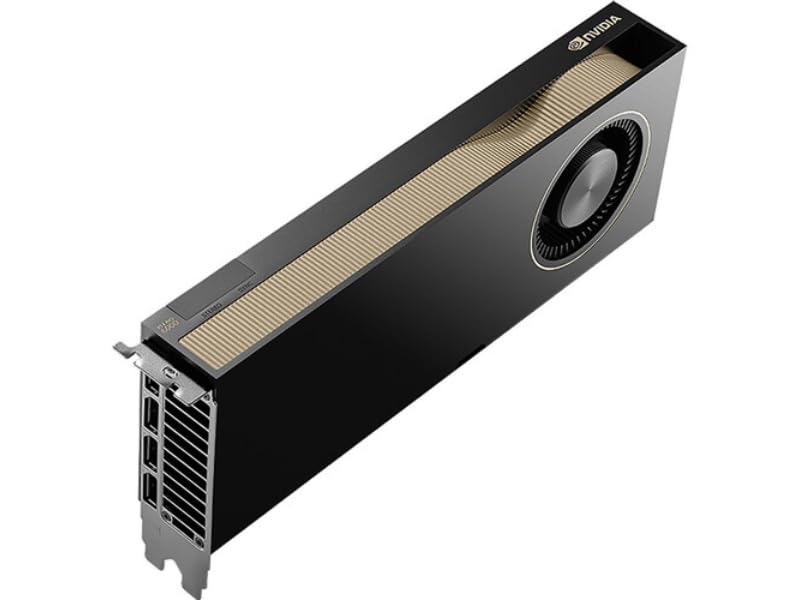
The current generation of AI GPUs has pushed air cooling to its physical limit. While the previous PNY NVIDIA RTX 6000 ADA could thrive in high-airflow chassis, the density required for Blackwell-class clusters makes liquid cooling a financial necessity rather than a luxury.
When you calculate TCO, the energy required to spin thousands of fans at 15,000 RPM often exceeds the cooling cost of a liquid-loop manifold (CDU). By moving to liquid-cooled racks, enterprises can reduce their Power Usage Effectiveness (PUE) from a mediocre 1.5 to a lean 1.1. This 40% reduction in "overhead" power directly translates to more "compute" power available within the same utility envelope.
§NVMe density and the 200GbE data straw
Compute is only as fast as its ability to be fed. We’ve seen a massive surge in demand for local high-density NVMe storage to act as a "hot tier" for training data. In the latest AI Workstations, such as the BoxGPT AI Workstation, RTX PRO 6000 Blackwell, we’re seeing 96GB VRAM GPUs paired with Gen5 NVMe drives to ensure the "data straw" is wide enough.
However, at the rack level, the bottleneck shifts to the Fabric. 200GbE (and increasingly 400GbE) networking is the minimum requirement to prevent Blackwell clusters from idling while waiting for checkpoints to sync. If your network can't keep up with the Blackwell interconnect, you're paying for idle silicon—the most expensive mistake an infrastructure lead can make.
Why storage and networking impact TCO
- Reduced IO Wait: Faster storage means GPUs spend more time on FLOPs and less time on wait-states.
- Rack Density: High-density NVMe allows for more storage per U-space, reducing physical footprint.
- Lower Latency: 200GbE reduces the time for gradient synchronization in distributed training.
§Balancing local workstations and enterprise Racks
Not every workload belongs in a $100k rack. Many R&D teams are finding that local development on machines like the NOVATECH Apex WS9985X AI Workstation provides a better "cost-per-experiment" than spinning up cloud instances for small-scale fine-tuning.
For enterprise-grade production, systems like the ASUS Dual AMD EPYC 9004 Series 4U GPU Server BRIDGE the gap by offering massive memory footprints (up to 6TB of DDR5) alongside specialized AI accelerators. The goal is to match the hardware to the stage of the project’s lifecycle.
| Feature | Workstation (Local) | Enterprise Server (Rack) |
|---|---|---|
| Typical GPU | RTX PRO 6000 Blackwell | H200 NVL 141GB |
| Cooling | AIO / High Airflow | Direct-to-Chip Liquid |
| Storage Capacity | 2TB - 8TB NVMe | Multi-Petabyte SAN/High-Density NVMe |
| Networking | 10GbE / 25GbE | 200GbE InfiniBand/Ethernet |
| Best Use Case | Model prototyping, EDA | Large-scale LLM Training |
§Efficiency through integration
Infrastructure leads are moving away from piecemeal builds. The labor cost of integrating custom liquid loops and configuring RDMA over Converged Ethernet (RoCE) is too high. This is why pre-configured systems like the Adamant Custom 12-Core Liquid Cooled Workstation have become the standard for professional labs. These systems are validated for thermal stability before they ever hit your loading dock.
When looking at Blackwell Rack TCO Efficiency, you have to look at the "Total" part of that acronym. If a specialized workstation saves your $250k/year ML engineer two hours of configuration time a week, it pays for itself in less than six months. On the rack side, the 20% premium you might pay for direct-to-chip liquid cooling is recovered the moment you avoid a multi-million dollar data center HVAC retrofit.
§The path to 2027: Future-proofing your investement
Buying Blackwell today means preparing for the power densities of tomorrow. Check our benchmarks to see how the move to larger VRAM capacities, like the 96GB found in the RTX PRO 6000 Blackwell, allows for larger local batch sizes, reducing the need for constant network chatter.
Infrastructure is no longer a "set it and forget it" purchase. It is a dynamic balance of thermals, bandwidth, and compute. The winners in the AI space won't be those with the most GPUs, but those with the most efficient ones.
FAQ
How much does liquid cooling actually save on TCO?
In high-density Blackwell deployments, liquid cooling can reduce cooling-related energy costs by up to 40% compared to traditional air-cooled racks. It also allows for higher rack density, reducing the physical real estate costs of the data center.
Is 200GbE necessary for Blackwell workstations?
For a standalone workstation like the BoxGPT AI Workstation, 10GbE or 25GbE is usually sufficient. However, if the workstation is part of a distributed training cluster, 200GbE is required to keep the Blackwell GPUs synchronized without significant latency penalties.
Can I mix Ada Lovelace and Blackwell GPUs in the same rack?
While technically possible, it is highly discouraged for TCO. You will be limited by the slowest component in the cluster. It’s more cost-effective to keep your RTX 6000 Ada units for inference or legacy workloads and dedicate new racks entirely to Blackwell’s unified architecture.
§Bottom line
Optimizing Blackwell Rack TCO Efficiency requires a holistic view of the stack. Don't overspend on VRAM and then starve it with slow networking. Don't buy state-of-the-art silicon and then throttle it with an inadequate air-cooling solution. Start with your thermal and data throughput targets, and then build the compute to fit those constraints.
Heads up: AI Hardware Hub may earn a commission when you buy through links on this page. We only recommend gear we'd run ourselves.