In 2026, the bottleneck for AI performance has shifted from the compute core to the silicon that feeds it. As enterprises scale their Blackwell deployments, the primary threat to Blackwell Rack TCO Efficiency isn't the thermal ceiling of the GPU itself, but the "Network Thermal Throttling" of the I/O and storage layers. To maintain maximum ROI, CTOs must pivot their cooling strategies to prioritize high-density Gen5 NVMe and 200GbE networking components that are increasingly gasping for air in the wake of 700W+ GPUs.
Heads up: AI Hardware Hub may earn a commission when you buy through links on this page. We only recommend gear we'd run ourselves.
§The hidden tax of I/O heat
Modern AI clusters are built on the back of massive data movement. While we’ve spent years perfecting liquid loops for GPUs like the A100 80GB Graphics Card, the supporting cast of Gen5 NVMe drives and 200GbE SmartNICs is now generating unprecedented heat. In a standard air-cooled rack, the exhaust from a row of Blackwell cards can reach temperatures that force the networking chips to throttle their throughput by as much as 40%.
When your 200GbE fabric drops to 120GbE due to heat, your expensive GPUs sit idle, waiting for data. This is the "I/O Thermal Tax," and it's the fastest way to ruin your Blackwell Rack TCO Efficiency. For local development, high-end builds like the NOVATECH Apex WS9985X AI Workstation mitigate this through massive airflow, but at the rack level, air is no longer enough.
§Why 200GbE networking is the new thermal frontier
In 2026, we’re seeing that networking cards are the "canary in the coal mine" for rack health. These cards are often located in the tightest spaces of a server chassis. Unlike the ASUS Dual AMD EPYC 9004 Series 4U GPU Server, which provides significant spacing for cooling, many 1U and 2U designs cram I/O into stagnant air pockets.
- The 200GbE Bottleneck: High-speed transceivers can consume up to 30W each. Multiply that by 32 ports in a switch or multiple NICs in a node, and you have a localized heat crisis.
- Packet Loss: Thermal stress on the NIC doesn't just slow down data; it causes dropped packets, triggering expensive TCP retransmissions that spike latency.
- The Blackwell Relationship: Blackwell chips demand a constant feed of data to saturate their Tensor cores. If the network layer throttles, the GPU utilization drops, directly impacting the benchmarks your C-suite cares about.
§Gen5 NVMe: The silent radiator
Storage used to be a passive component. In 2026, PCIe Gen5 NVMe drives are essentially small heaters. A single Gen5 drive can pull 20-25W under heavy sustained read/write loads during LLM checkpointing. In an enterprise system like the BoxGPT AI Workstation, we see these drives reaching 80°C within minutes of a training run if not properly managed.
For those running distributed training, the storage layer must be cooled as aggressively as the compute. This ensures that AI GPUs can pull data from local scratch space at 14GB/s without the controller card downclocking to Gen3 speeds.
§Comparing thermal impact on TCO
The following table illustrates the performance loss and TCO impact when I/O cooling is neglected in a standard 42U rack of Blackwell-based systems.
| Component Layer | Optimal Operating Temp | Throttle Point | Impact on Rack TCO | Performance Recovery via Liquid Cooling |
|---|---|---|---|---|
| GPU (Blackwell) | 65°C | 85°C | High (Power Draw) | 5-10% |
| Networking (200GbE) | 55°C | 75°C | Extreme (Cluster Latency) | 25-40% |
| Storage (Gen5 NVMe) | 45°C | 70°C | Medium (IOPS Drop) | 15% |
§The shift to liquid-cooled I/O
The solution isn't just liquid-cooling the GPUs; it's extending those loops to the PCIe riser cards and the networking fabric. We are seeing a major shift in AI workstations and enterprise servers toward "All-Loop" configurations.
Consider the Cloud Ninjas Iron Bull AI Workstation. While it uses high-end air cooling, its chassis design is optimized to prevent the RTX 5090's heat from soaking the NVMe slots. At the rack level, however, you need Direct-to-Chip (D2C) liquid cooling for the NICs themselves.
By capturing the heat at the source—before it enters the rack's ambient air—you can increase the inlet water temperature. This allows for "warm-water cooling," which eliminates the need for expensive chillers and significantly lowers the Power Usage Effectiveness (PUE) of the data center.
§Strategies for maximizing Blackwell ROI
To ensure your hardware investment doesn't go to waste, follow these three design principles:
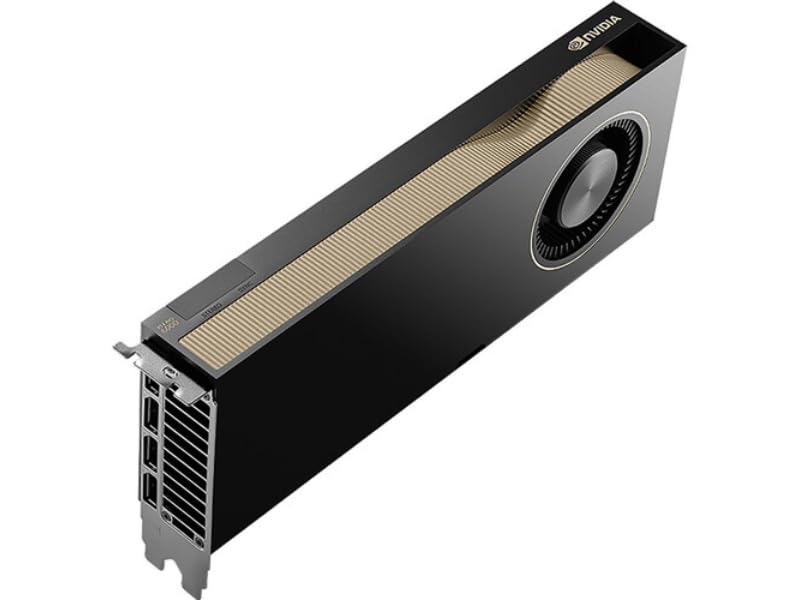
- Isolate the I/O Path: Ensure that storage and networking cards are not located directly in the "heat shadow" of GPUs. Using systems like the PNY Technology VCNRTXPRO6000BQ-PB NVIDIA RTX PRO 6000 Blackwell Max-Q allows for more flexible thermal management due to its workstation-optimized power profile.
- Monitor Fabric Latency: Implement telemetry that specifically tracks the temperature of your 200GbE transceivers. If you see a correlation between GPU idle time and NIC temperature, you have a "Network Thermal Throttling" issue.
- Active NVMe Cooling: Don't rely on passive sinks for Gen5 drives. Use systems that provide dedicated active airflow or cold-plate contact for the NVMe array.
§Bottom line: Cooling the whole stack
The era of only worrying about the "brain" of the AI server is over. In 2026, the "nervous system" (networking) and the "memory" (storage) are just as thermally sensitive. To optimize Blackwell Rack TCO Efficiency, CTOs must look at the rack as a single thermal organism. Investing in liquid-cooled I/O today prevents the expensive throttling that will otherwise plague your Blackwell clusters tomorrow.
FAQ
What is 'Network Thermal Throttling' in AI clusters?
It occurs when high-performance networking chips (like 200GbE or 400GbE NICs) overheat due to high ambient rack temperatures or sustained data loads. To prevent damage, the chip reduces its clock speed, leading to lower bandwidth and higher latency, which starves GPUs of data and lowers overall cluster efficiency.
Can I run Blackwell GPUs in a standard air-cooled data center?
While possible, it is not recommended for high-density racks. A full rack of Blackwell-based systems can exceed 100kW of power density. Without liquid cooling or extreme containment strategies, you will likely experience significant thermal throttling on both the GPUs and the supporting networking/storage hardware.
Why is Gen5 NVMe more of a cooling concern than previous generations?
Gen5 NVMe drives double the bandwidth of Gen4, but this speed comes at the cost of significantly higher power consumption and heat generation. In a 2026 enterprise environment, these drives can reach their thermal limits in seconds during data-intensive tasks like model checkpointing if they lack active or liquid cooling.
Heads up: AI Hardware Hub may earn a commission when you buy through links on this page. We only recommend gear we'd run ourselves.