Optimizing a modern data center in 2026 isn't just about raw FLOPS; it’s a desperate battle against physics. As we scale into the Blackwell era, the "hidden" Total Cost of Ownership (TCO) is no longer found in the sticker price of the silicon, but in the thermal inefficiencies that choke high-density I/O. For enterprise CTOs, achieving Blackwell Rack TCO efficiency requires a radical shift toward direct liquid cooling (DLC) to bridge the gap between 200GbE networking and high-density NVMe storage.
Without a unified thermal strategy, your $100k+ nodes won't run at peak frequency—they'll spend half their cycles waiting for heat to dissipate.
Heads up: AI Hardware Hub may earn a commission when you buy through links on this page. We only recommend gear we'd run ourselves.
§The thermal bottleneck of 200GbE and NVMe
In 2026, 200GbE is the baseline for inter-node communication. However, pushing 200 gigabits per second generates significant heat at the NIC level. When you pair this with high-density NVMe arrays—which can now pull 20-25W per drive during heavy AI training ingest—you create a "thermal curtain" that prevents air-cooled systems from maintaining turbo clocks.
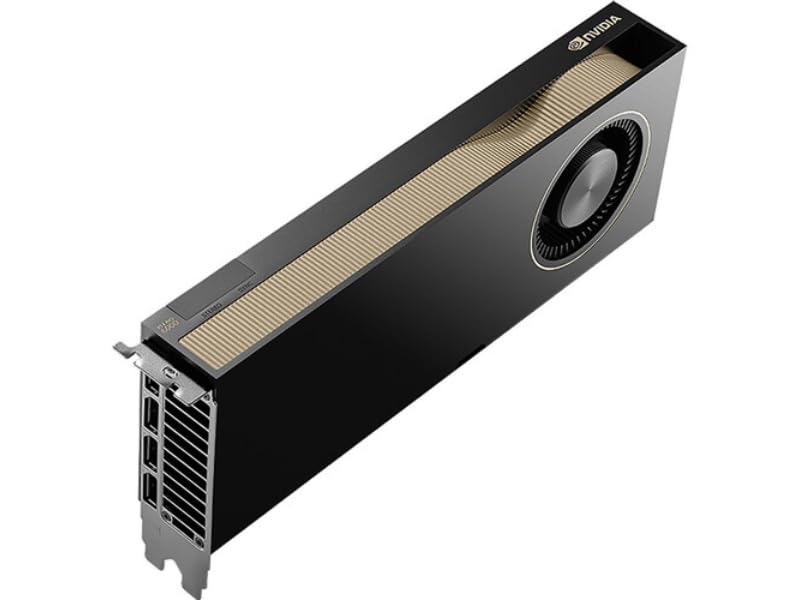
Traditional air cooling relies on a high delta-T (the difference between intake air and component temperature). As rack density increases, the intake air for the rear-mounted NICs is already pre-heated by the GPUs and CPUs. This leads to packet drops and increased latency, directly impacting your scaling efficiency. By moving to DLC, you remove the reliance on air as a medium, allowing the PNY Technology VCNRTXPRO6000BQ-PB NVIDIA RTX PRO 6000 Blackwell Max-Q to operate in its most efficient power band.
§Why Blackwell changes the TCO calculation
The Blackwell architecture is significantly more power-efficient per token than Ada Lovelace, but the power density has spiked. If you're comparing the PNY NVIDIA RTX 6000 ADA to the newer Blackwell-based units, you're looking at a massive leap in VRAM throughput (up to 96GB on a single card).
But here’s the kicker: if your rack PUE (Power Usage Effectiveness) is sitting at 1.5 because of massive CRAC units and high-RPM server fans, you're lighting money on fire.
- Reduced Fan Overhead: DLC can reduce server fan power consumption by up to 15%.
- Higher Reliable Clocks: Water-cooled Blackwell chips avoid the "thermal saw-tooth" performance profile.
- Rack Density: You can fit 2x the compute in the same footprint when you aren't limited by air-flow CFM requirements.
§From workstations to the data center: The Blackwell spectrum
While large clusters focus on DLC, the transition starts at the prototyping level. We see many teams beginning their development on high-end nodes like the BoxGPT AI Workstation. These systems feature the same 96GB VRAM Blackwell silicon found in enterprise racks, allowing for local weight loading and code optimization before moving to a massive ASUS ESC8000A-E12P 2x H200 NVL Server cluster.
For those running local R&D that requires absolute throughput, the networking synergy between the CPU and GPU is vital. The NOVATECH Apex WS9985X AI Workstation and the Cloud Ninjas Iron Bull AI Workstation showcase how high-wattage components can be managed, but once you scale these to a 42U rack, air cooling simply fails to keep up with the Blackwell I/O demands.
§Operational synergy: Networking meets Storage
To keep a Blackwell GPU fed, your storage sub-system must be as fast as your network. This is where the synergy happens. 200GbE allows for GPUDirect Storage (GDS), but GDS creates intense localized heat on the NVMe controllers.
| Feature | Air-Cooled Standard | DLC-Enhanced Blackwell |
|---|---|---|
| GPU Architecture | Ada Lovelace (RTX 6000 ADA) | Blackwell (RTX PRO 6000 Max-Q) |
| VRAM Capacity | 48GB | 96GB |
| I/O Potential | 100GbE / PCIe 5.0 | 200GbE / PCIe 6.0 Ready |
| Typical Rack PUE | 1.4 - 1.6 | 1.05 - 1.15 |
| Thermal Throttling | Common at 80% Load | Negligible |
By integrating DLC across the GPU, the 200GbE NIC, and the NVMe mid-plane, you eliminate the hotspots that cause "tail latency" in AI training. This is the secret to Blackwell Rack TCO efficiency: it’s not about the cost of the hardware, it’s about the cost of the work produced.
§Bridging the gap: Workstations and Clusters
You can check out our latest benchmarks to see how ai-workstations perform under sustained thermal load. Many creators find that starting with a BoxGPT AI Workstation provides the necessary 96GB of VRAM to test large models without the overhead of a full server. However, once you move to production, the leap to ai-gpus in a liquid-cooled rack is inevitable.
The transition from the ASUS ESC8000A-E12P (which supports the H200 NVL) to Blackwell-specific clusters represents a 3x increase in inference throughput, but only if you solve the cooling puzzle.
Critical lessons for 2026 infrastructure
- Don't skimp on the NIC: 200GbE is required to saturate Blackwell's memory bandwidth; anything less creates a bottleneck.
- Plan for DLC now: Even if you aren't 100% liquid today, ensure your enterprise-ai-systems are DLC-ready for future expansions.
- VRAM Matters: The jump from 48GB in the PNY NVIDIA RTX 6000 ADA to 96GB in the Blackwell Max-Q allows for significantly larger local batches, reducing network traffic and power-intensive data shuffling.
FAQ
Why is 200GbE networking considered a thermal risk?
200GbE NICs and optical transceivers operate at high power densities. In a dense Blackwell rack, these components are often located in the rear, receiving pre-heated air from the GPUs. Without proper thermal management or liquid cooling, these NICs can throttle, causing a massive spike in network latency and killing the cluster's collective performance.
How does Blackwell Max-Q differ from standard Blackwell GPUs?
Max-Q variants like the PNY Technology VCNRTXPRO6000BQ-PB are optimized for the highest performance-per-watt. By operating at a slightly lower clock frequency but with a massive 96GB VRAM pool, they provide the best TCO for high-density environments where heat dissipation is the primary constraint.
Can I run Blackwell GPUs in a standard air-cooled server?
It is possible, but not recommended for 24/7 enterprise production. You will likely experience thermal throttling and high fan noise, which leads to increased mechanical failure rates. Moving to a system like the ASUS ESC8000A-E12P or a DLC-enabled Blackwell rack ensures the longevity and stability of your investment.
Bottom line
The shift to Blackwell is more than a GPU upgrade; it’s an infrastructure revolution. CTOs who prioritize the synergy between networking, storage, and liquid cooling will see a vastly superior return on investment through improved Blackwell Rack TCO efficiency. If you are still relying on air to cool 200GbE and 96GB VRAM GPUs, you’re leaving 20-30% of your performance on the table.
Heads up: AI Hardware Hub may earn a commission when you buy through links on this page. We only recommend gear we'd run ourselves.