As we move deeper into 2026, the enterprise focus has shifted from merely acquiring compute to optimizing the massive infrastructure costs required to keep that compute running. The thesis is simple: in a Blackwell-dominated world, liquid cooling the GPUs is no longer enough; to avoid thermal throttling and predatory energy bills, CTOs must extend direct-to-chip (DTC) liquid cooling to the "hidden" heat sources—the 200GbE networking fabric and high-density NVMe storage arrays. Failing to address these I/O heat signatures ignores up to 20% of a rack’s thermal load, directly undermining the ROI of high-cap investments like the PNY Technology VCNRTXPRO6000BQ-PB NVIDIA RTX PRO 6000 Blackwell Max-Q.
Heads up: AI Hardware Hub may earn a commission when you buy through links on this page. We only recommend gear we'd run ourselves.

§The Blackwell thermal wall: Beyond the GPU
The NVIDIA Blackwell architecture has redefined performance, but it has also rewritten the rules of data center thermals. When you deploy a card like the PNY Technology VCNRTXPRO6000BQ-PB NVIDIA RTX PRO 6000 Blackwell Max-Q, you aren't just managing the GPU's heat. You're managing a 96GB VRAM footprint that demands massive throughput.
In high-density rack configurations, the networking and storage components are working overtime to feed data to these hungry chips. A single 200GbE Or 400GbE optical transceiver can pull 20W to 30W. Multiply that by 128 ports in a dense switch, and you have several kilowatts of heat localized in the I/O tray. If this heat isn't evacuated efficiently, it creates a "heat soak" effect that forces the Blackwell GPUs to downclock, destroying your benchmarks.
§Why I/O cooling is the new TCO frontier
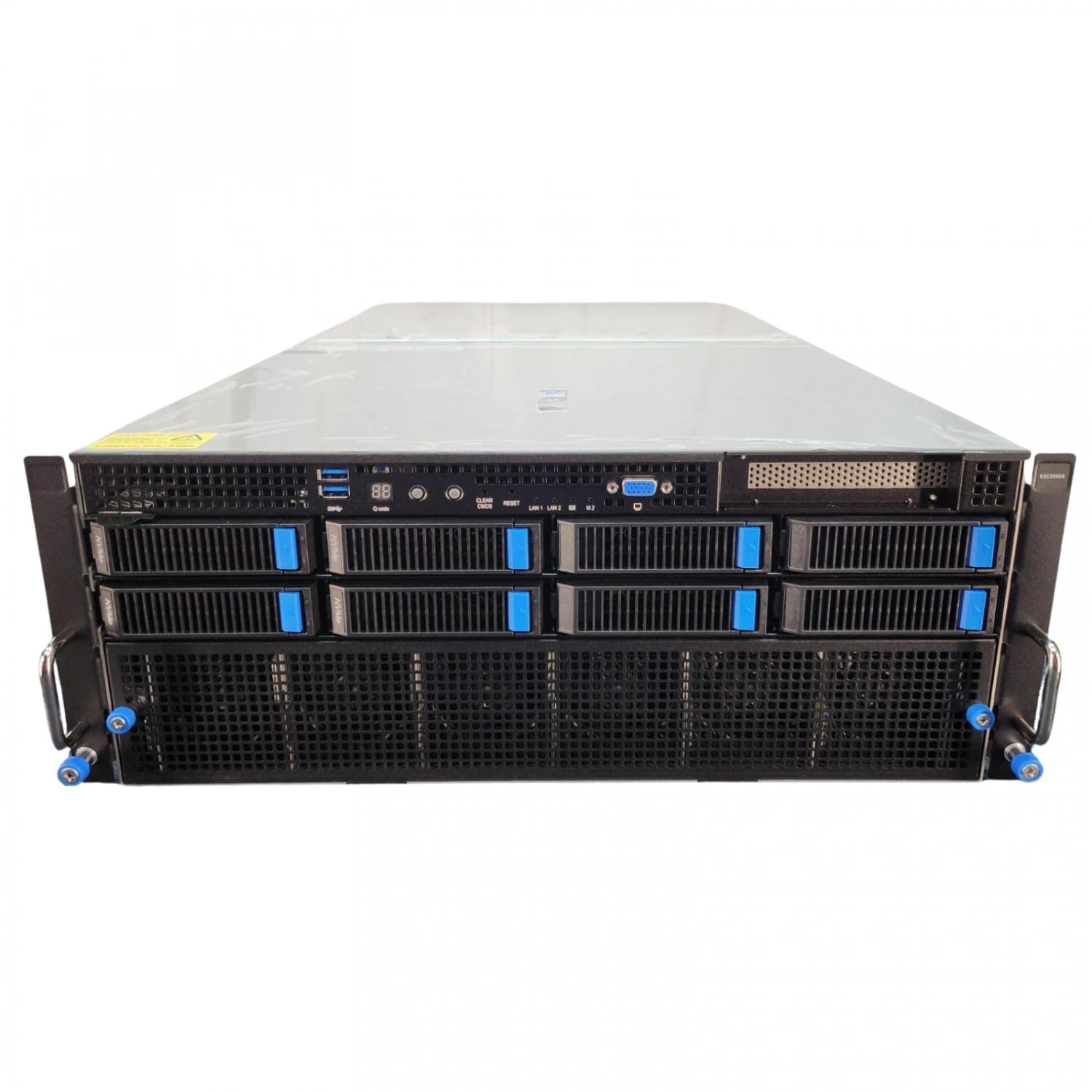
For the CTO, Total Cost of Ownership (TCO) isn't just the sticker price of an ASUS Dual AMD EPYC 9004 Series 4U GPU Server. It’s the Power Usage Effectiveness (PUE) over three years. Traditional air cooling for high-density NVMe storage is loud, inefficient, and requires massive fan power—which itself generates heat.
Transitioning to a holistic DTC liquid cooling strategy—where the coolant loop touches the GPU, the CPU, the NVMe controllers, and the networking ASICs—can reduce total rack power consumption by 15% or more. This isn't theoretical; it's a requirement for the megawatt-scale deployments of 2026.
The hidden heat generators in your rack:
- NVMe Gen5/Gen6 Controllers: These can reach 100°C under heavy LLM training loads, leading to drive failure or data corruption.
- ConnectX-7 / BlueField-3 NICs: High-speed networking is no longer a "cool" component; it requires dedicated heat sinks and high airflow.
- Power Distribution Units (PDUs): As rack density hits 100kW+, even the copper in your power cables generates significant resistive heat.
§Financial comparison: Air vs. Holistic Liquid Cooling
The following table illustrates the projected 3-year TCO for a 10-rack Blackwell cluster.
| Factor | Standard Air-Cooled Rack | Holistic Liquid-Cooled Rack |
|---|---|---|
| Cooling Energy Overhead | 35% | 8% |
| GPU Throttling Margin | 5-12% (at peak load) | < 1% |
| Maintenance Interval | Frequent (Dust/Fan failure) | Rare (Closed-loop) |
| Component Lifespan | ~3 Years (Thermal cycling) | ~5 Years (Stable temps) |
| PUE Rating | 1.45 - 1.6 | 1.05 - 1.15 |
§Bridging the gap from server to workstation
You don't need a massive data center to see the benefits of advanced cooling. Many enterprises are deploying "edge" development nodes like the BoxGPT AI Workstation, RTX PRO 6000 Blackwell, 96GB VRAM. These systems use similar principles to keep the massive 96GB of VRAM and the Ryzen processors within tight thermal envelopes.
For creative pros, the Adamant Custom 12-Core Liquid Cooled Workstation showcases how liquid cooling has moved into the mainstream for local AI training. By stabilizing the temperatures of both the CPU and the RTX 5090, these workstations ensure that your local dev work doesn't stutter when the room gets warm.

§Strategies for enterprise liquid cooling adoption
If you're overseeing a fleet of [[/categories/ai-workstations/|AI workstations]] or [[/categories/ai-gpus/|AI GPUs]], the transition to holistic cooling should follow three steps:
- Uniformity in the Loop: Ensure your CDU (Cooling Distribution Unit) has the headroom to support the entire server chassis, not just the GPU accelerators.
- Storage Immersion or DTC: For massive data lakes, consider direct-to-chip cold plates for NVMe drives. This prevents the "I/O bottleneck" where your GPU is waiting on a drive that has slowed down due to heat.
- Optical Networking Shifts: 2026 is the year of CPO (Co-Packaged Optics). By liquid-cooling the networking switches alongside the compute nodes, you reduce the fan noise and energy waste of the entire cluster.
§The Bottom Line
In 2026, efficiency is the only way to scale. Buying the fastest hardware, like the PNY Technology VCNRTXPRO6000BQ-PB NVIDIA RTX PRO 6000 Blackwell Max-Q, is only half the battle. The other half is ensuring that the I/O and storage don't become thermal anchors that drag down your ROI. Holistic liquid cooling is no longer a luxury for overclockers; it is a financial necessity for the modern enterprise.
Heads up: AI Hardware Hub may earn a commission when you buy through links on this page. We only recommend gear we'd run ourselves.
FAQ
Why is 200GbE networking a heat concern in 2026?
As networking speeds increase, the power consumption of transceivers and network ASICs has risen sharply. In a dense Blackwell rack, the combined heat of the networking fabric can exceed 3kW, which, if air-cooled, requires massive fans that consume further power and create "hot spots" within the rack.
Can I liquid-cool standard NVMe drives?
While standard consumer drives aren't built for liquid cooling, enterprise-grade high-density NVMe storage now comes with specialized cold plates or "carrier" designs that allow them to be integrated into a direct-to-chip liquid loop. This prevents thermal throttling during long data-ingestion phases of AI training.
Does liquid cooling actually lower TCO despite the high upfront cost?
Yes. Although the initial CAPEX for liquid cooling is approximately 15-20% higher than air cooling, the OPEX savings from lower electricity bills (lower PUE) and the performance gains (zero thermal throttling) typically lead to a break-even point within 14 to 18 months of 24/7 operation.