If you're building a Blackwell-based cluster in 2026, focusing only on GPU thermals is a recipe for expensive thermal throttling and wasted CapEx. Maximizing your Blackwell Rack TCO Efficiency requires a radical shift toward system-wide liquid cooling that includes the 200GbE NICs and Gen5 NVMe drives that feed these beasts. Without addressing the heat generated by the "supporting cast," your high-density interconnects will fail to maintain the line-rate speeds necessary to keep GPUs like the PNY Technology VCNRTXPRO6000BQ-PB NVIDIA RTX PRO 6000 Blackwell Max-Q saturated.
Heads up: AI Hardware Hub may earn a commission when you buy through links on this page. We only recommend gear we'd run ourselves.
§The unseen bottleneck: NIC and NVMe heat
Everyone talks about the 1000W+ TDP of Blackwell-class data center silicon, but the real silent killers of ROI are the 200GbE and 400GbE network interface cards (NICs) and PCIe Gen5 storage arrays. In a dense rack, a 200GbE NIC can pull 25-30W alone. When you have eight of these in a chassis to support GPUDirect RDMA, that’s 240W of concentrated heat just for networking.
If your NICs overheat, they drop packets. In a distributed training job, a single dropped packet creates a "bubble" in the pipeline, forcing your ASUS ESC8000A-E12P 4U GPU Server to wait. That wait time isn't just a nuisance; it's thousands of dollars of idle compute time per hour.
§Why air cooling fails Blackwell clusters
Traditional air cooling requires massive "keep-out" zones and high-velocity fans that consume up to 15% of a rack’s total power. By switching to liquid-to-chip cooling for the entire data path, you can:
- Increase Rack Density: Move from 40kW to 100kW+ per rack without localized hot spots.
- Stabilize Latency: Liquid cooling eliminates the "sawtooth" performance profile caused by air-cooled components fluctuating between clock speeds.
- Extend Hardware Lifespan: Gen5 NVMe controllers are notorious for thermal degradation; keeping them under 50°C via cold plates ensures consistent IOPS for local checkpointing.
§From workstations to the data center
The need for advanced cooling isn't limited to massive clusters. Even high-end local dev boxes like the BoxGPT AI Workstation utilize dual Blackwell GPUs that push the limits of traditional mid-tower airflow. While those systems are optimized for office noise levels, the data center requires a more aggressive approach.
When scaling up to an ASUS ESC8000A-E12P, the sheer volume of Gen5 NVMe lanes creates a "heat wall" at the front of the chassis. Liquid cooling the storage backplane allows for a more compact AI workstation or server design, reducing the physical footprint of your compute cluster.
§Component Thermal Impact on Cluster TCO
| Component | Typical TDP (2026) | Cooling Strategy | Impact on TCO |
|---|---|---|---|
| Blackwell GPU | 700W - 1200W | Direct-to-Chip (Liquid) | Primary compute driver; prevents throttling. |
| 200GbE/400GbE NIC | 25W - 40W | Cold Plate / Immersion | Critical for low-latency RDMA; prevents packet loss. |
| Gen5 NVMe SSD | 14W - 22W | Heatsink + Forced Air or Liquid | Essential for fast model checkpointing and loading. |
| Epyc/Xeon Host CPU | 350W - 500W | Liquid | Orchestrates data flow; high importance for benchmarks. |
§Bridging the gap: Liquid-cooled workstations
For teams not yet ready for a full rack-scale immersion, liquid-cooled high-end workstations serve as the perfect R&D bridge. The Adamant Custom 12-Core Liquid Cooled Workstation shows how liquid cooling can be used to maintain the performance of the latest AI GPUs. By stabilizing the thermals of the GPU and the NVMe storage simultaneously, these systems allow ML engineers to profile their code on hardware that behaves exactly like the liquid-cooled production clusters they’ll eventually deploy to.
Conversely, units like the Cloud Ninjas Iron Bull AI Workstation use high-volume airflow. These are excellent for post-production and single-node training where the duty cycle isn't 100% at all times. But for sustained Blackwell workloads, the move to liquid is no longer optional—it's an economic imperative.
§ROI metrics: Wattage, Water, and Wealth
The "Value" in any AI infrastructure purchase isn't the sticker price; it's the cost per trained token. When you factor in that liquid cooling can reduce total facility energy consumption by 20-30% compared to traditional CRAC-based cooling, the payback period for the plumbing infrastructure is often less than 18 months.
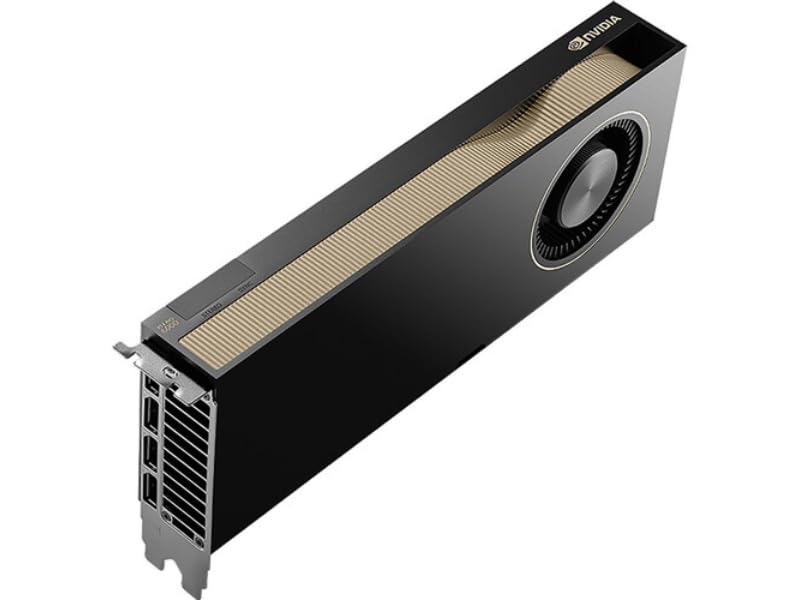
For the PNY NVIDIA RTX 6000 ADA users moving into the Blackwell era, the leap in power density is the biggest hurdle. Transitioning to something like the PNY Technology VCNRTXPRO6000BQ-PB doubles your VRAM to 96GB, but that memory generates significant heat. If your networking and storage aren't kept cool and efficient, that extra VRAM will sit idle while the system waits for the NIC to recover from a thermal spike.
Heads up: AI Hardware Hub may earn a commission when you buy through links on this page. We only recommend gear we'd run ourselves.
§FAQ
Does liquid cooling actually lower TCO for small clusters?
Yes. While the initial CapEx is higher, the reduction in power usage (PUE) and the ability to fit more compute into the same square footage generally leads to a lower TCO over a 3-year refresh cycle.
Can I air-cool Blackwell GPUs in a standard server?
While possible with specialized chassis like the ASUS ESC8000A-E12P, you will likely deal with extreme noise and the need for significant spacing between racks, which increases data center real estate costs.
How does cooling impact 200GbE NIC performance?
High-speed NICs use sophisticated DSPs that are sensitive to heat. When they reach thermal limits, they may reduce throughput or increase latency, which breaks the synchronization required for Large Language Model (LLM) training.
§Bottom line
The Blackwell generation has officially ended the era of "good enough" air cooling. To maximize Blackwell Rack TCO Efficiency, CTOs must look past the GPU and invest in liquid-cooled infrastructure for the entire data path. Whether you are deploying the latest RTX PRO 6000 Blackwell in a BoxGPT AI Workstation or a full data center rack, the "supporting cast" of NICs and storage will determine your ultimate success. Stop cooling just the engine; start cooling the whole car.