The massive thermal density of NVIDIA’s Blackwell architecture has forced a radical shift in how we think about data center cooling, but the GPUs aren't the only fire starters in the rack. As we push toward 200GbE networking and Gen5 NVMe storage to feed these massive compute clusters, the "supporting cast" of I/O components is contributing up to 20% of total rack heat. For CTOs, true Blackwell rack TCO infrastructure efficiency now requires moving beyond liquid-cooled silicon and addressing the thermal overhead of the interconnects and storage fabric that keep the system alive.
Heads up: AI Hardware Hub may earn a commission when you buy through links on this page. We only recommend gear we'd run ourselves.
§The hidden heat of 200GbE networking
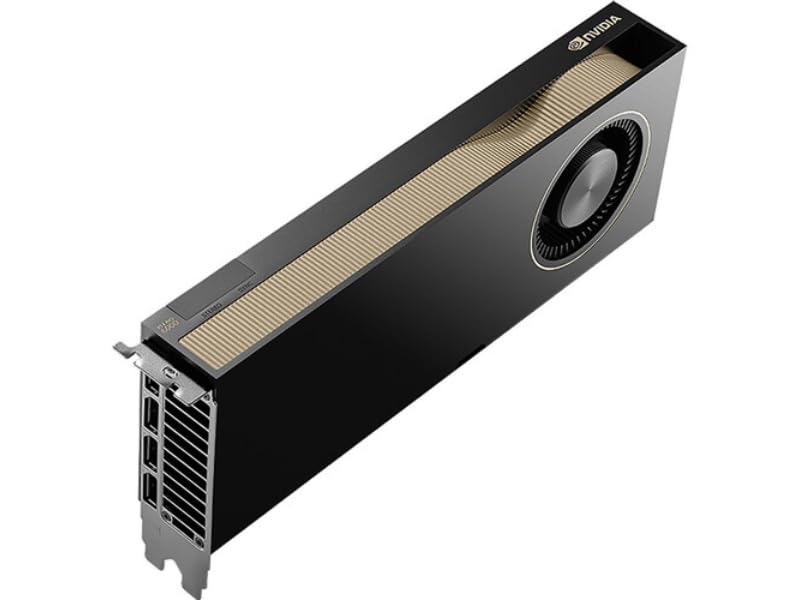
In the 2026 AI landscape, compute is rarely the bottleneck; it’s the data movement. To keep a cluster of [/categories/ai-gpus/pny-technology-vcnrtxpro6000bq-pb-nvidia-rtx-pro-6000-blackwell-max-q-workstation-graphics-card](PNY NVIDIA RTX PRO 6000 Blackwell) units or H200 accelerators saturated, networking has jumped to 200GbE and 400GbE per port.
These high-speed optics and NICs (Network Interface Cards) operate at significantly higher temperatures than their predecessors. A single 400G QSFP-DD transceiver can pull 12W to 15W. In a dense 1U chassis with 32 ports, that’s nearly 500W of heat generated just by the "plumbing." When you scale this to a full Blackwell rack, the networking layer alone creates a thermal pocket that can cause localized throttling, even if your GPUs are sitting comfortably under a cold plate.
§Gen5 NVMe: Fast, hot, and volatile
Feeding the 96GB VRAM buffers of cards like the PNY Technology VCNRTXPRO6000BQ-PB NVIDIA RTX PRO 6000 Blackwell Max-Q requires local Gen5 NVMe storage capable of 14GB/s+ sustained reads. However, Gen5 controllers are notorious for hitting thermal ceilings.
- Controller Throttling: Once an NVMe controller hits 80°C, performance drops by 50% or more to protect the NAND.
- Radiant Heat: In a server like the ASUS Dual AMD EPYC 9004 Series 4U GPU Server (ESC8000A-E12P), storage is often positioned at the front of the chassis. If these drives are running hot, they pre-heat the air before it ever reaches the GPUs or CPUs.
- Reduced MTBF: Sustained high heat in the storage backplane significantly reduces the mean time between failures for your highest-performance drives.
§Balancing the TCO: More than just power draw
When calculating Blackwell rack TCO infrastructure efficiency, infrastructure leads often focus on the $13,000+ per unit price tag of high-end GPUs or the $77,000+ cost of systems like the ASUS ESC8000A-E12P. But the real operational "tax" is the cooling energy.
If your rack uses air cooling for I/O and liquid for GPUs, you're running a hybrid environment that is often the "worst of both worlds" for PUE (Power Usage Effectiveness). Moving to a fully liquid-cooled I/O path—where cold plates cover the NICs and NVMe arrays—allows for higher inlet temperatures and lower fan speeds across the board.
| Component | Air-Cooled Overhead | Liquid-Cooled Efficiency | Impact on TCO |
|---|---|---|---|
| 200GbE NICs | High (Requires 10k+ RPM fans) | Low (Silent, stable) | Prevents packet drops |
| Gen5 NVMe | High (Frequent throttling) | Minimal (Sustained 14GB/s) | Better data pipeline |
| Blackwell GPUs | Extreme (Acoustic limits) | Optimal (Cold plate) | Maximized ROI per GPU |
| Chassis Fans | Critical (High power draw) | Optional/Low-flow | Reduced facility PUE |
§Scaling from the workstation to the rack
The transition from local development to production scale shows the stark difference in thermal management. A BoxGPT AI Workstation with RTX PRO 6000 Blackwell 96GB VRAM is an incredible tool for fine-tuning and local LLM prototyping. Because it’s a standalone unit, the 2TB NVMe and Ryzen 9900X can be managed with standard enthusiast-grade cooling.
However, once you move that same workload into a dense enterprise environment using the BoxGPT AI Workstation with 256GB RAM, the proximity of components changes the math. In a rack, heat is cumulative. Your networking hardware isn't just fighting its own heat; it's fighting the residual BTUs of twenty other servers.
§Protecting the ROI of high-end silicon
Investing in a PNY NVIDIA RTX 6000 ADA or the newer Blackwell-based PNY RTX PRO 6000 Blackwell is a five-figure commitment per slot. Allowing these cards to idle because a 200GbE switch port is overheating is an unacceptable waste of capital.
Infrastructure leads are now looking at "Total Rack Cooling" (TRC) rather than just GPU cooling. This includes:
- Direct-to-Chip (D2C) cooling for the GPUs and CPUs.
- Manifold-integrated cooling for high-density NVMe drive bays.
- Active Rear Door Heat Exchangers (RDHx) to capture any stray heat from secondary components that haven't been moved to liquid.
§The Bottom line
As we move deeper into 2026, the success of an AI deployment is measured by its uptime and its PUE. While the GPUs get the headlines, the 200GbE switches and Gen5 storage arrays are the components that will determine if your Blackwell rack runs at peak efficiency or spends its life in a thermal throttle. If you're building out infrastructure today, don't just solve for the silicon—solve for the whole data path.
For more on hardware optimization, check out our [/categories/ai-gpus](GPU buyers guide) or dive into the latest high-performance benchmarks.
Heads up: AI Hardware Hub may earn a commission when you buy through links on this page. We only recommend gear we'd run ourselves.
FAQ
Why is 200GbE networking so much hotter than 100GbE?
The increase in heat is primarily due to the higher switching capacity and the power required for high-frequency signal integrity. Components like the PNY Technology VCNRTXPRO6000BQ-PB NVIDIA RTX PRO 6000 Blackwell Max-Q enable massive throughput, but the transceivers and DSPs (Digital Signal Processors) in the networking hardware must work harder to maintain error-free data transmission at those speeds, leading to higher TCR (Total Chip Resistance) heat.
Can I run Blackwell GPUs in an air-cooled server?
It is possible, as seen in the ASUS ESC8000A-E12P 4U server, but it requires massive airflow. This often leads to "acoustic pollution" and high energy costs for the fans themselves. For large-scale Blackwell rack TCO infrastructure efficiency, liquid cooling is generally the more cost-effective long-term solution.
How does Gen5 NVMe heat affect AI training?
AI training involves constant "shuffling" of data from storage to VRAM. If your NVMe drives heat up and throttle, the GPUs—such as the PNY NVIDIA RTX 6000 ADA—will sit idle waiting for data packets. This creates a "starvation" effect that can extend training times by 15-30%, directly impacting the ROI of your hardware investment.