In 2026, the success of an AI data center isn't measured just by PFLOPS, but by how effectively you can evacuate heat from the rack without throttling your data fabric. As Blackwell-class compute pushes rack densities toward 120kW and beyond, the physical interplay between high-density NVMe storage, 200GbE (and increasingly 400GbE) networking, and direct-to-chip liquid cooling has become the primary lever for minimizing Total Cost of Ownership (TCO). Failing to synchronize these three elements results in "thermal debt"—where networking overhead and storage latencies eat the performance gains of your $13,000 GPUs.
Heads up: AI Hardware Hub may earn a commission when you buy through links on this page. We only recommend gear we'd run ourselves.
§The thermal bottleneck of 200GbE fabrics
We often focus on the power consumption of the GPU, but the networking fabric required to feed a Blackwell cluster is a silent radiator. In a high-density deployment, 200GbE and 400GbE transceivers generate significant heat localized at the I/O panel. When these switches are sandwiched between dense compute nodes, the ambient "pre-heat" can cause optical transceivers to throttle, leading to packet loss and increased tail latency in training checkpoints.
By integrating liquid cooling loops that extend past the GPUs to the networking ASICs and high-speed NICs, operators can maintain line-rate speeds without the aggressive (and power-hungry) fan curves typically required. This is especially critical when running distributed training benchmarks where a 5% drop in networking throughput can lead to a 20% increase in total training time due to synchronization delays.
§NVMe endurance in high-heat environments
Storage is the often-ignored third pillar of the triad. High-density NVMe drives used for scratch space and data ingestion are sensitive to the "thermal soak" of a Blackwell rack. As temperatures rise, NVMe controllers engage in thermal throttling to protect the NAND flash, which spikes the latency of data loads into VRAM.
In the enterprise space, we’re seeing a shift toward liquid-cooled cold plates for NVMe arrays. This isn't just about performance; it’s about endurance. High heat accelerates the wear-out of NAND cells. Lowering the mean operating temperature of your storage tier by 15°C can significantly extend the lifespan of the drives, directly lowering the "replacement" component of your TCO.
§The Blackwell Rack: A balancing act
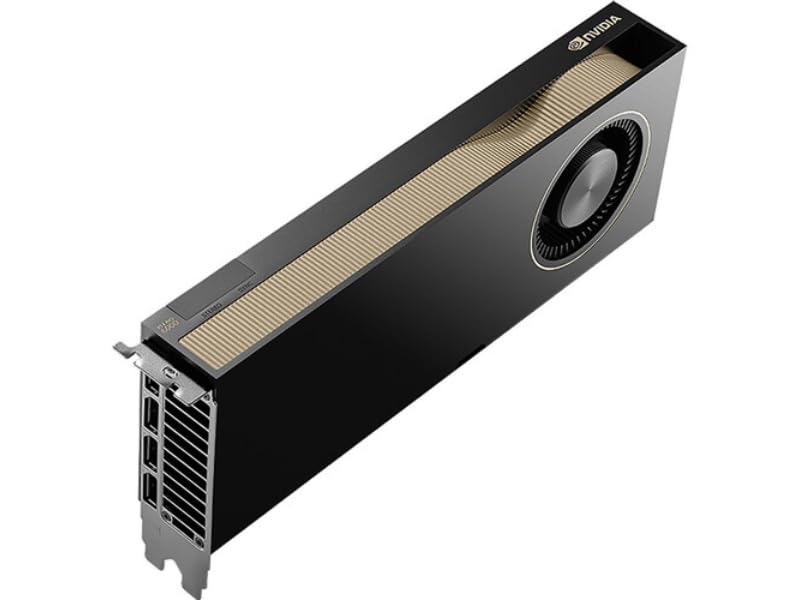
Deploying a card like the PNY Technology VCNRTXPRO6000BQ-PB NVIDIA RTX PRO 6000 Blackwell Max-Q Workstation Graphics Card in a single workstation is straightforward. However, when you stack these in an enterprise rack, the density creates unique challenges.
- Cooling Synergy: Liquid cooling allows for tighter component spacing, reducing the physical distance (and thus the latency) between the storage head-node and the compute nodes.
- Power Distribution: High-density racks require 415V or 480V 3-phase power to minimize conversion losses.
- VRAM Utilization: Systems like the BoxGPT AI Workstation, RTX PRO 6000 Blackwell, 96GB VRAM, Ryzen 9900X, 256GB DDR5, 2TB NVMe demonstrate the need for massive local memory to prevent constant networking round-trips to the storage lake.
§TCO Comparison: Air vs. Liquid-Cooled Blackwell Racks
| Feature | Traditonal Air-Cooled (50kW/Rack) | Advanced Liquid-Cooled (120kW/Rack) |
|---|---|---|
| Compute Density | ~8-10 ASUS ESC8000A-E12P units | ~24+ Blackwell Compute Nodes |
| Networking Stability | Throttling above 35°C ambient | Stable at high-density line rates |
| Storage MTBF | Standard | 1.8x longer due to lower temps |
| Power Usage Effectiveness (PUE) | 1.4 - 1.6 | 1.05 - 1.15 |
| Infrastructure Capex | High (Real Estate/Fans) | High (Chillers/CDUs) |
§Scaling from workstation to rack
For Many ML engineers, the journey starts with an enterprise-grade workstation. Units like the BoxGPT AI Workstation, RTX PRO 6000 Blackwell, 96GB VRAM, Ryzen 9900X, 64GB DDR5, 2TB NVMe serve as the development sandbox. These workstations are designed with high-quality airflow, but they mirror the same storage-to-GPU patterns used in the larger AI Workstations.
When these localized models move to production, they are often deployed on larger AI GPUs nodes. The PNY Blackwell Max-Q architecture is specifically designed to maximize efficiency in these scenarios, trading a small percentage of peak clock speed for a massive gain in thermal stability and power-per-watt metrics.
§Why 200GbE dictates your storage strategy
If your networking can't sustain the burst speeds required to fill 96GB of VRAM on a PNY Technology VCNRTXPRO6000BQ-PB NVIDIA RTX PRO 6000 Blackwell, your GPUs will sit idle. This is known as "starvation." To prevent this, modern Blackwell racks utilize GPUDirect Storage (GDS), which allows the A100 80GB Graphics Card or newer Blackwell chips to pull data directly from the NVMe fabric without involving the CPU. This bypass reduces latency and, crucially, reduces the thermal load on the CPU and its memory controllers.
Critical Infrastructure Components for 2026:
- CDUs (Coolant Distribution Units): Essential for managing the high-flow requirements of Blackwell racks.
- Low-Loss Transceivers: Optics that can withstand higher case temperatures.
- Wear-Leveling Aware Controllers: Storage firmware optimized for the constant high-transactional writes of AI checkpointing.
§Bottom line
Minimizing Blackwell Rack TCO networking storage cooling isn't just about buying the most expensive hardware; it's about physical integration. If you’re building out a cluster, don't skimp on the cooling for your 200GbE switches or your NVMe tiers. Heat is the enemy of uptime and the primary driver of hidden costs in the modern AI era. For those still in the prototyping phase, investing in a high-end AI Workstation is the best way to understand these data-flow bottlenecks before scaling to full-rack production.
Heads up: AI Hardware Hub may earn a commission when you buy through links on this page. We only recommend gear we'd run ourselves.
FAQ
How does liquid cooling affect the lifespan of NVMe drives?
Liquid cooling keeps NVMe controllers at a consistent temperature, preventing the extreme heat cycles that lead to component fatigue and NAND degradation. By maintaining a lower steady-state temperature, enterprise-grade storage can see significantly improved reliability over several years of 24/7 AI workloads.
Is 200GbE enough for a Blackwell-based cluster?
While 400GbE is becoming the standard for massive clusters, 200GbE remains the "sweet spot" for many mid-sized Blackwell deployments. However, even at 200GbE, thermal management of the transceivers is vital to avoid packet drops during heavy training runs.
Can I run Blackwell GPUs in an air-cooled server?
Yes, servers like the ASUS ESC8000A-E12P provide excellent airflow for enterprise GPUs. However, as you move to the highest density Blackwell configurations, the fan power required to cool them often makes liquid cooling more cost-effective from a total power (TCO) perspective.