In the high-stakes race to deploy Blackwell-class infrastructure, the industry has become dangerously myopic about GPU cooling. While liquid-cooled racks solve the primary heat load of the H100 or Blackwell dies, the secondary heat from 200GbE networking and dense NVMe storage tiers is creating a silent "performance tax" that erodes ROI. Successful Blackwell Rack TCO calculation requires shifting focus from peak FLOPS to the thermal headroom of the entire I/O subsystem.
Heads up: AI Hardware Hub may earn a commission when you buy through links on this page. We only recommend gear we'd run ourselves.
§The silent I/O bottleneck in Blackwell clusters
As we move into 2026, the bottleneck for LLM training and RAG (Retrieval-Augmented Generation) has shifted. We aren't just waiting on the GPU; we’re waiting on the data to reach it. To feed a Blackwell-based system, 200GbE (and increasingly 400GbE) networking is mandatory. However, these networking transceivers and high-density NVMe drives generate concentrated heat in the "cool" side of the rack.
When your NVMe storage throttles due to heat, your $40,000 GPUs sit idle, waiting for I/O. This underutilization is the fastest way to blow out your TCO. If you're building a local development environment, systems like the BoxGPT AI Workstation, RTX PRO 6000 Blackwell, 96GB VRAM, Ryzen 9900X, 256GB DDR5, 2TB NVMe integrate the storage and GPU thermal profiles far better than a mismatched DIY rack.
§Why 200GbE networking is a thermal wildcard
At 200GbE speeds, the power consumption of optical transceivers becomes a localized thermal event. In a fully populated 1U switch, these modules can reach temperatures that trigger safety protocols, reducing signal integrity and forcing packet retransmissions.
For many infrastructure leads, the TCO calculation often misses the "coolant for the switches." If you're running enterprise-grade ASUS Dual AMD EPYC 9004 Series 4U GPU Server (ESC8000A-E12P) with 2x NVIDIA H200 NVL 141GB GPUs, you have massive CFM (cubic feet per minute) of air moving through the chassis, but that air is often pre-heated by the time it reaches the networking fabric.
§NVMe density and the "Hot Spot" effect
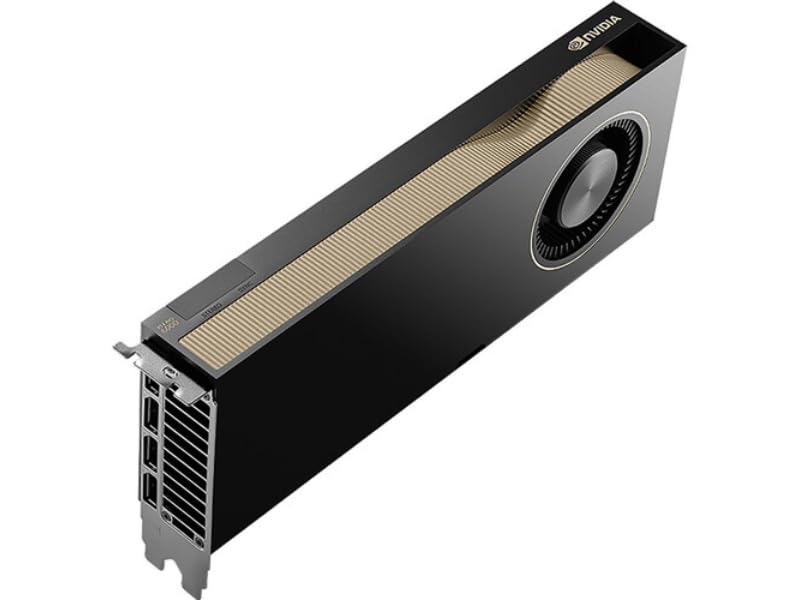
Storing petabytes of training data locally requires Gen5 or Gen6 NVMe drives. These drives are efficient per-terabyte but brutal per-square-inch. In a Blackwell architecture, where low-latency access is king, storage is often packed directly alongside the PNY Technology VCNRTXPRO6000BQ-PB NVIDIA RTX PRO 6000 Blackwell Max-Q Workstation Graphics Card.
- Proximity kills: Placing NVMe arrays adjacent to GPUs without dedicated ducting leads to drive controller throttling.
- Sequential vs. Random: Under heavy AI workloads (check our benchmarks), sustained sequential reads push NVMe temps to 80°C+ within minutes.
- The TCO impact: A drive that throttles to 50% speed effectively doubles the time your GPUs spend in an "I/O Wait" state.
§Comparing Blackwell infrastructure tiers
The transition from the previous generation to Blackwell isn't just about VRAM—it's about how the system handles the total energy envelope.
| Feature | PNY NVIDIA RTX 6000 ADA | Blackwell RTX 6000 Max-Q | ASUS ESC8000A-E12P (H200) |
|---|---|---|---|
| Primary Use | Pro Vis / Early AI | High-Density Compute | Enterprise Data Center |
| VRAM | 48GB GDDR6 | 96GB GDDR7 | 141GB HBM3e |
| Thermal Challenge | Air-cooled airflow | TDP Density | High Rack CFM |
| Networking Req. | 10/100GbE | 200GbE+ | 400GbE / InfiniBand |
| Architecture | Ada Lovelace | Blackwell | Hopper (Optimized) |
§Refining your Blackwell Rack TCO calculation
To get a real-world TCO for a Blackwell deployment, you must look beyond the purchase price of the PNY Technology VCNRTXPRO6000BQ-PB NVIDIA RTX PRO 6000 Blackwell Max-Q Workstation Graphics Card.
- Direct Energy Cost: The GPU power draw.
- Indirect Energy Cost: The fans and pumps required to keep the I/O (networking/storage) from throttling.
- Opportunity Cost of Throttling: Every hour of training lost to I/O wait is money thrown away.
- Hardware Longevity: Heat is the primary killer of high-density NVMe.
For teams that don't want to manage rack-level liquid cooling, looking at pre-integrated solutions like the Sentinel Non-RGB RTX PRO 6000, 16-Core AMD Ryzen 9 9950X, 128GB DDR5 RAM, 8TB NVMe allows you to offload the thermal engineering to the OEM. These workstations are designed to handle the 96GB Blackwell thermal profile in a form factor that doesn't require a dedicated data center HVAC upgrade.
§The move to liquid-to-chip
By late 2026, we expect "air-cooled" to refer only to the edge. For the core Blackwell clusters, liquid-to-chip cooling for the GPUs—coupled with directed airflow for the 200GbE NICs—is the only way to maintain a reasonable TCO. If you are comparing the older PNY NVIDIA RTX 6000 ADA to the new Blackwell series, remember that while Blackwell is more efficient per-FLOP, the rack density usually increases, which compounds the heat challenge.
Check out our full guides on /categories/ai-gpus and /categories/ai-workstations to see which form factor fits your power and cooling budget.
FAQ
How does 200GbE networking affect my AI training speed?
Faster networking reduces the time spent on "All-Reduce" operations during distributed training. However, if the NICs overheat, they drop to lower power states, causing latency spikes that can significantly stall a Blackwell cluster.
Is the 96GB VRAM on the Blackwell RTX 6000 worth the price over the Ada generation?
Yes, specifically for LLM fine-tuning. The jump from 48GB on the PNY NVIDIA RTX 6000 ADA to 96GB on the PNY Technology VCNRTXPRO6000BQ-PB NVIDIA RTX PRO 6000 Blackwell Max-Q Workstation Graphics Card allows for significantly larger context windows and model sizes without resorting to slower multi-GPU offloading.
What is the biggest hidden cost in a Blackwell Rack TCO calculation?
Thermal-induced performance degradation. Most TCO models assume 100% uptime at 100% clock speed. In reality, poorly cooled networking and storage often cause 5-15% performance loss, which increases the "cost per trained model" significantly.
§The Bottom Line
Blackwell represents a massive leap in AI compute, but it’s a demanding neighbor. If you're building out a rack, don't spend your entire budget on the silicon and skimp on the thermal management of your I/O. Whether you're opting for an ASUS Dual AMD EPYC 9004 Series 4U GPU Server (ESC8000A-E12P) with 2x NVIDIA H200 NVL 141GB GPUs or a high-end BoxGPT AI Workstation, RTX PRO 6000 Blackwell, 96GB VRAM, Ryzen 9900X, 256GB DDR5, 2TB NVMe, ensure your networking and storage have the thermal headroom to keep pace with the GPUs.
Heads up: AI Hardware Hub may earn a commission when you buy through links on this page. We only recommend gear we'd run ourselves.