Modern AI infrastructure has shifted from a race for VRAM to a battle against thermal throttling and data starvation. As we move into 2026, the arrival of Blackwell-based systems has redefined the silicon floor, but the real gains are found in the plumbing—the critical interplay between high-density NVMe storage, 200GbE fabric, and liquid cooling. Success in this era requires a Blackwell Rack TCO optimization strategy that prioritizes operational uptime and cooling efficiency over simple component-level benchmarks.
Heads up: AI Hardware Hub may earn a commission when you buy through links on this page. We only recommend gear we'd run ourselves.
§The Blackwell thermal wall: Why air isn't enough
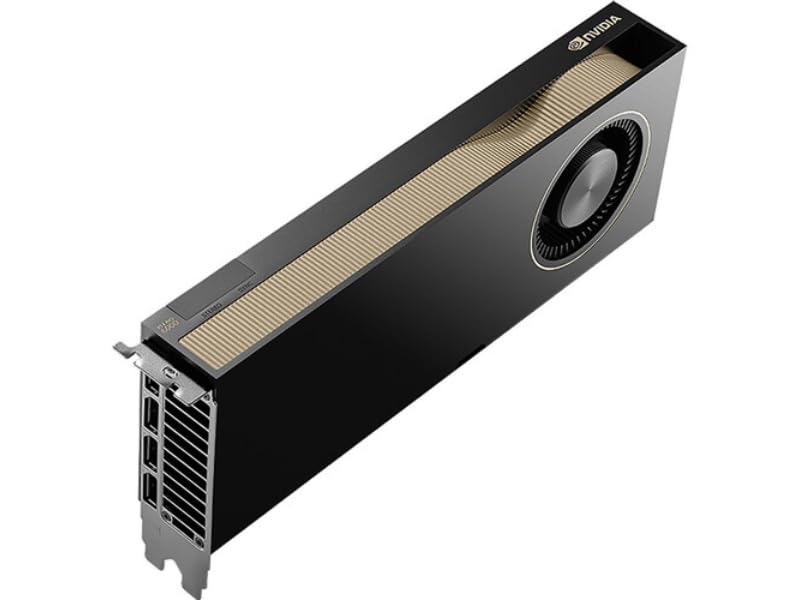
The raw power of the Blackwell architecture brings an unprecedented jump in compute density, but it also pushes traditional air-cooling to its breaking point. When you are deploying chips like the PNY Technology VCNRTXPRO6000BQ-PB NVIDIA RTX PRO 6000 Blackwell Max-Q Workstation Graphics Card, the "Max-Q" designation is more than a branding exercise—it’s a necessity for thermal management in dense workstation environments.
In a rack-scale environment, the challenge isn't just one hot card; it’s the cumulative heat of 32 or 64 GPUs in a single cabinet. Traditional 4U chassis designs, while excellent for previous generations, now face turbulence and "dead zones" that lead to clock throttling. Liquid cooling has transitioned from a high-end luxury to a baseline requirement for maintaining the performance of systems like the Adamant Custom 12-Core Liquid Cooled Editing Modelling AI Learning Workstation. By moving heat more efficiently through cold plates and coolant loops, infrastructure leads can drive higher clock speeds across the board, radically improving the TCO by reducing the number of units required to hit a specific FLOP target.
§Feeding the beast: 200GbE and NVMe synchronization
Compute is only as fast as its slowest feeder. With Blackwell systems, the bottleneck has moved to the storage fabric. If your NVMe drives can’t saturate the 200GbE pipe, your expensive GPUs spend idle cycles waiting for training data. This is where high-density NVMe configurations, like the 3x4TB setup found in the Sentinel Non-RGB RTX PRO 6000, become critical.
For enterprise-scale training, the transition to 200GbE (and increasingly 400GbE) networking ensures that the massive datasets required for LLM fine-tuning are delivered with minimal latency. When you look at the architecture of the ASUS Dual AMD EPYC 9004 Series 4U GPU Server, notice how the I/O balance is designed to support high-throughput networking alongside dual H200 accelerators. Without this balance, the TCO of your Blackwell rack skyrockets because your expensive silicon is perpetually underutilized.
§Quantifying the Blackwell Rack TCO advantage
When evaluating a transition to Blackwell, don't just look at the sticker price of the card or the workstation. You need to calculate the Operational TCO, which includes:
- Power Utilization Effectiveness (PUE): How much of your energy is going to compute versus fans?
- MTBF (Mean Time Between Failure): Liquid-cooled systems often see fewer failures due to more consistent thermal profiles.
- Density Metrics: How many BF16 TFLOPS can you fit per square foot of data center space?
| Feature | Legacy Air-Cooled (e.g., RTX 6000 Ada) | Blackwell Liquid-Cooled (e.g., RTX 6000 BQ) | TCO Impact |
|---|---|---|---|
| Cooling Method | High-RPM Fans | Liquid Cold Plates / Manifolds | Lower noise, higher reliability |
| VRAM Capacity | 48GB | 96GB | 2x scaling for larger models |
| Storage Fabric | 100GbE | 200GbE+ | Reduced data-starvation idle time |
| Typical System | PNY NVIDIA RTX 6000 ADA | BoxGPT AI Workstation | Faster ROI on large-scale projects |
§Operationalizing Blackwell in the workstation
Not every Blackwell deployment happens in a 42U rack. The "professional desktop" is undergoing its own infrastructure revolution. For local LLM development and inference, the BoxGPT AI Workstation provides a blueprint for what a 2026 developer rig should look like. It pairs 96GB of VRAM with a Ryzen 9900X, ensuring that the local storage and CPU don't bottleneck the GPU during heavy RAG (Retrieval-Augmented Generation) workloads.
Key infrastructure checklist for Blackwell deployments:
- Acoustic Management: If deploying near engineers, liquid cooling is mandatory to prevent hearing fatigue.
- Circuit Load: Ensure you have 20A or 30A circuits dedicated; Blackwell's power spikes can trip standard office breakers during peak training.
- NVMe Gen5 Support: While 2TB is a start, for production training, look at systems that support mass storage arrays to keep the GPU pipeline full.
- Network Latency: At benchmarks levels, the difference between 10G and 200G fabric can cut training time by weeks on multi-node clusters.
§The data center gap: Bridging compute and cold air
Enterprise leads are finding that 10-15kW per rack is no longer enough. Blackwell clusters are pushing towards 30-50kW. This isn't just an electrical challenge; it’s a physical one. Moving this much air requires massive fans that consume a significant percentage of total system power.
By switching to liquid-to-liquid heat exchangers (CDUs), as utilized by high-end systems in our /categories/ai-workstations and /categories/ai-gpus sections, the energy diverted to cooling drops significantly. This directly improves your TCO by lowering your monthly power bill while extending the life of the GPUs. A Sentinel Non-RGB RTX PRO 6000 might seem like a workstation, but its thermal design principles represent the same shift happening at the rack scale: efficient heat extraction enables sustained high performance.
§Final Verdict: Optimize the rack, not the chip
If you are planning a Blackwell deployment in 2026, stop looking at VRAM in a vacuum. A 96GB card is useless if it’s thermal throttling at 70% of its rated speed or waiting for an outdated SATA-based storage array to deliver data.
The smart money is moving toward integrated infrastructure. Systems like the BoxGPT AI Workstation and the ASUS ESC8000A-E12P represent the two ends of this spectrum: localized compute and massive enterprise scale. Both succeed because they respect the triad of Blackwell infrastructure: dense NVMe, fast fabric, and aggressive cooling. Optimize for these three, and the TCO will take care of itself.
FAQ
Why is 200GbE necessary for Blackwell systems?
Blackwell GPUs are capable of processing data so quickly that standard 10GbE or even 25GbE networks become a bottleneck. To keep the GPUs at 100% utilization during distributed training, 200GbE (or higher) is required to minimize the time spent syncing weights across the cluster.
Can I run a Blackwell RTX Pro 6000 on air cooling?
While possible, cards like the PNY RTX PRO 6000 Blackwell Max-Q are designed with a specific power and thermal envelope in mind. In a workstation with good airflow, air cooling works, but in a dense rack, liquid cooling is necessary to prevent clock-speed degradation and high noise levels.
Does more VRAM impact the TCO of the rack?
Yes, but perhaps not how you think. While 96GB GPUs like those in the BoxGPT AI Workstation carry a higher upfront cost, they allow for fitting larger models on fewer cards. This reduces the number of chassis, motherboards, and power supplies you need, ultimately lowering the TCO per billion parameters trained.
Heads up: AI Hardware Hub may earn a commission when you buy through links on this page. We only recommend gear we'd run ourselves.