Deploying NVIDIA’s Blackwell architecture isn't just a hardware upgrade; it’s a fundamental shift in how data centers manage density, heat, and capital expenditure. To achieve true Blackwell Rack TCO optimization, enterprise CTOs must solve the "Triple Threat" of 200GbE networking congestion, PCIe Gen5 storage bottlenecks, and the inevitable migration to liquid cooling. This roadmap outlines how to balance these variables to ensure your infrastructure scales without breaking the bank.
Heads up: AI Hardware Hub may earn a commission when you buy through links on this page. We only recommend gear we'd run ourselves.
§The Blackwell shift: Why density is the new currency
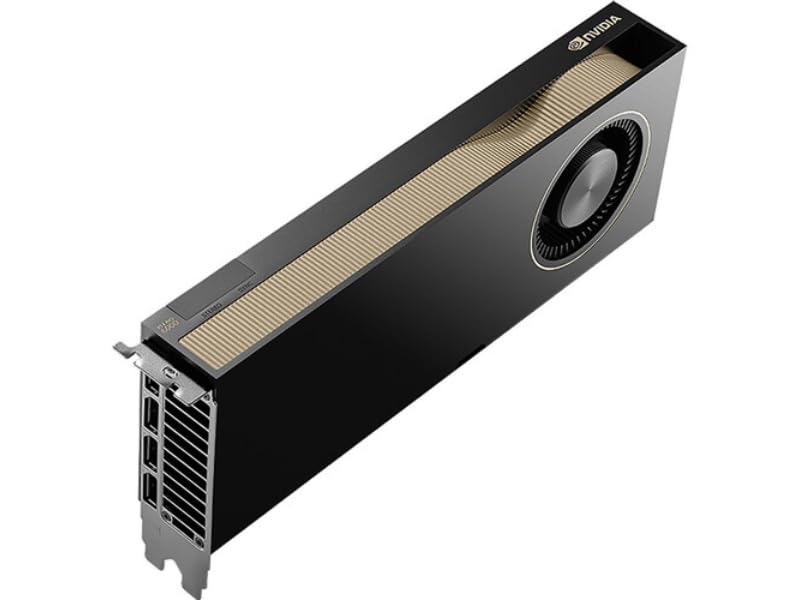
In 2026, the conversation has moved past simple TFLOPS. We are now measuring success in "tokens per watt" and "rack-unit ROI." The Blackwell architecture introduces a massive leap in memory density—exemplified by cards like the PNY Technology VCNRTXPRO6000BQ-PB NVIDIA RTX PRO 6000 Blackwell Max-Q Workstation Graphics Card, which packs 96GB of VRAM into a single slot.
When you scale this to a full-rack deployment, the traditional air-cooled data center hits a wall. TCO optimization starts by understanding that Blackwell's performance is tied directly to its thermal overhead. If you're thermal throttling, you're essentially burning money. For localized development that mirrors these enterprise clusters, systems like the BoxGPT AI Workstation, RTX PRO 6000 Blackwell, 96GB VRAM, Ryzen 9900X, 256GB DDR5, 2TB NVMe provide a sandbox for profiling workloads before they hit the production rack.
§Storage and networking: Solving the I/O starvation problem
Blackwell GPUs are so fast that they often sit idle waiting for data from the NVMe layer. To minimize TCO, you must eliminate these wait states using Gen5 storage and 200GbE (or 400GbE) InfiniBand/Ethernet backplanes.
- Gen5 Storage: Standardizing on PCIe Gen5 allows for sequential read speeds exceeding 14GB/s, crucial for loading large model weights into the 96GB buffers of the Blackwell cards.
- 200GbE Fabric: Without high-bandwidth networking, multi-node training becomes inefficient. The latency introduced by 100GbE bottlenecks the collective communication (All-Reduce) operations required for massive clusters.
- Local Caching: Use high-performance workstation nodes, such as the BoxGPT AI Workstation, RTX PRO 6000 Blackwell, 96GB VRAM, Ryzen 9900X, 64GB DDR5, 2TB NVMe, for data preprocessing to ensure that only "clean" data hits the primary enterprise AI systems.
§Comparing Blackwell to legacy architectures
To understand the TCO benefits, we have to look at the transition from Ada Lovelace—the previous gold standard—to Blackwell.
| Feature | Ada Lovelace (RTX 6000 Ada) | Blackwell (RTX 6000 Max-Q) | Impact on TCO |
|---|---|---|---|
| VRAM per Card | 48GB | 96GB | Reduces node count by 50% for large models. |
| Architecture | PNY NVIDIA RTX 6000 ADA | PNY RTX PRO 6000 Blackwell | Better energy efficiency per parameter. |
| Cooling Requirement | Primarily Air-Cooled | Hybrid/Liquid Optimized | Lower long-term cooling costs in density. |
| Interconnect | PCIe Gen4/5 | PCIe Gen5 + Link Enhancements | Faster data throughput, less idle time. |
§Thermal management: The move to liquid and Max-Q
The secret to Blackwell Rack TCO optimization is often "undervolting" at the architectural level. The "Max-Q" designation in the PNY RTX PRO 6000 Blackwell isn't just for laptops anymore; it's a philosophy for the data center. By running chips at their peak efficiency curve rather than their peak clock speed, you reduce heat output by 20-30% while only losing a fraction of performance.
For edge deployments or high-end dev work, liquid cooling is now mandatory. Evolution in this space is visible in consumer-adjacent workstations like the Adamant Custom 12-Core Liquid Cooled AI Learning Workstation, which uses closed-loop cooling to maintain stability during 24/7 training runs. In the rack, this translates to Rear Door Heat Exchangers (RDHx) or direct-to-chip liquid cooling.
§Balancing the cluster: Heterogeneous deployments
Not every task needs a Blackwell rack. A cost-optimized data center uses a mix of high-density Blackwell nodes for training and highly efficient older nodes for lighter inference. For example, legacy ASUS ESC8000A-E12P servers with NVIDIA H200 NVL still offer incredible value for traditional HPC workloads and high-precision scientific modeling. Check the latest /benchmarks to see how H200 stacks up against Blackwell in specific FP8 vs FP16 tasks.
Strategic CTOs are also looking at /categories/ai-workstations to offload the initial R&D from the expensive cloud or local AI-GPU clusters. Running a BoxGPT AI Workstation locally for fine-tuning can save thousands in egress fees and cloud compute costs.
§Total Cost of Ownership: The final calculation
Optimizing TCO isn't just about the purchase price—it's about the lifecycle of the rack.
- Reduce Footprint: High-density VRAM (96GB per GPU) means you need fewer servers to host the same model, reducing rack space rental and power whip costs.
- Energy Efficiency: Choosing Max-Q Blackwell variants reduces PUE (Power Usage Effectiveness) ratios.
- Future-Proofing: Standardizing on Gen5 through components like the Ryzen 9900X platform ensures your storage won't bottleneck future GPU refreshes.
FAQ
Does Blackwell require a full data center redesign?
For small clusters (1-4 racks), existing air cooling with improved airflow management is often sufficient if using Max-Q variants. However, for full-scale LLM training, liquid cooling is highly recommended to prevent thermal throttling and maximize TCO.
Can I mix Blackwell and Ada Lovelace GPUs in the same cluster?
While possible via PCIe, it is not recommended for synchronized training (Model Parallelism) due to the disparity in VRAM and interconnect speeds. It's better to segment these into separate pools for training and inference.
Why is 96GB of VRAM such a big deal for TCO?
It allows for larger batch sizes and the ability to fit massive models (like Llama 4 variants) on fewer GPUs. This reduces the "communication tax" between cards, leading to faster training times and lower power consumption.
§Verdict: The Blackwell roadmap
If you’re planning your 2026-2027 infrastructure, the path to Blackwell Rack TCO optimization is clear: prioritize memory density and thermal efficiency over raw clock speeds. The PNY RTX PRO 6000 Blackwell Max-Q is the cornerstone of this strategy. Pair it with Gen5 networking and a liquid-compatible chassis, and you’ll find that the higher upfront cost of Blackwell is rapidly offset by lower operational expenses and significantly higher throughput.
Heads up: AI Hardware Hub may earn a commission when you buy through links on this page. We only recommend gear we'd run ourselves.