In 2026, the conversation around AI infrastructure has shifted from simple FLOPs chasing to a more sober reality: sustainability and Total Cost of Ownership (TCO). As Blackwell-based systems dominate the market, the real challenge for CTOs isn't just procuring the silicon—it's managing the massive thermal and data throughput requirements of high-density racks. To achieve Blackwell Rack TCO optimization, organizations must look beyond the GPU and solve the three-body problem of 200GbE networking, dense NVMe storage, and liquid cooling.
Heads up: AI Hardware Hub may earn a commission when you buy through links on this page. We only recommend gear we'd run ourselves.
§The Blackwell thermal wall and the liquid cooling mandate
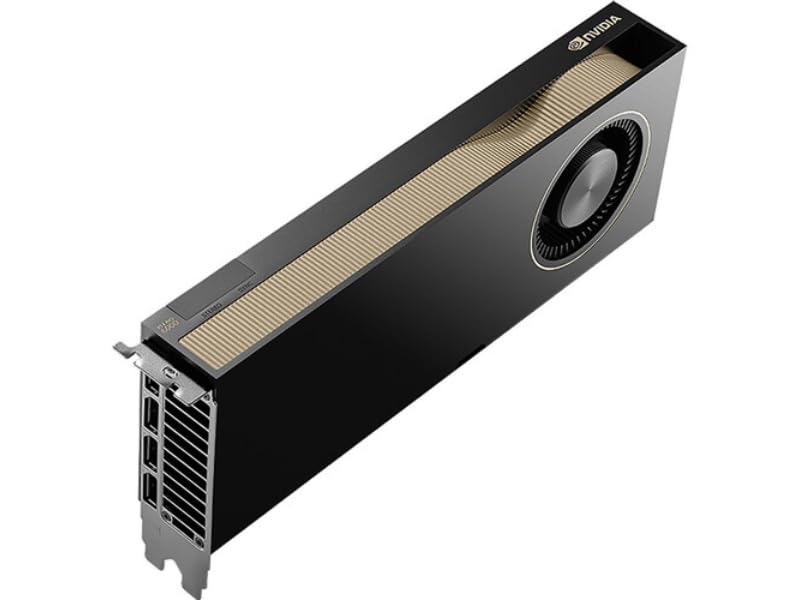
The transition to NVIDIA's Blackwell architecture has rendered traditional air-cooling nearly obsolete for high-density enterprise deployments. While the PNY Technology VCNRTXPRO6000BQ-PB NVIDIA RTX PRO 6000 Blackwell Max-Q offers a more power-efficient profile for focused professional use, the full-scale Blackwell rack systems demand specialized infrastructure.
Liquid-to-chip cooling isn't just an "enthusiast" feature anymore; it's a TCO necessity. By moving to liquid cooling, data centers can reduce Cooling Power Usage Effectiveness (PUE) from a typical 1.5 down to 1.1 or lower. This directly impacts the bottom line by allowing for higher compute density per square foot without triggering thermal throttling. Systems like the Adamant Custom 12-Core Liquid Cooled Workstation demonstrate how integrated liquid cooling stabilizes performance even under sustained AI training loads.
§Why 200GbE is the new networking floor
Raw compute is useless if the GPUs are starving for data. With Blackwell cards featuring massive memory pools—like the 96GB found on the PNY Technology VCNRTXPRO6000BQ-PB—the internal bus and external fabric must keep pace.
In a multi-node Blackwell cluster, 200GbE (Gigabit Ethernet) has become the minimum requirement for efficient scaling. Anything less creates a "tail latency" problem where your $13k GPUs sit idle waiting for weight updates or dataset shards. This is particularly critical for local LLM development where rapid iteration is key. For those building development clusters, workstations like the BoxGPT AI Workstation provide a bridge, offering high-speed I/O that matches its dual Blackwell GPU configuration.
§High-density NVMe: Feed the beast
Storage is the often-overlooked third pillar of TCO. Traditional SSDs are too slow, and mechanical HDDs are strictly for cold archiving. In the Blackwell era, high-density NVMe storage is required to feed data to the AI GPUs at a rate that justifies their power consumption.
We are seeing a shift toward PCIe Gen5 and Gen6 NVMe arrays. For instance, the Sentinel Non-RGB RTX PRO 6000 utilizes 8TB of high-speed NVMe to ensure that the 96GB GDDR7 VRAM on its Blackwell-class GPU is never data-starved. When calculating TCO, the cost of the storage must be weighed against the potential "idle time" cost of the GPU.
Comparison: Blackwell vs. Previous Gen Architectures
| Feature | Blackwell (e.g., RTX PRO 6000 Max-Q) | Ada Lovelace (e.g., RTX 6000 Ada) |
|---|---|---|
| Standard VRAM | 96GB GDDR7 | 48GB GDDR6 |
| Cooling Profile | Liquid-Optimized / Max-Q focused | Air-Cooled Standard |
| Recommended Networking | 200GbE+ | 100GbE |
| Typical MSRP | ~$13,522 | ~$7,379 |
| Primary Use Case | Large-scale LLM & Enterprise HPC | Professional Video/3D Rendering |
§Strategic TCO optimization for enterprise leads
To truly optimize a Blackwell rack, infrastructure leads need to stop looking at components in isolation. A PNY NVIDIA RTX 6000 ADA might seem like a bargain, but if the task requires the 96GB VRAM of a Blackwell chip to avoid multi-node communication overhead, the cheaper card becomes more expensive over time.
- Consolidate where possible: One Blackwell GPU with 96GB VRAM can often replace two 48GB cards, reducing the number of PCIe lanes and power supplies needed.
- Invest in the fabric: High-speed interconnects (NVLink and 200GbE) allow for "memory pooling," effectively making the entire rack behave as one giant GPU.
- Thermal Reuse: In 2026, efficient enterprises are using the heat exhaust from liquid-cooled AI workstations and servers to supplement building heating systems—a massive win for ESG goals.
For massive production scale, the ASUS Dual AMD EPYC 4U GPU Server represents the peak of this integrated philosophy, combining dual EPYC processors with high-bandwidth H200 accelerators and massive RAM support to handle the most complex benchmarks.
§The infrastructure bottleneck: A warning
Many teams rush to buy the PNY Technology VCNRTXPRO6000BQ-PB only to find their existing rack PDU (Power Distribution Unit) can't handle the localized load. Blackwell TCO optimization requires a holistic audit of your power delivery. Moving to liquid cooling often requires a "sidecar" CDU (Coolant Distribution Unit), which takes up rack units but saves on total power draw.
FAQ
Why is 200GbE preferred over 100GbE for Blackwell?
Blackwell GPUs process data significantly faster than previous generations. A 100GbE connection often becomes a bottleneck during "All-Reduce" operations in distributed training, leading to 20-30% GPU underutilization. 200GbE ensures the pipe is wide enough to keep the VRAM saturated.
Is liquid cooling mandatory for all Blackwell systems?
While not "mandatory" for single cards like the PNY Blackwell Max-Q, it is highly recommended for rack deployments. Air cooling a 40kW rack requires immense fan power and creates acoustic issues that liquid systems elegantly bypass.
How does VRAM size affect TCO?
The 96GB capacity of modern Blackwell cards allows larger models to fit on a single GPU. This reduces the need for expensive high-bandwidth cross-node communication, lowering the complexity and cost of the networking fabric required to reach a specific performance target.
§Bottom line
Effective Blackwell Rack TCO optimization isn't about finding the cheapest components; it's about balancing the "triad of throughput"—networking, storage, and cooling. By investing in liquid cooling and 200GbE today, you're not just preventing thermal throttling; you're future-proofing your infrastructure for the next wave of model scaling. Whether you're deploying a single BoxGPT AI Workstation for dev work or a full fleet of enterprise servers, remember that the most expensive GPU is the one that stays idle.
Heads up: AI Hardware Hub may earn a commission when you buy through links on this page. We only recommend gear we'd run ourselves.