The era of air-cooled AI clusters is effectively over. In 2026, Blackwell Rack TCO optimization is no longer just about the raw teraflops of your accelerators; it’s about the surgical management of heat, data movement, and energy efficiency. To keep your Total Cost of Ownership (TCO) from spiraling, you must address the critical interplay between liquid cooling, 200GbE networking, and the thermal load of Gen5 storage.
Heads up: AI Hardware Hub may earn a commission when you buy through links on this page. We only recommend gear we'd run ourselves.
§The Blackwell thermal wall: Why air isn't enough
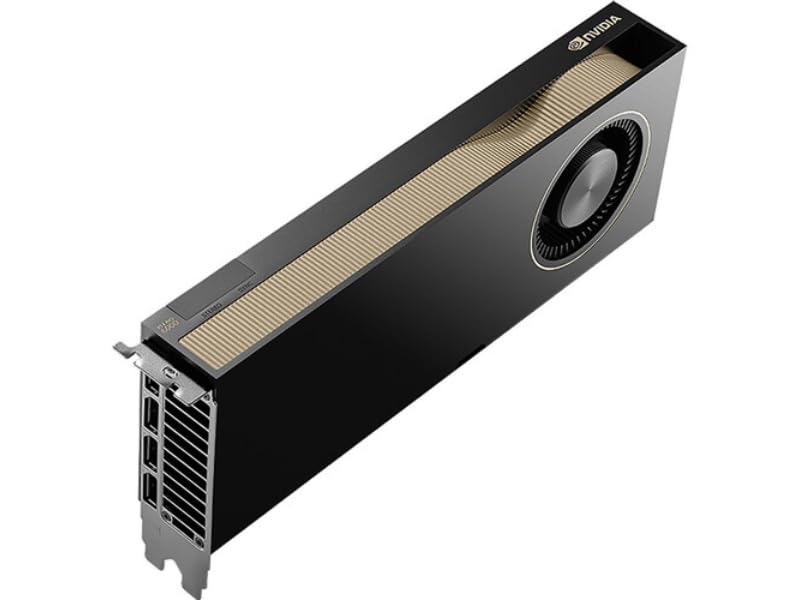
The leap from the PNY NVIDIA RTX 6000 ADA to the latest Blackwell architecture has pushed rack densities to a breaking point. While the previous generation could survive on high-velocity air cooling in many enterprise environments, a fully populated Blackwell rack generates heat signatures that make traditional CRAC (Computer Room Air Conditioning) units look like toys.
When we talk about Blackwell Rack TCO optimization, the cooling method is the primary lever. Transitioning to Direct-to-Chip (D2C) or immersion cooling reduces the energy required for fans and significantly lowers the PUE (Power Usage Effectiveness). If you're running high-density systems like the ASUS Dual AMD EPYC 9004 Series 4U GPU Server, the thermal headroom provided by liquid allows the GPUs to sustain peak boost clocks without the "performance sawtooth" caused by thermal throttling.
§Gen5 NVMe: The silent heater in the storage path
Data center leads often focus on the GPU's TDP, but high-density Gen5 NVMe storage is a concentrated heat source. In Blackwell clusters, the IOPS required to keep the PNY Technology VCNRTXPRO6000BQ-PB NVIDIA RTX PRO 6000 Blackwell Max-Q fed with data means storage controllers are running at maximum capacity.
- Thermal Congestion: Gen5 SSDs can reach temperatures exceeding 80°C under heavy sequential reads.
- Latency Spikes: Thermal throttling on the SSD side increases tail latency, which stalls the GPU training pipeline.
- The TCO Fix: Integrating storage into the rack's liquid loop or using high-density EDSFF (E3.S) form factors helps dissipate heat more effectively than traditional M.2 drives found in consumer-grade gear.
§Networking at 200GbE and beyond
You can't achieve Blackwell Rack TCO optimization with yesterday's 100GbE fabric. To minimize the "idle time" of an expensive BoxGPT AI Workstation, your networking needs to match the throughput of the PCIe Gen5 bus. 200GbE (and increasingly 400GbE) InfiniBand or RoCE v2 is the standard for 2026.
High-speed networking also contributes to the thermal budget. Optical transceivers draw significant power, and at scale, this adds up to kilowatts per rack. CTOs are now looking at Co-Packaged Optics (CPO) to bring that power consumption down, directly impacting the long-term utility costs of the data center.
§Comparison: Workstation vs. Enterprise Rack Thermal Profile
| Feature | Adamant Custom Liquid Cooled Workstation | Blackwell Enterprise Rack |
|---|---|---|
| Cooling Method | Closed-loop AIO / Liquid | Direct-to-Chip / Immersion |
| Primary Bottleneck | Single-node PCIe throughput | Inter-node Fabric Latency |
| Storage Thermal Load | Low (Spread out) | Extreme (High-density NVMe) |
| TCO Focus | Upfront hardware cost | OPEX, Power, and PUE |
| Best For | Local LLM Dev / Fine-tuning | Large Scale Training / Inference |
§Balancing VRAM density and power draw
The move to 96GB of VRAM in cards like the PNY Technology VCNRTXPRO6000BQ-PB allows for much larger models to reside entirely on-chip. This reduces the frequency of data swaps across the network, which ironically helps TCO by reducing the power consumed by the networking fabric.
However, maximizing VRAM density usually requires more complex power delivery. When designing your rack, ensure your PDUs (Power Distribution Units) are rated for the transient spikes common in Blackwell architectures. A system like the BoxGPT AI Workstation is excellent for edge deployments, but in the data center, these power requirements must be aggregated across 42U.
Check our latest benchmarks to see how these VRAM configurations handle the latest 2026 model architectures.
§The infrastructure interplay: A holistic view
True Blackwell Rack TCO optimization occurs when the storage, networking, and compute are balanced to avoid any single component becoming a "bottleneck heater." If your networking is too slow, your GPUs sit idle, wasting power. If your storage is too hot, it throttles, causing the ASUS Dual AMD EPYC 9004 Server to wait for data, again wasting money.
Investing in liquid-cooled infrastructure today might have a higher Day 1 CAPEX, but the reduction in cooling energy and the increase in hardware longevity make it the only viable path for Blackwell-class deployments. For those building out specialized labs, looking at the /categories/ai-workstations category can provide a blueprint for how these technologies scale down to the desktop.
FAQ
How does liquid cooling improve Blackwell TCO?
Liquid cooling allows GPUs to maintain higher clock speeds without throttling, meaning you get more compute for every dollar spent on electricity. It also allows for higher rack density, reducing the physical footprint and real estate costs of your data center.
Is 200GbE necessary for Blackwell workstations?
For a single PNY Technology VCNRTXPRO6000BQ-PB, 100GbE is often sufficient. However, for multi-node training where Blackwell cards are clustered, 200GbE or 400GbE is mandatory to prevent the network from becoming a massive bottleneck that leaves expensive GPUs underutilized.
Why does Gen5 NVMe heat affect GPU performance?
In high-density AI servers, the storage is often physically close to the GPU or the PCIe switch. If the Gen5 NVMe drives throttle due to heat, the data feed to the GPU slows down. This creates "bubbles" in the processing pipeline, lowering the overall efficiency of the rack.
§Bottom line
Optimizing TCO in a Blackwell world requires moving past the GPU specs. You have to look at the rack as a single thermodynamic organism. By integrating liquid cooling across the compute and storage layers and matching that with high-bandwidth 200GbE fabric, you ensure that every watt of power contributes to model training rather than fighting thermal congestion.
If you're starting smaller, consider a liquid-cooled workstation like the Adamant Custom 12-Core System to understand the thermal dynamics before scaling to full /categories/ai-gpus rack deployments.
Heads up: AI Hardware Hub may earn a commission when you buy through links on this page. We only recommend gear we'd run ourselves.