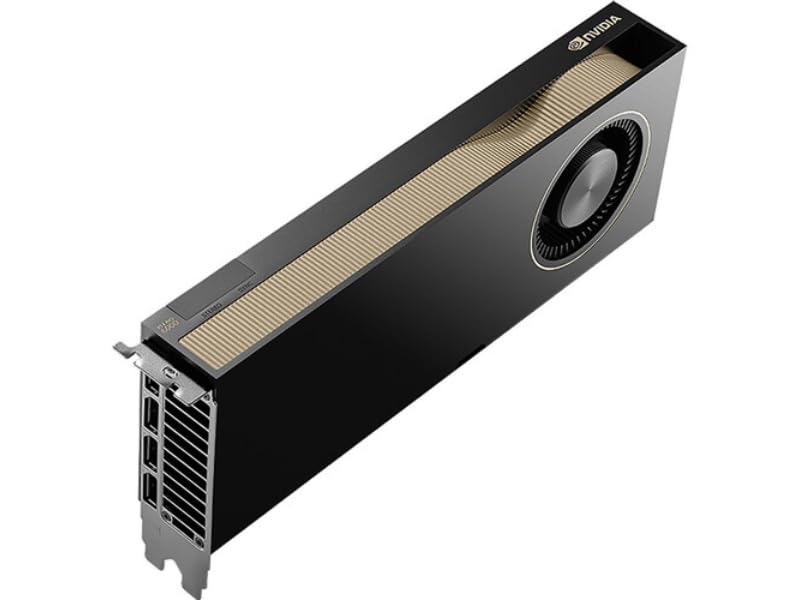
The arrival of NVIDIA’s Blackwell architecture in 2026 has fundamentally shifted the math of data center efficiency, but not always in the ways predictable by a spec sheet. While everyone is focused on the massive compute gains of PNY Technology VCNRTXPRO6000BQ-PB NVIDIA RTX PRO 6000 Blackwell Max-Q Workstation Graphics Cards, a quieter, more insidious threat is emerging in the rack: I/O heat soak. As liquid cooling handles the primary compute dies, the surrounding 200GbE networking and Gen5 storage components are gasping for air, leading to thermal throttling that can slash system-wide ROI by up to 25%.
Heads up: AI Hardware Hub may earn a commission when you buy through links on this page. We only recommend gear we'd run ourselves.
§The heat soak dilemma: Why Blackwell Rack TCO optimization matters
For years, the industry focused on the TDP of the GPU. Today, that’s only half the story. In a high-density Blackwell rack, the compute nodes are often liquid-cooled via Cold Plates or immersive tanks. This is fine for the GPU chips themselves, but it creates a secondary problem. Because the liquid loop is so efficient at removing heat from the processors, airflow through the chassis is often reduced to save power.
This "low-flow" environment is lethal for uncooled peripherals. Your 200GbE NICs and NVMe Gen5 storage drives sit right in the exhaust path of the remaining air-cooled components. We’re seeing "I/O heat soak" where networking transceivers reach 85°C and throttle back to 100GbE speeds just to stay alive. If your networking is throttled, your Blackwell Rack TCO optimization goes out the window because your expensive GPUs are sitting idle, waiting for data.
§The I/O bottleneck in 2026
In older architectures like the A100 80GB Graphics Card, the power density was low enough that traditional fans could keep the whole system balanced. With Blackwell, the delta between the cooled compute and uncooled I/O is staggering.
- Networking: 200GbE and 400GbE optics generate significant heat at the port level.
- Storage: Gen5 NVMe drives require active cooling or massive heat sinks which are often blocked in compact 4U configurations.
- Memory: While HBM3e on the GPU is cooled, the system RAM in servers like the ASUS Dual AMD EPYC 9004 Series Server still generates substantial ambient heat.
§Comparison: Cooling demands across generations
| Component Type | Ampere Era (A100) | Blackwell Era (RTX 6000 Max-Q) | Impact on TCO |
|---|---|---|---|
| Primary Cooling | Air-cooled (standard) | Liquid-to-Chip (required) | Increased CAPEX |
| I/O Thermal Limit | High Margin | Critical/Low Margin | Risk of Throttling |
| Networking Speed | 100GbE | 200GbE - 400GbE | High Latency Risk |
| Storage Interface | PCIe Gen4 | PCIe Gen5/Gen6 | Heat-induced jitter |
§Why local workstations are the "Canary in the Coal Mine"
Interestingly, we see this heat soak phenomenon first in high-end local workstations before it hits the scaled-out data center. Take the BoxGPT AI Workstation - RTX PRO 6000 Blackwell. These units pack 96GB of VRAM into a chassis that must maintain quiet operation.
Engineers using the dual-GPU BoxGPT AI Workstation 256GB RAM variant have noted that while the Blackwell Max-Q chips stay cool, the NVMe drives can hit thermal ceilings during heavy checkpointing of models. This is because the Max-Q design is so efficient at heat management that the system fans don't always ramp up high enough to cool the secondary components.
§Strategies for CTOs: Minimizing the I/O thermal tax
To optimize Blackwell Rack TCO, infrastructure teams need to look beyond the GPU.
- Direct-to-Chip Liquid Cooling for NICs: Don't just cool the GPUs. Modern Blackwell-ready racks should extend liquid loops to the networking cards.
- Over-provisioning Airflow: Even in a liquid-cooled rack, you need a "keep-alive" airflow strategy specifically measured for the rear-of-rack I/O.
- Tiered Hardware Selection: For local development, choosing the BoxGPT AI Workstation ensures that the integration of the Ryzen 9900X and Blackwell GPU has been thermally validated in a way that DIY builds often miss.
§The role of high-bandwidth memory and enterprise servers
When we look at heavy-duty enterprise setups like the ASUS Dual AMD EPYC 9004 Series 4U GPU Server, we see the scale of the challenge. This server supports up to 6TB of DDR5 RAM. In a Blackwell deployment, that RAM isn't just sitting there; it's constantly feeding data to the accelerators. The sheer heat generated by 24 DIMMs can create a "curtain of heat" that impacts the 200GbE networking ports located just inches away.
Failure to address this leads to "Tail Latency"—where 99% of your compute is fast, but 1% of your data packets are delayed due to a hot NIC, causing the entire AI training cluster to stall. Check our benchmarks to see how thermal throttling affects epoch times in multi-node Blackwell setups.

§Bottom line: Don't let the "Small Stuff" melt your ROI
The transition to Blackwell is the most significant performance jump we've seen since the transition from Pascal to Volta. However, the physical infrastructure requirements are unforgiving. If you are planning a deployment, don't just budget for the PNY RTX PRO 6000 Blackwell cards. Budget for the sophisticated cooling and high-spec networking needed to keep them fed.
Blackwell Rack TCO optimization isn't about buying the cheapest components; it's about ensuring every watt of power delivered to the rack results in a cycle of compute, not a cycle of thermal throttling. Whether you’re deploying a single BoxGPT AI Workstation or a row of ASUS GPU Servers, the physics of heat soak remain the same.
Heads up: AI Hardware Hub may earn a commission when you buy through links on this page. We only recommend gear we'd run ourselves.
FAQ
What is I/O heat soak in AI racks?
I/O heat soak occurs when the cooling systems in a server rack primarily focus on the high-TDP GPUs (like Blackwell), leaving networking cards and storage drives to overheat in the residual warm air, leading to performance throttling.
How does Blackwell differ from Ampere in cooling?
While an A100 80GB Graphics Card could often be cooled with standard data center air conditioning, Blackwell nodes frequently require liquid cooling at the chip level due to much higher power densities.
Why does networking speed matter for Blackwell TCO?
If your 200GbE networking throttles due to heat, your GPUs will spend millions of cycles waiting for data. This lowers the effective utilization of your hardware, making the cost-per-training-run much higher than expected.
Is liquid cooling necessary for the PNY RTX PRO 6000 Blackwell?
The PNY RTX PRO 6000 Blackwell Max-Q is designed for workstation environments. While it doesn't strictly require an external liquid loop like data center chips, it thrives in well-ventilated chassis like those provided by BoxGPT.