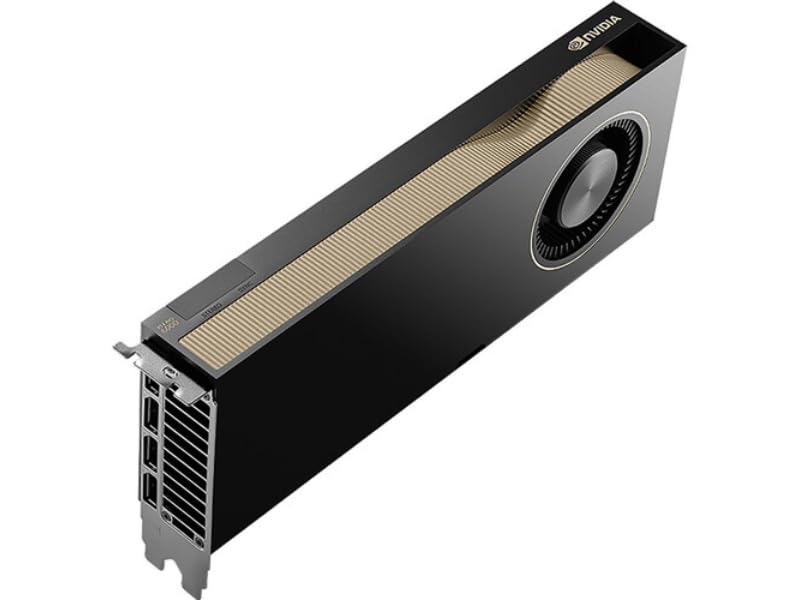
The hype around Blackwell’s raw FLOPS is a distraction for the person actually signing the checks. While 2026 is the year of the Blackwell deployment, the real Total Cost of Ownership (TCO) isn't won or lost in the vRAM; it’s won in the operational plumbing of 200GbE fabric and NVMe-over-Fabrics (NVMe-oF) storage. To extract value from a PNY Technology VCNRTXPRO6000BQ-PB NVIDIA RTX PRO 6000 Blackwell Max-Q, the bottleneck isn't the chip—it's how fast you can feed it data and how efficiently you can cool the rack.
Heads up: AI Hardware Hub may earn a commission when you buy through links on this page. We only recommend gear we'd run ourselves.
§The 200GbE wall: Networking as the backbone
In 2026, 100GbE is the new 10GbE—meaning it’s officially too slow for Blackwell-scale clusters. If you’re deploying the BoxGPT AI Workstation, you’re likely working in a localized dev environment. But as soon as those nodes scale into a rack, 200GbE networking becomes the mandatory minimum to prevent GPU starvation.
The Blackwell architecture thrives on massive parameter exchange. Without a 200GbE RDMA (Remote Direct Memory Access) fabric, your expensive GPUs spend 30-40% of their cycles waiting for the network. When calculating TCO, a $15k switch that enables 95% GPU utilization is significantly cheaper than a $5k switch that caps you at 60%. Check our latest benchmarks to see how interconnect latency impacts training wall-clock time.
§Storage strategies: Moving beyond local NVMe
While the Sentinel Non-RGB RTX PRO 6000 ships with 8TB of blazing-fast local storage, enterprise Blackwell racks require a decoupled storage strategy. For CTOs, the goal is "Data Gravity."
- NVMe-oF (NVMe over Fabrics): This allows your ASUS ESC8000A-E12P 4U GPU Server to access remote flash storage with latencies nearly identical to local PCIe lanes.
- GPUDirect Storage (GDS): By bypassing the CPU and moving data directly from the NVMe fabric to the PNY NVIDIA RTX 6000 ADA or Blackwell counterparts, you reduce latency and CPU overhead.
- Tiered Caching: Use local NVMe for checkpoints, but keep the massive datasets on 200GbE-connected flash arrays.
§Cooling and power: The hidden TCO killers
A Blackwell rack in 2026 can easily pull 40kW to 100kW. If your data center isn't ready for liquid-to-chip cooling, you're going to pay a "thermal tax" in the form of throttled performance and massive AC bills.
| Feature | Air-Cooled Standard | Blackwell Liquid-Ready |
|---|---|---|
| Max TDP per Node | 1200W - 1600W | 2800W+ |
| Rack Density | 12-15 kW | 40-100 kW |
| PUE Efficiency | 1.4 - 1.6 | 1.1 - 1.2 |
| Primary GPU Target | RTX 6000 ADA | Blackwell Max-Q |
For high-density deployments, the NOVATECH Apex WS9985X offers a bridge for edge use cases, but the core of your AI workstations strategy should involve rear-door heat exchangers (RDHx) if you're sticking with air-cooled chips in a high-density rack.
§Balancing legacy and Blackwell
You don't need to throw away your Ampere or Hopper hardware. A smart infrastructure strategy uses A100 80GB Graphics Cards for steady-state inference and smaller fine-tuning tasks, saving the Blackwell nodes for heavy lifting. By mixing AI GPUs across different generation tiers, you can optimize your capital expenditure while keeping operational costs low.
The PNY Technology VCNRTXPRO6000BQ-PB is particularly interesting for this "mixed-fleet" approach because its Max-Q design keeps power consumption in check, allowing you to slot it into existing racks that might struggle with the full-power 700W+ enterprise variants.
Networking Comparison for Multi-Node AI
To maximize the throughput of a system like the BoxGPT AI Workstation, consider the following:
- RoCE v2: Best for Ethernet-based shops wanting high performance without InfiniBand complexity.
- InfiniBand NDR: The gold standard for Blackwell clusters, offering 400Gb/s per link.
- P4 Programmable Switches: Essential for deep packet inspection and traffic shaping in multi-tenant AI labs.
§Bottom line: Focus on the "Inside" of the Rack
The performance of 2026 AI models is no longer gated by TFLOPS. It’s gated by the speed at which you can move weights between nodes and the cost of keeping those nodes from melting. For a winning Blackwell Rack TCO Strategy, invest 20% more in your networking and storage fabric now; it will pay for itself by increasing GPU utilization by 50% over the lifecycle of the hardware.
FAQ
What is the recommended networking speed for Blackwell racks in 2026?
Multiple 200GbE or 400GbE links are required per node. 100GbE is generally considered a bottleneck for large-scale Blackwell training tasks and will result in lower TCO efficiency due to GPU idle time.
Can I run Blackwell GPUs on traditional air cooling?
While possible with lower-power variants like the Blackwell Max-Q, the high-density racks preferred for enterprise AI (40kW+) usually require liquid cooling or rear-door heat exchangers to maintain optimal performance without thermal throttling.
How does NVMe-oF improve AI workload performance?
NVMe over Fabrics allows AI servers to access high-speed storage pools with nearly zero latency impact. This enables systems like the ASUS ESC8000A-E12P to swap massive datasets in and out of GPU memory without waiting for traditional NAS bottlenecks.
Heads up: AI Hardware Hub may earn a commission when you buy through links on this page. We only recommend gear we'd run ourselves.