In 2026, the discussion around generative AI has shifted from "how many GPUs do we have?" to "how much of our compute are we actually using?" As Blackwell-based architectures flood the enterprise market, CTOs are discovering that raw TFLOPS are useless if the data can’t reach the chip or if the rack hits a thermal wall within ten minutes of training. To maximize Blackwell Rack TCO synergy, you have to stop looking at the GPU as a silo and start treating the 200GbE fabric, NVMe storage tiers, and liquid cooling as a single, unified organ.
Heads up: AI Hardware Hub may earn a commission when you buy through links on this page. We only recommend gear we'd run ourselves.
§The starvation problem: Why 200GbE is the new baseline
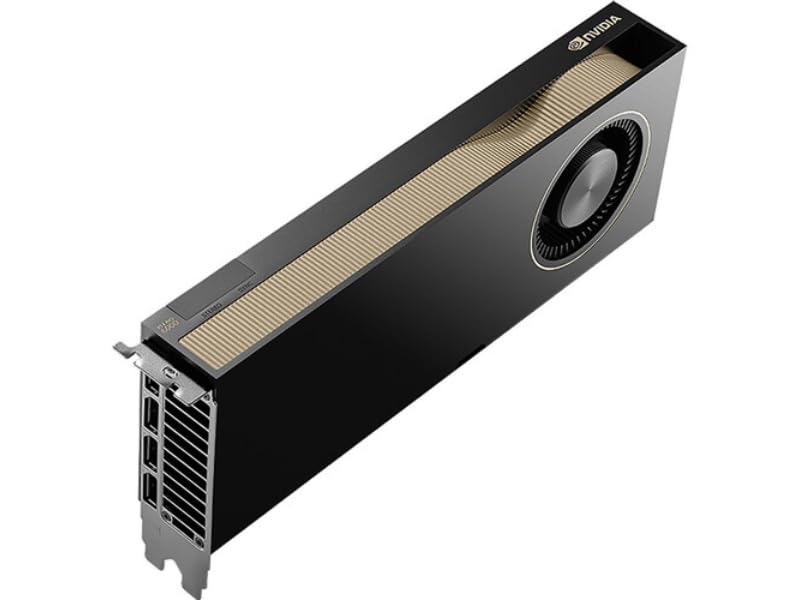
The Blackwell architecture, found in high-end units like the PNY Technology VCNRTXPRO6000BQ-PB NVIDIA RTX PRO 6000 Blackwell Max-Q Workstation Graphics Card, offers a generational leap in throughput. However, if your networking fabric is still stuck on legacy 100GbE or congested 400GbE shared backplanes, you’re starving the beast.
When training multi-billion parameter models, the "All-Reduce" operations—where GPUs sync their gradients—become the primary bottleneck. 200GbE (and increasingly 400/800GbE in the data center) isn't just about speed; it's about reducing latency to the point where the GPU doesn't cycle into an idle "wait" state. In Blackwell deployments, networking is no longer an external peripheral; it is the physical extension of the GPU's memory bus.
§Storage synergy: NVMe and the "data ingest" wall
It’s a common mistake: spending $100k on a rack and then feeding it from a slow NAS. To hit the ROI targets required in 2026, your local storage must match the Blackwell ingest rate. Systems like the Sentinel Non-RGB RTX PRO 6000 address this by integrating multiple 4TB NVMe SSDs directly onto the PCIe 5.0/6.0 bus.
- Zero-Copy Networking: Utilizing GPUDirect Storage (GDS) to move data from NVMe to the GIGABYTE AORUS GeForce RTX 5090 Stealth ICE 32G Graphics Card without involving the CPU.
- Sequential Throughput: Modern training sets for video or high-fidelity 3D require sequential reads that only Gen5 NVMe can sustain.
- IOPS for Checkpointing: AI models checkpoint frequently. If your storage can't handle the write-burst, your $13,000 GPUs sit idle while a $200 drive struggles to save the state.
§The thermal ceiling: Moving beyond air
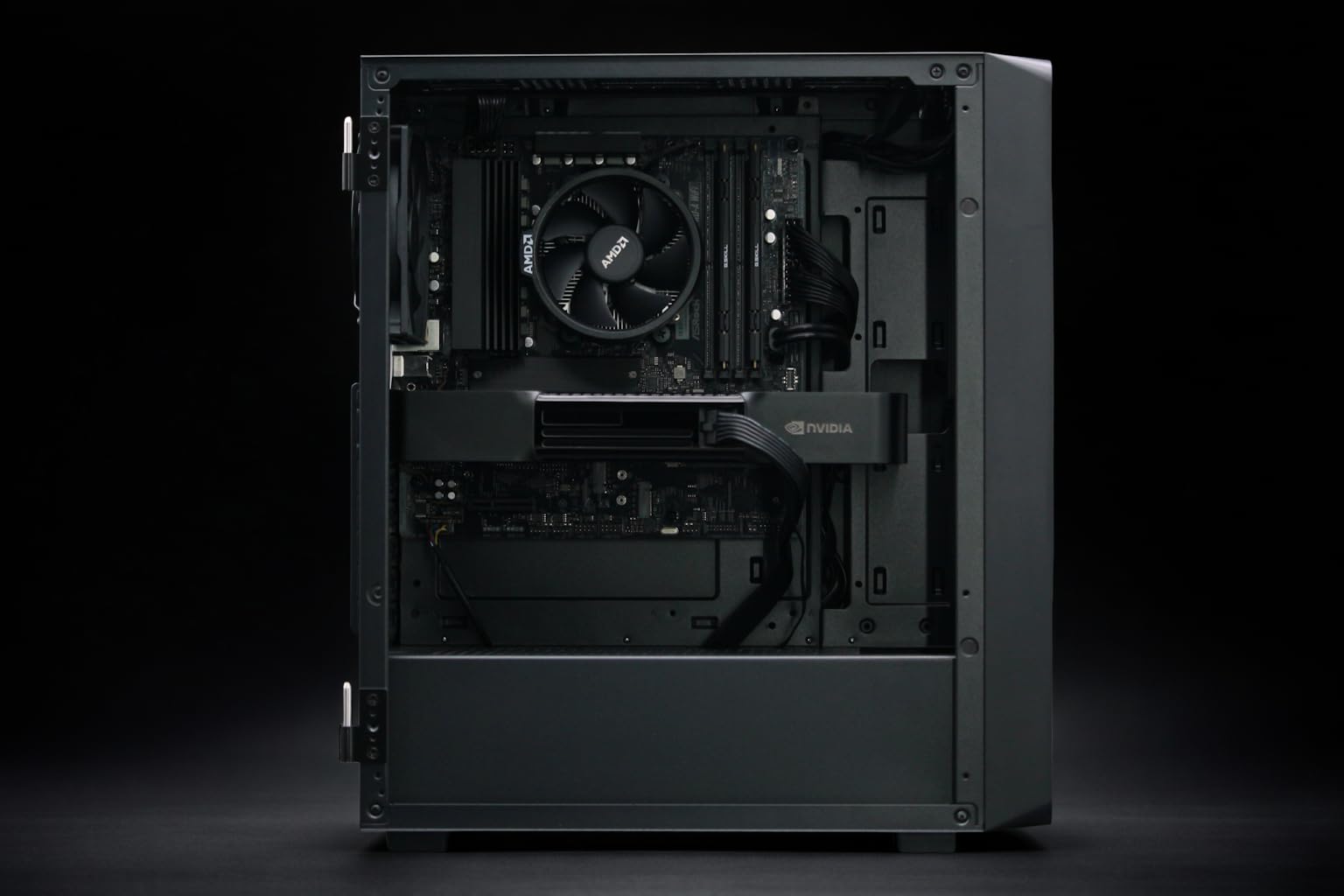
Blackwell chips have pushed TDP levels to their logical limit for air cooling. For a single workstation, like the Cloud Ninjas Iron Bull AI Workstation, high-static pressure fans might suffice. But for rack-scale deployments, liquid cooling is the only way to ensure Blackwell Rack TCO synergy.
Air cooling requires massive physical spacing between cards to prevent "re-breathing" hot air. Liquid cooling allows for tighter packing, effectively doubling the compute density per square foot of rack space. When you calculate the cost of data center floor space and the electricity wasted on "chiller" air conditioning versus direct-to-chip liquid cooling, the liquid-cooled rack pays for its own infrastructure within 18 months.
§Comparing Blackwell Deployment Tiers
| Feature | Pro Workstation (BoxGPT) | Enterprise Node (ASUS ESC8000A-E12P) | Full Rack Scaled |
|---|---|---|---|
| Primary GPU | RTX PRO 6000 Blackwell | NVIDIA H200 NVL | Blackwell B200 / B100 |
| VRAM | 96GB | 141GB | 192GB+ per GPU |
| Networking | 10GbE / 25GbE | 200GbE / 400GbE | 800GbE InfiniBand |
| Cooling | Active Air / AIO | High-Flow Air | Direct-to-Chip Liquid |
| Best For | Local LLM Fine-tuning | Heavy Inference / HPC | Foundation Model Training |
§Managing I/O thermal throttling
Thermal throttling isn't just about the GPU core temperature anymore. In 2026, we’re seeing "I/O Throttling," where the networking controllers or the PCIe switches overheat and downclock, even if the GPU stays at 60°C.
To prevent this, integrated systems like the ASUS Dual AMD EPYC 9004 Series 4U GPU Server utilize sophisticated airflow paths that prioritize the NICs (Network Interface Cards) and NVMe bays just as much as the accelerators. If you're building custom, ensure your 200GbE cards have dedicated active cooling or are positioned in the highest-velocity air streamers. Check out our latest benchmarks for a deeper look at how heat affects epoch times.
§Holistic ROI: The "hidden" costs of imbalanced builds
Buying five GIGABYTE AORUS GeForce RTX 5090 Stealth ICE 32G units and sticking them in a legacy chassis is a recipe for a 40% performance loss. The TCO of a Blackwell rack is optimized when the expenditure follows the "1:1:1" rule: for every dollar spent on compute, ensure there is a proportional investment in high-speed interconnects and thermal management.
The PNY Technology VCNRTXPRO6000BQ-PB is a prime example of a chip designed for this balanced ecosystem. Its Max-Q design focuses on energy efficiency, which reduces the strain on the rack’s Power Distribution Units (PDUs), allowing you to fit more nodes into a standard 42U rack without exceeding the 50kW power limit common in 2026 facilities.
FAQ
Does Blackwell require a specific type of NVMe?
While any Gen4/Gen5 NVMe will work, Blackwell Blackwell deployments benefit most from NVMe drives that support GPUDirect Storage (GDS). This allows the GPU to pull data directly from the drive, bypassing the CPU and significantly reducing latency during massive dataset loading.
Why is 200GbE considered the minimum for Blackwell?
The compute density of Blackwell chips is so high that 100GbE has become a bottleneck. To keep the GPU throughput at 90%+ utilization, the inter-node communication needs the 200GbE—or ideally 400GbE—bandwidth to handle the "All-Reduce" synchronization tasks without stalling the training pipeline.
Can I run Blackwell GPUs on air cooling in a rack?
It is possible, but it is not optimal for TCO. Air cooling requires high-RPM fans that consume significant power and requires the GPUs to be spaced out (usually 4U or 5U servers). Transitioning to liquid cooling allows for 2U or even 1U densities, effectively doubling your compute per rack and lowering the long-term electricity bill.
§Bottom line
Maximizing Blackwell Rack TCO synergy isn't about finding the cheapest components; it's about eliminating the friction between them. If you’re building for local development, start with a balanced workstation like the Sentinel Non-RGB RTX PRO 6000. For data center scales, prioritize the ASUS ESC8000A-E12P and ensure your networking fabric is ready for the 200GbE era. Anything less, and you're just paying for performance you can't use.
Heads up: AI Hardware Hub may earn a commission when you buy through links on this page. We only recommend gear we'd run ourselves. Explore our full range of [/categories/ai-gpus](AI GPUs) and [/categories/ai-workstations](high-performance workstations) to find your perfect build.