The shift to NVIDIA’s Blackwell architecture has fundamentally rewired the data center, pushing power densities to a staggering 120kW per rack. While the industry is fixated on cooling the GPUs themselves, a more insidious threat is emerging: the thermal bottleneck between Gen5 NVMe storage and 200GbE networking. To maintain the massive throughput required by GB200 clusters, Enterprise CTOs must optimize for heat dissipation at the I/O level or risk thermal throttling that can slash effective IOPS by up to 40%.
Heads up: AI Hardware Hub may earn a commission when you buy through links on this page. We only recommend gear we'd run ourselves.
§The Blackwell thermal reality
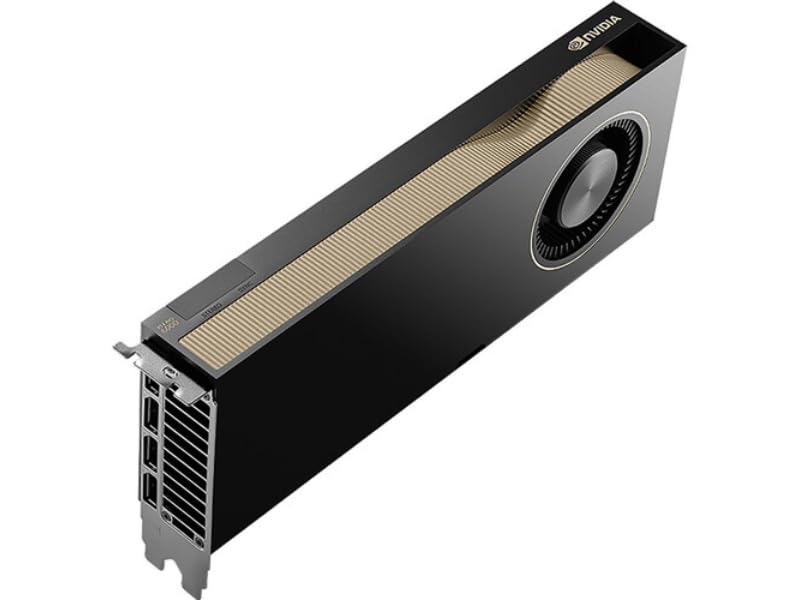
We are now firmly in the era of liquid cooling. In 2026, air-cooling a full-scale Blackwell deployment is no longer viable for high-density environments. The heat generated by the PNY Technology VCNRTXPRO6000BQ-PB NVIDIA RTX PRO 6000 Blackwell Max-Q workstation graphics card and its enterprise siblings creates a massive thermal envelope. However, as liquid cold plates draw heat away from the GPUs, the surrounding components—specifically the ConnectX-7 NICs and Gen5 NVMe drives—are often left in a "heat shadow."
When 200GbE (and increasingly 400GbE) networking cards run at full tilt to feed a Blackwell cluster, they generate significant localized heat. In a standard AI workstation, managed airflow can compensate. But in a dense GB200 rack, the lack of high-velocity air (due to the presence of liquid manifolds) means these components can reach their T-junction limits rapidly.
§Solving the Gen5 NVMe storage choke point
Gen5 NVMe SSDs are notorious for running hot. To sustain the 14GB/s+ read speeds required to keep AI GPUs fed, these drives pull considerable wattage. In a rack optimized for Blackwell, the thermal optimization strategy must include:
- Active M.2 Cooling: Passive heat sinks are no longer sufficient for Gen5 drives in a 200GbE environment.
- Direct-to-Chip for Networking: High-end enterprise AI systems are now extending liquid loops to the NICs to prevent packet drops caused by thermal oscillations.
- Staggered Drive Placement: Physical spacing between NVMe modules to prevent cumulative heat soak.
If you are developing locally before scaling to a rack, systems like the BoxGPT AI Workstation - RTX PRO 6000 Blackwell, Ryzen 9900X, 128GB RAM, 2TB NVMe provide a balanced thermal profile designed for the first-generation Blackwell Max-Q cards, ensuring that the VRAM and storage stay within optimal operational windows.
§200GbE and the networking friction
Data movement is the silent killer of TCO. When a Blackwell node waits for data because the network controller has throttled due to heat, your $100k+ investment is idling. The integration of 200GbE networking into the NVIDIA Blackwell ecosystem allows for incredible RDMA performance, but it doubles the thermal output of the networking sub-tier compared to the previous 100GbE standard.
| Feature | Gen4 Standard (2023-2024) | Gen5/Blackwell Era (2026) | Impact on Rack Thermal Design |
|---|---|---|---|
| Networking Speed | 100GbE | 200GbE - 400GbE | 2x heat density at the NIC |
| Storage Interface | PCIe Gen4 | PCIe Gen5 / Gen6 | Requires active airflow or liquid cold plates |
| GPU Architecture | PNY NVIDIA RTX 6000 ADA | PNY NVIDIA RTX PRO 6000 Blackwell Max-Q | 30% higher power density per rack U |
| Cooling Method | Air / Hybrid | Full Liquid (DLC) | Shift from fans to CDU and manifolds |
§Strategic infrastructure advice for CTOs
For those managing the transition from Ada Lovelace to Blackwell, the hardware choice is only half the battle. If you're building a local playground for ML engineers, a BoxGPT AI Workstation, RTX PRO 6000 Blackwell, 96GB VRAM, Ryzen 9900X, 256GB DDR5, 2TB NVMe offers the necessary thermal headroom.
However, for enterprise-scale deployments, consider the ASUS Dual AMD EPYC 9004 Series 4U GPU Server (ESC8000A-E12P) with 2x NVIDIA H200 NVL 141GB GPUs. While it uses H200 chips, the chassis design provides the airflow blueprints necessary to understand how to handle high-wattage networking cards in a multi-GPU environment. Consult our latest benchmarks to see how these configurations hold up under sustained synthetic loads.
§Local development as a bridge
Not every workload needs a Blackwell rack immediately. Often, the thermal bottleneck can be avoided by distributing development across high-end workstations. The NOVATECH Apex WS9985X AI Workstation & Gaming PC utilizes the RTX 5090 alongside Threadripper Pro processors, providing a massive 64-core offload capability that reduces the stress on the GPU's memory controller.
For projects requiring liquid-cooled stability, the Adamant Custom 12-Core Liquid Cooled Editing Modelling AI Learning Workstation is an excellent middle ground, ensuring that the 32GB of VRAM on the 5090 stays cool even during 48-hour training runs.
§Bottom line: Optimize for the "Heat Shadow"
The "Storage-to-Network" bottleneck is real. As you scale into Blackwell GPUs, ensure your AI workstations or enterprise racks aren't just cooling the processors.
- Prioritize NICs with integrated heat sinks.
- Use Gen5 NVMe drives with active cooling (fans or liquid).
- Ensure your rack's CDU (Cooling Distribution Unit) has enough overhead to account for networking and storage heat, typically an additional 15% beyond the GPU/CPU calculations.
Heads up: AI Hardware Hub may earn a commission when you buy through links on this page. We only recommend gear we'd run ourselves.
FAQ
Why does 200GbE networking cause thermal issues in Blackwell racks?
High-speed networking cards like the ConnectX-7 generate significant heat when processing 200Gbps of traffic. In liquid-cooled Blackwell environments, the reduction in total systemic airflow (since GPUs aren't using fans) creates stagnant air pockets around the NICs, leading to thermal throttling.
Can I run Blackwell GPUs in traditional air-cooled racks?
While a single PNY RTX PRO 6000 Blackwell Max-Q can work in a high-airflow workstation, full clusters of GB200 chips generally exceed the heat rejection capabilities of air cooling. Enterprise deployments require liquid-to-chip or immersion cooling to maintain performance.
What is the advantage of the 96GB VRAM on the Blackwell Max-Q?
The 96GB VRAM allows for significantly larger model shards to be held in local memory, reducing the frequency of storage I/O and networking calls. This actually helps alleviate the thermal bottleneck by reducing the workload on the Gen5 NVMe and 200GbE components.
Is liquid cooling necessary for the RTX 5090?
For short bursts, air cooling is sufficient. However, for AI training and professional modeling, systems like the Adamant Custom Liquid Cooled Workstation are preferred to prevent the GPU from down-clocking during sustained 100% utilization.