High-density RAM and 100GbE networking are no longer optional "nice-to-haves" for enterprise AI labs; they are the primary gatekeepers of GPU utilization. As we scale into the Blackwell era, the bottleneck has shifted from raw TFLOPS to the "data hunger" of massive VRAM pools. If your infrastructure isn't feeding your cards fast enough, you aren't just losing time—you're torching your distributed AI training infrastructure ROI.
Heads up: AI Hardware Hub may earn a commission when you buy through links on this page. We only recommend gear we'd run ourselves.
§The starvation problem: Why VRAM isn't enough
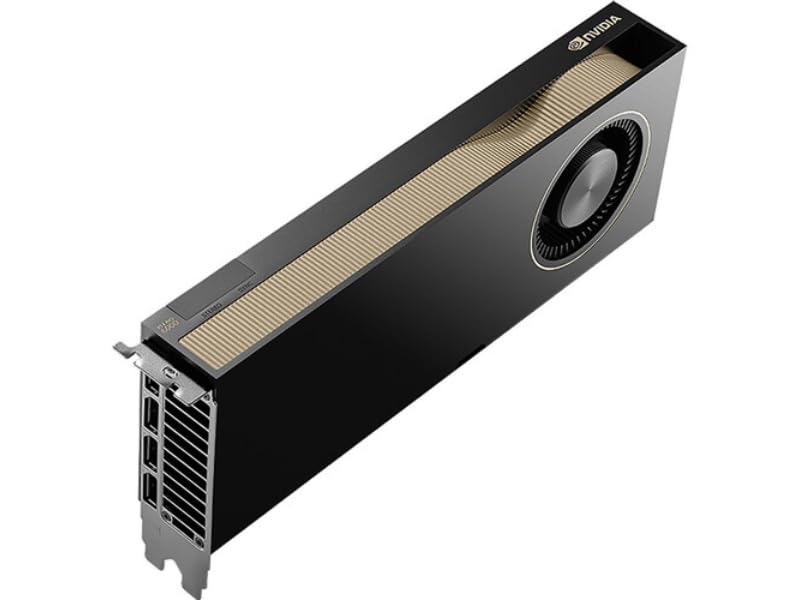
In 2026, the delta between a "fast" cluster and a "productive" cluster is measured in I/O throughput. When you deploy a card like the PNY Technology VCNRTXPRO6000BQ-PB NVIDIA RTX PRO 6000 Blackwell Max-Q, you are managing a staggering 96GB of high-speed memory. Multiply that across a 4-node or 8-node cluster, and you’re looking at nearly a Terabyte of active VRAM that needs to be refreshed constantly during training iterations.
If your local system RAM or your network backbone (the "data pipe") is too small, those expensive Blackwell chips sit idle, waiting for the next batch of tokens to arrive. This "idle tax" is the silent killer of distributed AI training infrastructure ROI.
§Scaling ECC RAM: The buffer between disk and GPU
To keep high-density nodes fed, enterprise AI workstations now require a minimum 2:1 ratio of System RAM to VRAM. For a dual-GPU setup featuring the PNY NVIDIA RTX 6000 ADA (48GB x 2), you need at least 256GB of ECC DDR5 to ensure the CPU can stage data without swapping to NVMe.
Systems like the Cloud Ninjas Iron Bull AI Workstation come pre-configured with 256GB of ECC Registered DDR5. This isn't just about capacity; ECC (Error Correction Code) is non-negotiable for long-running training jobs. A single bit-flip in a 48-hour training run can corrupt the entire model weights, effectively wasting thousands of dollars in electricity and compute time.
Why 100GbE is the new floor for NAS integration
The days of 10GbE or even 25GbE NAS connections are behind us for multi-GPU Blackwell clusters. If you are pulling datasets from an enterprise NAS into a node like the BoxGPT AI Workstation, a 10GbE link becomes a massive bottleneck.
- Saturation: A 10GbE link tops out at ~1.25 GB/s. A single RTX PRO 6000 Blackwell Max-Q can ingest data significantly faster during local staging.
- 100GbE Throughput: Moving to a 100GbE fabric allows for ~12.5 GB/s, enabling the NAS to feed the system RAM as fast as the RAM can feed the GPUs via PCIe Gen5.
- Latency: RDMA (Remote Direct Memory Access) over 100GbE allows the GPU to pull data directly from the network, bypassing the CPU overhead and slashing latency by 40-60%.
§Comparing High-Density Compute Nodes
When choosing between the current generation of workstation-class AI GPUs, you're balancing VRAM density against architectural efficiency.
| GPU / System | Architecture | VRAM | Best Use Case |
|---|---|---|---|
| RTX PRO 6000 Blackwell | Blackwell | 96GB | Massive LLM Fine-tuning |
| A100 80GB | Ampere | 80GB | Legacy Scaling / HBM2e stability |
| RTX 6000 Ada | Ada | 48GB | High-density 3D & Mid-size AI |
| NOVATECH Apex WS9985X | Hybrid | 32GB+ | Multi-modal dev & Low-lat inferencing |
§The thermal cost: Cooling dense Blackwell clusters
We can't talk about ROI without talking about the cooling bill. High-density cards like the PNY RTX PRO 6000 Blackwell Max-Q are designed for efficiency, but "Max-Q" in the workstation world still generates significant heat when stacked four-deep in a rack.
CTOs often make the mistake of calculating only the purchase price of the hardware. To get a true ROI, you must factor in:
- Chilled Water vs. Air: Are you retrofitting for liquid cooling, or using high-CFM blowers?
- Power Factor: A cluster of A100 80GB units in a rack might draw 10kW+, requiring 208V or 240V industrial circuits.
- Acoustics: If these units are in a lab rather than a data center, the noise from those fans can be a productivity drain.
§Maximizing ROI through balanced builds
A lopsided build is a waste of money. Don't pair a 64-core Threadripper PRO 9985WX with only 64GB of RAM and a slow spinning-disk NAS. The CPU will be waiting for the RAM, and the RAM will be waiting for the disk.
The sweet spot for ROI right now for a mid-ranged lab involves using systems like the BoxGPT AI Workstation, which provides 256GB of DDR5 and Blackwell-tier VRAM out of the box. This ensures that the massive datasets required for 2026-era LLMs can reside in high-speed memory pools, reducing the "time to first token" and overall training epochs.
Heads up: AI Hardware Hub may earn a commission when you buy through links on this page. We only recommend gear we'd run ourselves.
FAQ
Why is ECC RAM vital for Blackwell-based clusters?
Blackwell GPUs handle massive weights; even a minor memory error in the system RAM during the data-shuttling process can lead to gradient explosions or model weights drifting into "NaN" (Not a Number) territory. ECC prevents these silent data corruptions.
Does 100GbE actually improve training speed?
In single-node setups, the impact is minimal. However, in distributed training where data is sharded across multiple nodes, the interconnect speed (100GbE or InfiniBand) becomes the primary factor in how fast nodes can sync their gradients. Without 100GbE, your multi-GPU cluster will spend 30% or more of its time communicating rather than computing.
Is the RTX 6000 Ada still viable compared to Blackwell?
The RTX 6000 Ada remains a powerhouse for inference and workstation tasks. While it lacks the sheer VRAM density of the Blackwell 96GB card, its lower TDP and proven stability make it an excellent choice for distributed clusters focused on multi-modal AI rather than foundational LLM training.
§Bottom line
True ROI in the Blackwell era comes from balance. If you're spending $100k on GPUs, you can't afford to skimp on the $5k for 100GbE networking and high-density ECC RAM. Feed your GPUs or prepare to watch your ROI evaporate in idle cycles. For most enterprise labs, starting with a pre-integrated platform like the Iron Bull or the BoxGPT Blackwell workstation is the safest path to maximizing compute-per-dollar.