Building an enterprise AI lab in 2026 isn't just about snagging the fastest silicon; it’s about ensuring that silicon never starves for data. As models push into the multi-trillion parameter range, the bottleneck has shifted from raw compute to the interconnect and the storage fabric. This guide breaks down the critical shift toward enterprise AI NAS infrastructure, focusing on high-density RAM scaling and why 100GbE is no longer optional for distributed training environments.
Heads up: AI Hardware Hub may earn a commission when you buy through links on this page. We only recommend gear we'd run ourselves.
§The backbone of distributed training: 100GbE and beyond
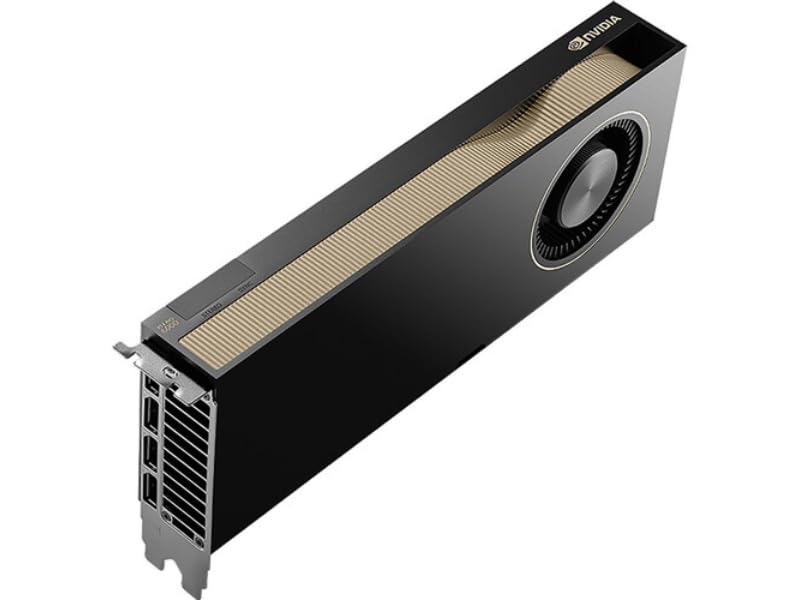
In a distributed training setup, your GPUs are only as fast as your network. When you're syncing gradients across multiple nodes, traditional 10GbE or even 25GbE links become massive chokepoints. This is particularly true when running a cluster of PNY NVIDIA RTX 6000 ADA units or the newer Blackwell-based systems.
Enterprise AI NAS infrastructure needs to handle sustained, bursty read/write operations during checkpointing and dataset loading. Moving to a 100GbE (or dual 100GbE) fabric ensures that your benchmarks aren't artificially capped by I/O wait times. For CTOs, this means investing in All-Flash arrays that can saturate these pipes, reducing the "Time to Train" and increasing the overall ROI of your hardware fleet.
§High-density RAM: Feeding the Blackwell beast
While VRAM on cards like the PNY Technology VCNRTXPRO6000BQ-PB NVIDIA RTX PRO 6000 Blackwell Max-Q Workstation Graphics Card has reached a staggering 96GB, system RAM remains the vital staging area. High-density RAM scaling—specifically moving toward 256GB and 512GB ECC DDR5 configurations—is essential for:
- Dataset Pre-processing: Keeping massive chunks of your training data in system memory to avoid disk latency.
- CPU-GPU Offloading: Utilizing modern optimizers that swap weights between the GPU and system RAM.
- Virtualization: Running multiple LXC containers or VMs for different dev teams on a single AI workstation.
We're seeing workstations like the BoxGPT AI Workstation, RTX PRO 6000 Blackwell ship with 256GB of DDR5 as a baseline precisely because the VRAM-to-System-RAM ratio must remain balanced for local LLM finetuning.
§Infrastructure Comparison: Workstation vs. Data Center Node
Choosing between a localized high-end workstation and a rack-mounted data center unit depends on your cooling and power availability.
| Feature | BoxGPT AI Workstation | A100 80GB Graphics Card (Node) | NOVATECH Apex WS9985X |
|---|---|---|---|
| Primary GPU | RTX PRO 6000 Blackwell | NVIDIA A100 | RTX 5090 (Consumer/Prosumer) |
| VRAM per GPU | 96GB | 80GB | 32GB |
| Networking | 10GbE (Standard) | 100/200GbE (InfiniBand) | 10GbE (Standard) |
| Ideal Use Case | Local LLM Dev / Fine-tuning | Multi-node Clusters | VFX / Entry-level AI |
| Cooling | Active (Air) | Passive (Chilled Water/Rack Air) | Active (Air/AIO) |
§Power and cooling: The hidden costs of Blackwell
If you are moving to the PNY Technology VCNRTXPRO6000BQ-PB NVIDIA RTX PRO 6000 Blackwell Max-Q, the "Max-Q" designation helps with efficiency, but a multi-GPU cluster still demands serious juice.
- Thermal Loads: A quad-GPU setup can easily dump 1.2kW of heat into a room. Without dedicated HVAC or hot/cold aisle containment, your AI GPUs will thermal throttle within minutes of starting a training run.
- Circuit Density: Standard 15A circuits won't cut it. You’ll need 20A or 30A 240V lines to maintain stability for machines like the Cloud Ninjas Iron Bull AI Workstation, which draws heavily under full VFX and AI load.
- NAS Latency: Your enterprise AI NAS infrastructure should be physically close to your compute nodes. Long fiber runs are fine, but every switch hop adds nanoseconds of latency that aggregate over billions of training iterations.
§Why 100GbE is the new 10GbE for AI Labs
In 2026, data throughput is the king of the lab. When training on image datasets or high-resolution video for generative models, the file sizes are astronomical. If you're utilizing older A100 80GB Graphics Card clusters, you might have gotten away with 25GbE. However, the throughput required to feed 96GB of VRAM on a Blackwell card means your NAS must be capable of saturated 100GbE delivery.
Systems like the NOVATECH Apex WS9985X AI Workstation offer the PCIe bandwidth to support these high-speed NICs. Lab managers should prioritize workstations that lead with PCIe Gen 5 or Gen 6 lanes to ensure the network card isn't competing with the GPU for bus priority.
FAQ
What is the advantage of 100GbE over 10GbE for AI?
100GbE provides 10 times the bandwidth, which is critical for reducing "all-reduce" sync times in distributed training. Without it, your GPUs spend 40-60% of their time idle, waiting for data packets from other nodes or the NAS.
Does Blackwell require more RAM than Ada Lovelace?
While the GPU architecture is more efficient, the larger VRAM capacity of cards like the 96GB RTX PRO 6000 Blackwell necessitates a corresponding increase in system RAM (ideally 2-3x the total VRAM) to prevent staging bottlenecks.
Can I use consumer NAS for enterprise AI workloads?
Generally, no. Consumer NAS units lack the IOPS (Input/Output Operations Per Second) and the RDMA (Remote Direct Memory Access) support required to feed enterprise AI workstations efficiently during training.
§The bottom line
Success in the 2026 AI landscape depends on a holistic view of your stack. Don't just buy the PNY NVIDIA RTX 6000 ADA and call it a day. Evaluate your enterprise AI NAS infrastructure, ensure your networking is 100GbE-ready, and don't skimp on the high-density DDR5 RAM. If you're building a new lab, a pre-integrated solution like the BoxGPT AI Workstation offers the best balance of cutting-edge Blackwell compute and proven architectural stability.
Heads up: AI Hardware Hub may earn a commission when you buy through links on this page. We only recommend gear we'd run ourselves.