The arrival of NVIDIA’s Blackwell architecture has shifted the goalposts for enterprise AI scaling infrastructure from "challenging" to "industrial-grade." Dealing with the massive compute density of 96GB VRAM cards requires more than just a big power bill; it demands a fundamental rethink of your data center’s cooling, networking, and memory topology. If you’re a CTO or Lab Manager planning a 2026 rollout, your success hinges on whether your physical infrastructure can keep up with the silicon.
Heads up: AI Hardware Hub may earn a commission when you buy through links on this page. We only recommend gear we'd run ourselves.
§The 96GB VRAM paradigm shift
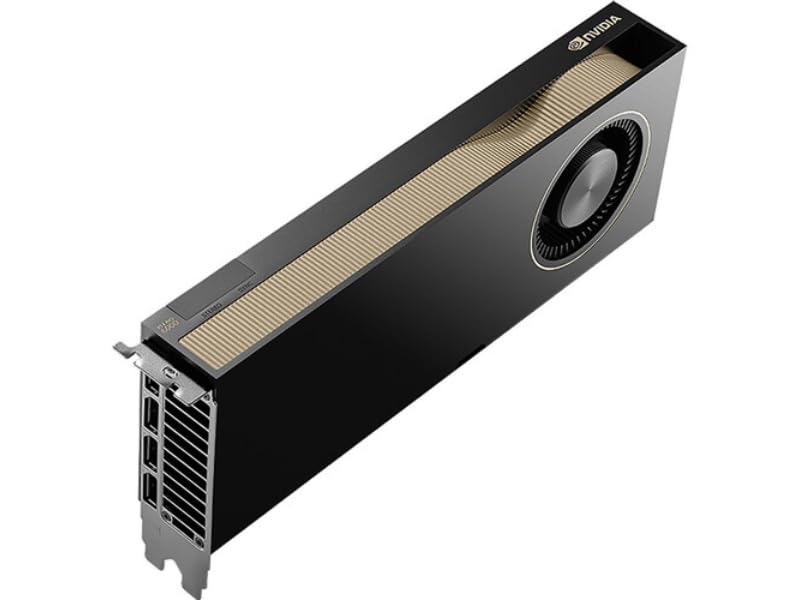
In the previous generation, we were happy with 48GB. But as Large Language Models (LLMs) push past the trillion-parameter mark, the PNY Technology VCNRTXPRO6000BQ-PB NVIDIA RTX PRO 6000 Blackwell Max-Q Workstation Graphics Card and its 96GB of VRAM have become the new baseline for serious LLM fine-tuning.
Doubling the VRAM isn't just a vanity metric. It significantly alters your strategy for model parallelism. With 96GB per card, you can fit larger model chunks into a single GPU, reducing the frequency of inter-GPU communication and effectively bypassing some of the latency bottlenecks inherent in multi-node training. However, these cards are power-dense. Even in "Max-Q" configurations, a multi-GPU Blackwell deployment requires a level of thermal management that would melt a standard office server room.
§100GbE networking: The NAS bottleneck
You cannot feed a Blackwell cluster with legacy 10GbE or even 25GbE networking. When your GPUs are processing data at the rates enabled by the Blackwell architecture, your storage backbone must be equally responsive.
For a multi-GPU deployment, 100GbE NAS connectivity is the required floor. High-density AI workstations like the BoxGPT AI Workstation are designed to utilize these high-speed lanes to prevent "GPU starvation"—a state where your $13,000 GPUs sit idle waiting for the next training batch to arrive from the network.
- Non-blocking Fabrics: Ensure your top-of-rack switches support 100GbE non-blocking throughput.
- RDMA over Converged Ethernet (RoCE): This is essential for Blackwell deployments to allow the GPUs to access remote storage memory directly without involving the host CPU.
- Storage Tiering: Use NVMe-over-Fabrics (NVMe-oF) to ensure your 100GbE pipe stays saturated with high-IOPS data.
§High-density RAM scaling and the CPU balance
While the GPU does the heavy lifting, enterprise AI scaling infrastructure relies heavily on the supporting system RAM. We see a lot of labs make the mistake of pairing a PNY Technology VCNRTXPRO6000BQ-PB NVIDIA RTX PRO 6000 Blackwell Max-Q Workstation Graphics Card with insufficient system memory.
A general rule of thumb for 2026 is a 2:1 or 3:1 ratio of System RAM to VRAM. If you’re running dual Blackwell cards (192GB total VRAM), your system should ideally have at least 256GB to 512GB of ECC DDR5. The Cloud Ninjas Iron Bull AI Workstation and the NOVATECH Apex WS9985X both utilize 256GB of high-speed DDR5 to ensure the CPU can manage data preprocessing and orchestration without stumbling.
§Comparing enterprise GPU options
Not every node needs the 96GB flagship. Understanding where the older Ampere and Ada Lovelace architectures fit can save your budget while you scale.
| GPU Model | Architecture | VRAM | Best Use Case |
|---|---|---|---|
| NVIDIA RTX PRO 6000 Blackwell | Blackwell | 96GB | Massive LLM Fine-tuning & 3D GenAI |
| NVIDIA A100 80GB | Ampere | 80GB | High-bandwidth legacy scientific compute |
| NVIDIA RTX 6000 ADA | Ada Lovelace | 48GB | Mid-range inference and CAD |
| RTX 5090 32GB | Blackwell (Consumer) | 32GB | Local prototyping and VFX |
§Thermal management for Blackwell clusters
Blackwell’s compute capability comes with a significant thermal cost. If you're building a multi-node rack, you need to look at your CFM (Cubic Feet per Minute) airflow ratings. Standard server fans often can't pull enough air through the dense fins of a four-GPU setup.
For enterprise environments, we're seeing a shift toward Rear Door Heat Exchangers (RDHx) or direct-to-chip liquid cooling. If you are sticking to air cooling, ensure your rack spacing follows the "Hot Aisle/Cold Aisle" containment protocol perfectly. Even a BoxGPT AI Workstation, which is optimized for professional use, deserves clear intake paths to keep those Blackwell chips from thermal throttling during a 48-hour training run. Check our benchmarks to see how heat affects training throughput over time.
§Physical infrastructure ROI
Why spend $13k on a PNY Technology VCNRTXPRO6000BQ-PB NVIDIA RTX PRO 6000 Blackwell Max-Q instead of four cheaper consumer cards?
- Space Efficiency: You get 96GB in a single slot. This allows you to pack more compute into fewer racks, saving on data center floor space and power distribution costs.
- Reliability: Enterprise cards like the A100 80GB and the Blackwell Pro series are rated for 24/7 operation with long-term driver support.
- Memory Density: Many state-of-the-art models simply will not fit on 32GB or 48GB cards without massive quantization, which can degrade the model's intelligence.
FAQ
What is the power requirement for a multi-Blackwell rack?
A typical 8-GPU Blackwell node can draw upwards of 5kW to 8kW under peak load. Most enterprise AI scaling infrastructure requires 208V or 240V circuits; standard 120V wall outlets are insufficient for professional AI workstations or clusters.
Can I mix Blackwell and Ada Lovelace GPUs in the same cluster?
While possible via certain software orchestrators, it's highly discouraged for training. The differences in VRAM (96GB vs 48GB) and interconnect speeds will cause "straggler" issues, where the faster Blackwell chips idle while waiting for the Ada cards to catch up.
Why is 100GbE necessary for 96GB VRAM cards?
As VRAM size increases, the datasets loaded into that VRAM also grow. A 10GbE connection would take nearly 80 seconds just to fill the VRAM of a single Blackwell card once. 100GbE reduces this to a few seconds, allowing for frequent checkpointing and rapid data shuffling essential for distributed training.
§Bottom line
Scaling Enterprise AI in 2026 isn't just about buying the most expensive GPU; it’s about building an ecosystem that lets that GPU breathe and stay fed with data. The PNY Technology VCNRTXPRO6000BQ-PB NVIDIA RTX PRO 6000 Blackwell Max-Q is a beast of a card, but it's only as good as your 100GbE fabric and your thermal management strategy. Invest in high-density AI workstations from trusted builders and ensure your physical facility is ready for the heat.
Heads up: AI Hardware Hub may earn a commission when you buy through links on this page. We only recommend gear we'd run ourselves.