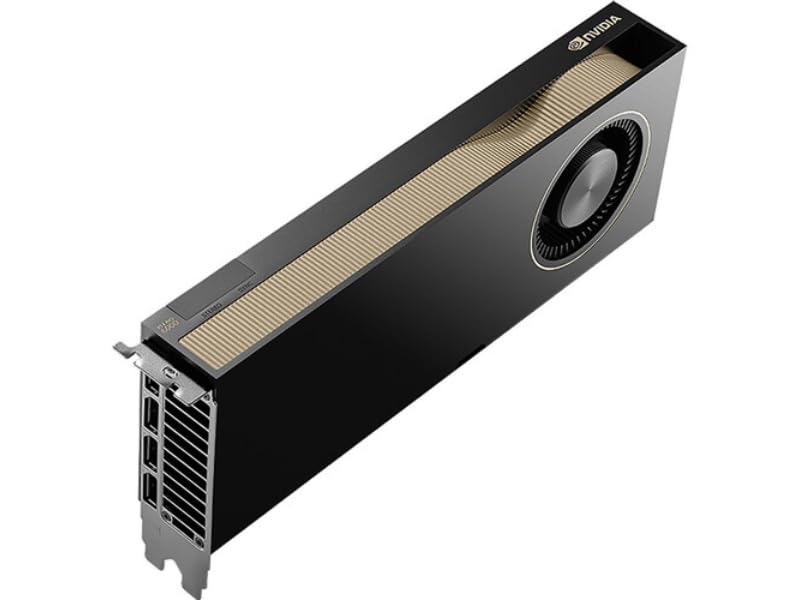
In the high-stakes world of enterprise AI, the GPU often gets all the glory, but it’s the "data pipe" that determines whether your cluster actually delivers or just sits idle. As we scale into 2026, the transition to Blackwell-based architectures has shifted the bottleneck from pure FLOPs to data movement efficiency. If your infrastructure can't feed a PNY Technology VCNRTXPRO6000BQ-PB NVIDIA RTX PRO 6000 Blackwell Max-Q Workstation Graphics Card at line speed, you’re essentially paying a premium for hardware to wait on slow storage.
The secret to maximizing ROI in modern distributed training environments lies in two pillars: massive system-side RAM for dataset caching and 100GbE (or faster) NAS integration to eliminate I/O wait times.
Heads up: AI Hardware Hub may earn a commission when you buy through links on this page. We only recommend gear we'd run ourselves.
§The Blackwell tax: Why your networking is suddenly too slow
NVIDIA’s Blackwell architecture has redefined the memory wall. With cards like the PNY Technology VCNRTXPRO6000BQ-PB NVIDIA RTX PRO 6000 Blackwell Max-Q Workstation Graphics Card boasting 96GB of VRAM, the sheer volume of data required to keep these units saturated during a training run is immense. In a distributed environment, you aren't just moving weights; you're shuffling multi-terabyte datasets across the fabric.
Standard 10GbE networking is no longer a viable option for labs running more than two nodes. At 1.25 GB/s theoretical maximum, a 10GbE link would take hours just to move a mid-sized checkpoint. To truly unlock the potential of AI workstations, a 100GbE backbone is the baseline. This allows for RDMA (Remote Direct Memory Access) protocols, which let the GPU pull data directly from the NAS without burdening the host CPU.
§Dense system RAM as a local buffer
While VRAM is where the magic happens, system RAM (DDR5) acts as the staging area. For datasets that exceed the 96GB limit of even the best Blackwell cards, high-density system RAM prevents constant, expensive round-trips to the NAS.
Systems like the BoxGPT AI Workstation, RTX PRO 6000 Blackwell, 96GB VRAM, Ryzen 9900X, 256GB DDR5, 2TB NVMe are popular because they balance GPU power with 256GB of local DDR5. This allows the OS to cache significant portions of the training set in memory. If your budget allows for higher-tier builds, moving to the NOVATECH Apex WS9985X AI Workstation provides a 64-core Threadripper Pro foundation, which is essential for handling the massive PCIe lane count needed for dual 100GbE NICs and quad-GPU configurations.
Memory and Storage Scaling Requirements
- RAM-to-VRAM Ratio: Aim for at least 2:1. If you run 192GB of VRAM, you need 384GB+ of system memory.
- Network Fabric: 100GbE RoCE v2 is the sweet spot for 2026 lab deployments.
- Storage Tiering: NVMe-over-Fabrics (NVMe-oF) is required to prevent the "I/O Wait" state in training logs.
- CPU Cache: Threadripper Pro's massive L3 cache helps significantly with data preprocessing before it hits the AI GPUs.
§Comparing enterprise workstation foundations
When scaling a training lab, the choice of chassis and motherboard platform determines your ceiling for networking and RAM expansion.
| Workstation Model | CPU Platform | Max GPU Potential | Default RAM | Primary Use Case |
|---|---|---|---|---|
| BoxGPT Blackwell | Ryzen 9900X | Single/Dual Blackwell | 256GB DDR5 | Local LLM Dev |
| Cloud Ninjas Iron Bull | Threadripper 9960X | Multi-GPU | 256GB ECC | VFX & Training |
| NOVATECH Apex WS9985X | Threadripper PRO 9985WX | High-Density Compute | 256GB DDR5 | Enterprise Lab Node |
§The ROI of 100GbE and Enterprise Storage Networking
For a CTO, the cost of a 100GbE switch and the associated fiber transceivers can seem daunting. However, let’s look at the math for a 4-node cluster. If your researchers spend 20% of their time waiting for data to sync across nodes or for checkpoints to save, you're losing one full day of productivity per week, per person.
By integrating a 100GbE NAS with workstations like the Cloud Ninjas Iron Bull, you eliminate the storage bottleneck. In many benchmarks, moving from 10GbE to 100GbE reduces inter-node synchronization time by up to 8x for large-batch gradient updates.
§Transitioning from Ampere and Ada
If you are still running A100 80GB Graphics Cards, you've likely noticed the 400W+ power draw and the reliance on HBM2e. While still capable, these units lack the transformer-engine optimizations found in the Blackwell series. Similarly, the PNY NVIDIA RTX 6000 ADA was a workhorse for its era, but its 48GB VRAM is now considered "entry-level" for serious enterprise LLM fine-tuning.
Moving to the PNY Technology VCNRTXPRO6000BQ-PB NVIDIA RTX PRO 6000 Blackwell Max-Q Workstation Graphics Card doubles your VRAM per slot, which simplifies the networking requirement because more of the model stays on-card. However, the data you do have to move now moves in larger chunks, reinforcing the need for that 100GbE backbone.

§Final considerations for lab managers
Building a high-density environment isn't just about picking the fastest card. It's about ensuring the PCIe lanes on your motherboard can support both the GPUs and the high-speed networking cards.
- Power Budgeting: Ensure your racks can handle the 1600W+ draw of units like the Cloud Ninjas Iron Bull.
- Thermal Load: High-density RAM generates significant heat. In 2026, airflow management in AI workstations is as critical as GPU cooling.
- Software Stack: Systems pre-configured with the latest drivers for Blackwell, such as the BoxGPT AI Workstation, save weeks of engineering time.
FAQ
Why do I need 100GbE for AI storage networking?
Standard networking creates a "starvation" scenario where the GPU finishes a computation and has to wait for the next batch of data to arrive over the network. 100GbE, especially with RDMA, allows the storage to feed the GPU at its native speed.
Can I mix A100 and Blackwell cards in the same cluster?
Yes, but it’s not recommended for a single distributed training job. The different VRAM capacities (80GB on the A100 80GB vs 96GB on the Blackwell RTX 6000) and different architectures will lead to synchronization delays where the faster cards wait for the slower ones.
Is 256GB of system RAM enough for 2026 workloads?
For single-node development, 256GB is the current standard. However, for multi-GPU systems utilizing the full 192GB+ of VRAM, we recommend scaling system RAM to 512GB or 1TB to maintain a healthy cache ratio for the dataset.
§Verdict
Enterprise AI in 2026 demands a holistic approach to hardware. If you’re investing $13k+ into a PNY Technology VCNRTXPRO6000BQ-PB NVIDIA RTX PRO 6000 Blackwell Max-Q Workstation Graphics Card, don't handicap it with a legacy 10GbE network or skimpy system RAM. High-density workstations like the NOVATECH Apex WS9985X provide the necessary foundational "heft" to actually use the compute power you're paying for.
Heads up: AI Hardware Hub may earn a commission when you buy through links on this page. We only recommend gear we'd run ourselves.