The release of state-of-the-art (SOTA) models like Llama-4 and the latest DeepSeek iterations has shifted the hardware conversation from raw compute to memory bandwidth. For ML engineers, the choice between GDDR7-based consumer cards and HBM3e enterprise silicon isn't just about price; it's about whether your model will bottleneck at the memory bus or the tensor cores. If you're building local coding agents or fine-tuning vision-language models, understanding the GDDR7 vs HBM3e AI inference trade-off is the difference between 5 tokens per second and a fluid 80.
Heads up: AI Hardware Hub may earn a commission when you buy through links on this page. We only recommend gear we'd run ourselves.
§The memory bottleneck in 2026
Inference for Large Language Models (LLMs) is fundamentally memory-bound. While the floating-point performance of modern GPUs is staggering, the chip must move model weights from memory to the processor for every single token generated.
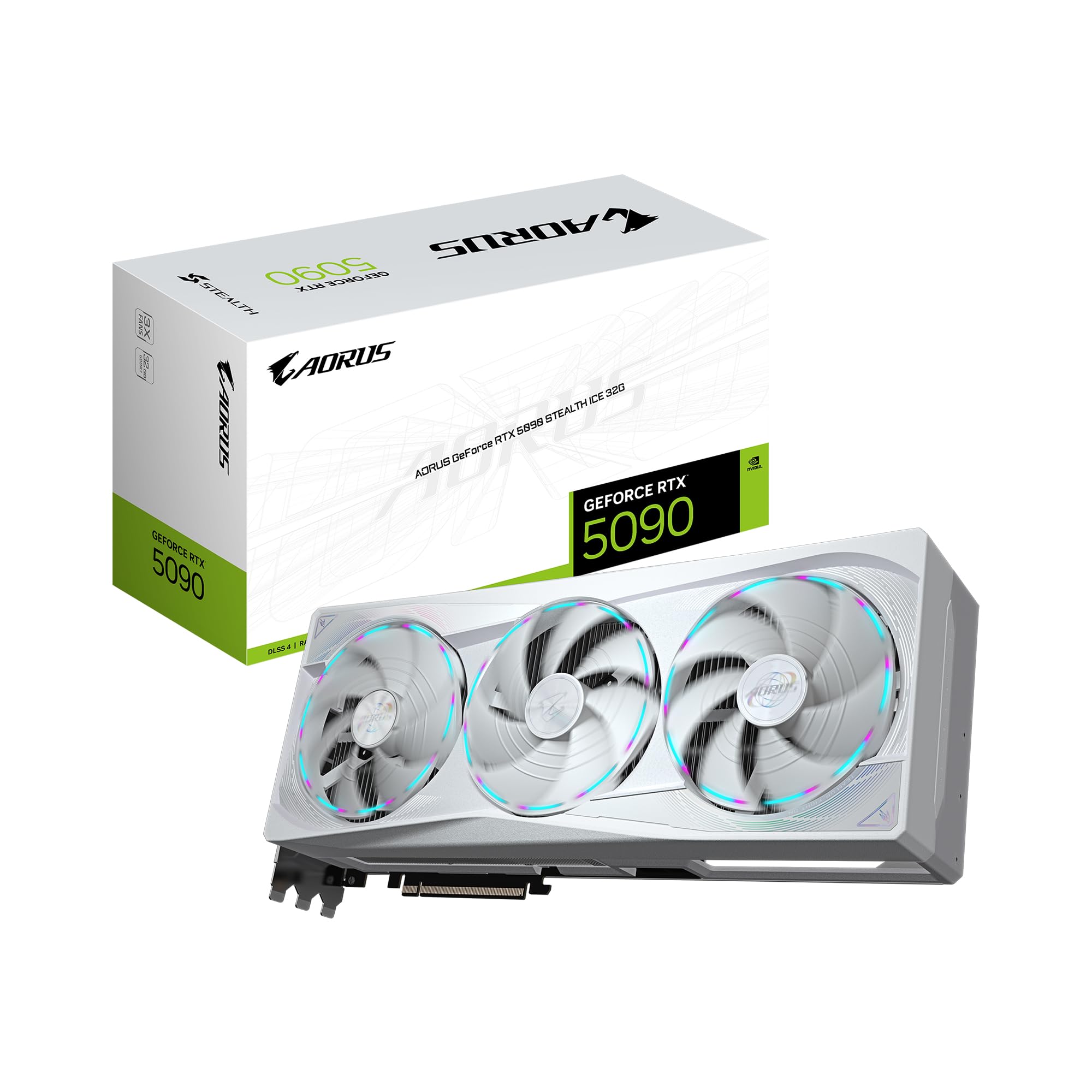
GDDR7, found in the latest consumer flagships like the GIGABYTE AORUS GeForce RTX 5090 Stealth ICE 32G Graphics Card, offers a substantial leap over previous generations, hitting bandwidth speeds near 1.5 TB/s. However, enterprise-grade HBM3e (High Bandwidth Memory) systems, typically found in AI workstations or data center units, can exceed 4 TB/s. When running a massive model like a 400B Llama-4 variant, that delta determines if the model is usable in real-time or relegated to batch processing.
§GDDR7: The cost-effective quantization king
For most independent ML engineers and small labs, GDDR7 is the sweet spot. The introduction of the GIGABYTE AORUS GeForce RTX 5090 Stealth ICE 32G Graphics Card has democratized high-speed inference.
With 32GB of VRAM, you can run a 70B model at 4-bit quantization (using GGUF or EXL2 formats) with room to spare for a decent context window. The "Stealth ICE" design focus on thermal management is critical here; GDDR7 runs hot, and thermal throttling is the silent killer of benchmarks.
Key advantages of GDDR7 for AI:
- Availability: You can buy these cards off the shelf without enterprise contracts.
- Clock Speeds: Higher effective memory clocks help with smaller, latency-sensitive tasks.
- Form Factor: Standard PCIe slots mean you can build a multi-GPU rig in a standard mid-tower.
§HBM3e and the multi-GPU enterprise advantage
When you step into the territory of models that cannot fit on a single consumer card without aggressive quantization—think DeepSeek-V3 or full-precision Llama-4—HBM3e becomes mandatory.
The PNY Technology VCNRTXPRO6000BQ-PB NVIDIA RTX PRO 6000 Blackwell Max-Q Workstation Graphics Card is a prime example of this professional tier. With 96GB of VRAM, it allows you to load larger model shards and keep them "close" to the compute. While the Pro 6000 focuses on capacity, the underlying HBM architectures in the broader Blackwell data center line provide the massive overhead needed for concurrent user requests.
If you don't want to deal with the intricacies of cooling and power delivery yourself, pre-built solutions like the BoxGPT AI Workstation, RTX PRO 6000 Blackwell, 96GB VRAM, Ryzen 9900X, 256GB DDR5, 2TB NVMe offer an out-of-the-box environment specifically tuned for local LLM development.
§Comparison: GDDR7 vs HBM3e for Inference
| Feature | GDDR7 (Consumer/Prosumer) | HBM3e (Enterprise/SOTA) |
|---|---|---|
| Example GPU | RTX 5090 32GB | RTX PRO 6000 Blackwell |
| Typical Bandwidth | 1.2 - 1.8 TB/s | 3.5 - 4.8+ TB/s |
| Max Capacity | 32GB (per card) | 80GB - 192GB+ |
| Power Target | High (450W+) | Optimized for Efficiency |
| Best Use Case | Quantized 70B inference, fine-tuning | Full-precision SOTA, Multi-user API |
§Quantization trade-offs: FP8 vs. INT4
The "hidden" factor in the GDDR7 vs HBM3e AI inference battle is quantization. On a consumer card with 32GB, you are almost always running in 4-bit or 8-bit. While modern techniques like AWQ and OmniQuant minimize perplexity loss, there is still a noticeable "intelligence" dip compared to FP16 or FP8.
HBM3e-equipped cards, like the A100 80GB Graphics Card - 80 GB HBM2e ECC, though an older generation, still hold their own because the 80GB of ECC HBM memory allows for significantly higher precision levels on medium-sized models. However, for 2026 workflows, the Blackwell-based BoxGPT AI Workstation, RTX PRO 5000 Blackwell, 48GB VRAM, Ryzen 9700X, 64GB DDR5, 2TB NVMe is the smarter professional entry point, giving you the architecture shift needed for the latest inference kernels.
§Scaling your local AI lab
If you're building a rig today, you have to decide: do you buy three consumer cards or one enterprise beast?
- The Parallel Path: Three RTX 5090s give you 96GB of GDDR7 VRAM. You get massive raw throughput for fractionated models, but you'll fight with PCIe lane bottlenecks and massive heat.
- The Unified Path: A single RTX PRO 6000 Blackwell or a dedicated system like the BoxGPT AI Workstation. This is the cleaner, more reliable way to run DeepSeek level models without the headache of consumer-grade thermal throttling.
§FAQ
Is GDDR7 fast enough for real-time Llama-4 inference?
Yes, for quantized versions (4-bit or 8-bit). A single RTX 5090 can handle a 70B model at very usable speeds, but for the 400B+ flagship models, you'll need the bandwidth and capacity of HBM3e or a multi-GPU Blackwell workstation.
Why is HBM3e so much more expensive than GDDR7?
HBM3e uses 3D-stacked DRAM directly on the GPU die package. This requires sophisticated manufacturing (TSMC's CoWoS) and offers much higher energy efficiency and data throughput than GDDR7, which sits on the PCB surrounding the chip.
Can I mix GDDR7 and HBM3e GPUs in the same workstation?
Technically, yes, but it’s a headache. Most inference engines will default to the slowest common denominator in terms of speed if you're spanning a model across both. It's generally better to stick to one architecture for your AI GPUs to ensure predictable latency.
§Bottom line
If your goal is to experiment, fine-tune smaller models, or run 70B coding assistants, the GDDR7 found in the GIGABYTE AORUS GeForce RTX 5090 Stealth ICE 32G Graphics Card is the best value per dollar.
However, if you are a professional ML engineer deploying local SOTA models (Llama-4 400B+, DeepSeek-V3) for enterprise use, the HBM3e advantage is undeniable. Investing in a BoxGPT AI Workstation with dual RTX PRO 6000 Blackwell GPUs ensures you aren't just running the models, but running them at the precision and speed your workflow demands.
Heads up: AI Hardware Hub may earn a commission when you buy through links on this page. We only recommend gear we'd run ourselves.