The release of Llama-4 and the DeepSeek-V3 variants has fundamentally shifted the baseline for local machine learning. As we move deeper into 2026, the architectural divide between consumer GDDR7 and enterprise HBM3e (High Bandwidth Memory) has become the primary bottleneck for engineers trying to run these massive weights locally. If you're building a rig today, your choice isn't just about speed—it's about whether your model fits in memory at all, or if you're forced into aggressive quantization that might degrade reasoning capabilities.
Heads up: AI Hardware Hub may earn a commission when you buy through links on this page. We only recommend gear we'd run ourselves.
§The VRAM crunch: Llama-4 and DeepSeek-V3 requirements
Llama-4’s mid-tier dense models and DeepSeek-V3’s Mixture-of-Experts (MoE) architecture present a unique challenge. While MoE models are computationally "sparse"—meaning they don't fire every parameter for every token—they still require the entire model to reside in VRAM to avoid crippling PCIe latency.
On consumer hardware like the MSI Gaming RTX 5080 16G Ventus 3X OC White Graphics Card or the ASUS SFF-Ready Prime NVIDIA GeForce RTX 5070 Ti 16GB GDDR7 Graphics Card, the 16GB limit is a hard ceiling. Even with 4-bit quantization (GGUF or EXL2), a 70B parameter model simply won't fit. You're left with two choices: aggressive 2-bit quantization—which often turns sophisticated reasoning into word salad—or stepping up to specialized hardware.
§GDDR7 vs HBM3e: More than just capacity
The technical gap between these memory types is widening. GDDR7, featured on the new Blackwell consumer cards, offers a massive bandwidth leap over the previous generation, but it’s still optimized for high-frequency bursts typical of gaming. HBM3e, found in enterprise systems like the ASUS Dual AMD EPYC 9004 Series 4U GPU Server (ESC8000A-E12P), uses a 3D-stacked architecture that places the memory directly on the GPU die.
The implications for AI are twofold:
- Energy Efficiency: HBM3e consumes significantly less power per gigabyte transferred, allowing enterprise cards to maintain massive buffers without exceeding thermal limits.
- Throughput: For long-context window tasks (like analyzing a 100,000-line codebase in Llama-4), the 1.2 TB/s+ bandwidth of HBM3e prevents the "context wall" where inference speed drops to single-digit tokens per second.
§Navigating the 16GB-32GB GDDR7 limits
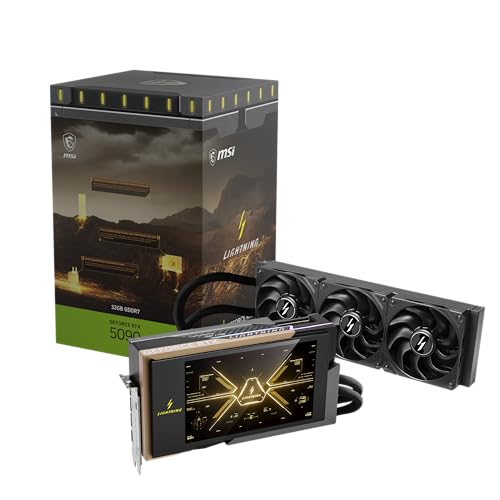
For many local ML engineers, the MSI Gaming RTX 5090 32G Lightning Z Graphics Card is the "Goldilocks" zone. With 32GB of GDDR7, it can comfortably run Llama-4 70B at Q3_K_M quantization or the smaller DeepSeek variants with room for a sizeable KV cache.
However, if you're looking at a pre-built solution for a lab or a startup, the NOVATECH Apex WS9965X AI Workstation offers a professional entry point, though its single RTX 5080 (16GB) makes it better suited for fine-tuning smaller 8B / 14B models rather than running the "frontier" weights.
§The Workstation workaround: Unified buffers
If you need to run DeepSeek-V3 or Llama-4 at higher precision (FP16 or 8-bit), consumer cards won't cut it. This is where the Blackwell-pro line enters the frame. The PNY Technology VCNRTXPRO6000BQ-PB NVIDIA RTX PRO 6000 Blackwell Max-Q delivers a staggering 96GB of VRAM.
This isn't just about "more" memory; it's about a single, unified address space. When you can fit the entire weights of a DeepSeek-V3 MoE model into 96GB, you eliminate the need for multi-GPU orchestration layers like DeepSpeed, which add complexity and latency.
Comparison: VRAM Capacity vs AI Utility
| GPU / System | VRAM | Memory Type | Best Use Case |
|---|---|---|---|
| RTX 5070 Ti | 16GB | GDDR7 | 8B-14B models, RAG dev |
| RTX 5090 Lightning Z | 32GB | GDDR7 | 70B models (quantized) |
| RTX 6000 Ada | 48GB | GDDR6 | Professional multi-model pipelines |
| RTX PRO 5000 Blackwell | 48GB | GDDR7 | Next-gen professional inferencing |
| RTX PRO 6000 Blackwell | 96GB | GDDR7 | Full 70B-400B Model Inference |
§When to go Enterprise: The H200 Edge
For researchers pushing the boundaries of what local hardware can do, the jump to HBM3e is inevitable. Systems like the ASUS Dual AMD EPYC 9004 Series 4U GPU Server utilize NVIDIA H200 NVL 141GB GPUs.
With 141GB of HBM3e per card, you are no longer playing the quantization game. You can run models at BF16 precision, which is critical if you are training or fine-tuning. Consumer GDDR7 cards, while fast, simply cannot compete with the massive memory bus and reliability of these enterprise units in a 24/7 AI workstations environment.
§Pre-configured solutions: BoxGPT vs DIY
Building a Blackwell rig from scratch is a headache for those who want to code rather than troubleshoot Linux drivers. Companies like BoxGPT have filled this gap. The BoxGPT AI Workstation with RTX PRO 6000 Blackwell is a "turnkey" solution that ships with 96GB of VRAM and pre-installed tools like Ollama and ComfyUI.
If that's overkill for your budget, the BoxGPT AI Workstation with RTX PRO 5000 Blackwell offers 48GB of VRAM. It’s slightly more than the older PNY NVIDIA RTX 6000 ADA in terms of architectural efficiency, making it the sweet spot for developers working on Llama-4's 70B variant.
Why ML Engineers are choosing Blackwell Workstations:
- Driver Stability: Professional drivers are validated for CUDA kernels used in PyTorch and JAX.
- Thermal Design: Blow-style fans or advanced cooling allow for 100% duty cycles during training.
- ECC Memory: Error-correcting code memory is standard on cards like the RTX PRO 6000, preventing bit-flips during long inference runs.
§The Bottom Line
The "compatibility gap" is really a memory gap. If you’re a hobbyist or early-stage dev, the RTX 5090 32GB is your ticket to the Llama-4 ecosystem, provided you're comfortable with benchmarks showing some loss in reasoning at lower bitrates.
But for professionals, the math has changed. The massive VRAM pools of Blackwell workstation cards like the 96GB PRO 6000 are no longer a luxury—they are a requirement for running DeepSeek-V3 and Llama-4 without architectural compromise.
FAQ
Can I run Llama-4 on a 16GB RTX 5080?
Yes, but only the smaller parameter variants (likely 8B or 14B). To run the larger 70B models, you would need to use extremely high levels of quantization (2-bit), which significantly reduces the model's intelligence and ability to follow instructions.
Why is HBM3e better than GDDR7 for AI?
While GDDR7 is incredibly fast, HBM3e offers significantly higher memory bandwidth and better energy efficiency. In AI tasks, moving data from memory to the processor is often the bottleneck; HBM3e’s 3D-stacked design allows for much wider data paths, which is essential for large language model inference.
Is it worth buying an RTX 6000 Ada in 2026?
The PNY NVIDIA RTX 6000 ADA remains a powerhouse with 48GB of VRAM. However, with the arrival of Blackwell-based AI GPUs, the newer Blackwell Pro cards offer better energy efficiency and higher peak throughput for the latest FP8 transformer kernels used in Llama-4.
Heads up: AI Hardware Hub may earn a commission when you buy through links on this page. We only recommend gear we'd run ourselves.