The release of Llama-4 and the newest DeepSeek iterations has shifted the bottleneck for AI engineers from compute FLOPS to the "Quantization Gradient." To run these massive models locally, you’re now forced to choose between the blistering speed of GDDR7 consumer cards and the massive, high-bandwidth memory (HBM3e) found in enterprise glass. Whether you should lean into aggressive 4-bit compression on a consumer flagship or invest in a 96GB Blackwell workstation depends entirely on your tolerance for perplexity loss.
Heads up: AI Hardware Hub may earn a commission when you buy through links on this page. We only recommend gear we'd run ourselves.

§The GDDR7 revolution in consumer silicon
In 2026, GDDR7 has officially replaced GDDR6X as the standard for enthusiast hardware. With bandwidth exceeding 1.5 TB/s on top-tier cards, the latency for token generation is lower than ever. However, the capacity remains the sticking point for LLMs.
The ASUS ROG Astral NVIDIA GeForce RTX 5090 32GB GDDR7 OC Edition Gaming Graphics Card is the gold standard for high-speed, quantized inference. With 32GB of VRAM, you can run a 70B parameter model, provided you’re willing to use 3-bit or 4-bit quantization (GGUF or EXL2). While the speed is incredible, the "quantization tax" is real—expect a slight but measurable increase in perplexity compared to the original FP16 weights.
For those on a tighter budget or building multi-GPU setups, the ASUS ROG Astral NVIDIA GeForce RTX 5080 16GB GDDR7 White OC Edition offers a gateway into the GDDR7 ecosystem. While 16GB is tight for Llama-4 70B, it is a powerhouse for the smaller 8B or 14B "distilled" variants that many developers use for RAG (Retrieval-Augmented Generation) pipelines.
§HBM3e and the Blackwell workstation leap
If you’re moving beyond simple inference into fine-tuning or running Llama-4 at FP16/BF16 precision, GDDR7 cards won't cut it. This is where the Blackwell architecture and HBM3e (High Bandwidth Memory) change the game. HBM3e doesn't just offer more bandwidth; it offers the massive address space required for large context windows.
The PNY Technology VCNRTXPRO6000BQ-PB NVIDIA RTX PRO 6000 Blackwell Max-Q Workstation Graphics Card packs a staggering 96GB of VRAM. This allows you to load Llama-4 high-parameter models almost entirely in their native precision.
Why VRAM capacity actually matters for 2026 models:
- Context Window Inflation: As context windows expand to 128k or 1M tokens, the KV cache alone can consume 20GB+ of VRAM.
- Lossless Reasoning: DeepSeek’s latest MoE (Mixture of Experts) models are notoriously sensitive to quantization; keeping them in FP16 ensures the "expert" weights aren't degraded.
- Multi-Model Pipelines: Real-world AI agents often run an LLM, a vision model, and an embedding model simultaneously. A 96GB buffer allows for this without constant swapping to system RAM.
§GDDR7 vs HBM3e for Llama-4: Architecture comparison
| Feature | GDDR7 (RTX 5090/5080) | HBM3e (Blackwell Workstation) | HBM3e (Enterprise H200) |
|---|---|---|---|
| Typical Capacity | 16GB - 32GB | 48GB - 96GB | 141GB+ |
| Max Bandwidth | ~1.8 TB/s | ~2.5+ TB/s | 4.8 TB/s |
| Best Llama-4 Use Case | 4-bit Quantized Inference | FP16 Inference / LoRA Tuning | Full Fine-Tuning / Enterprise API |
| Cooling | Active (Quad-fan) | Active (Blower/Max-Q) | Passive (Server Rack) |
§Choosing the right workstation platform
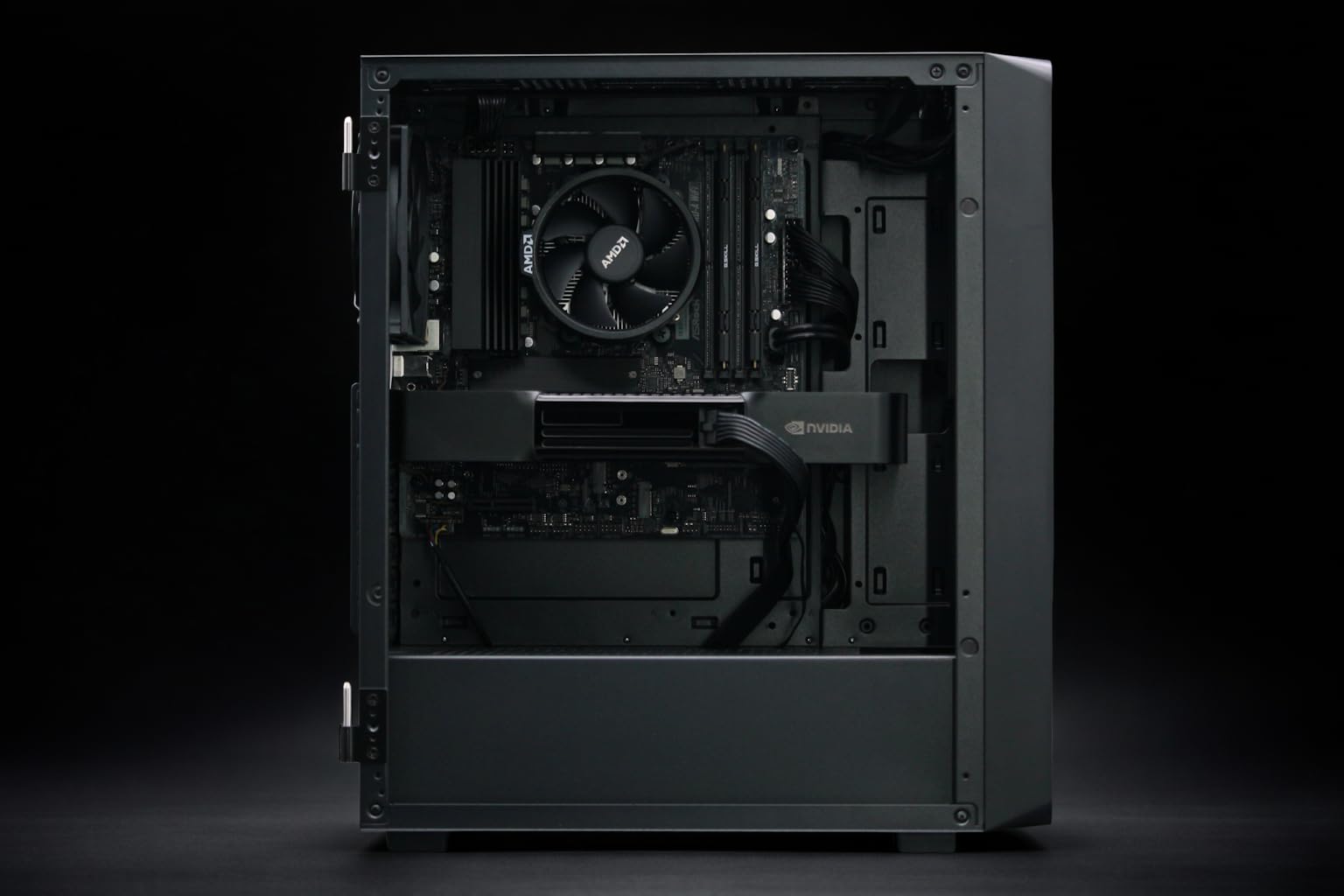
For engineers who don't want to build from scratch, pre-configured workstations have become the preferred way to access Blackwell. If you need a balanced machine for both coding and local inference, the BoxGPT AI Workstation, RTX PRO 5000 Blackwell, 48GB VRAM, Ryzen 9700X, 64GB DDR5, 2TB NVMe is an excellent middle ground. Its 48GB buffer is significantly more versatile than consumer cards for development.
However, if your goal is local sovereignty—running the most capable models without an internet connection at peak performance—the BoxGPT AI Workstation, RTX PRO 6000 Blackwell, 96GB VRAM, Ryzen 9900X, 256GB DDR5, 2TB NVMe is the ultimate desktop platform. Two Blackwell units working in NVLink-sync can handle almost any open-weights model currently on benchmarks.
§Professional vs. Consumer: The "Ada" legacy
It's worth noting that the older Ada Lovelace architecture still holds a place in the market for specific niches. The PNY NVIDIA RTX 6000 ADA with 48GB of GDDR6 is now a "value" play for those who need capacity but can't justify the jump to Blackwell pricing. It's often found in systems like the NOVATECH Apex WS9965X AI Workstation & Gaming PC, though newer builds are rapidly transitioning to the NVIDIA RTX PRO 5000 series.
§Moving to the Enterprise Tier
When 96GB still isn't enough, you’re looking at the ASUS Dual AMD EPYC 9004 Series 4U GPU Server (ESC8000A-E12P) with 2x NVIDIA H200 NVL 141GB GPUs. Here, HBM3e is exploited to its fullest. With 141GB per GPU, this system is designed for multi-user inference or training massive DeepSeek datasets. The jump in price is significant, but for startups building their own proprietary models, the H200 NVL is the definitive enterprise silicon.
Frequently Asked Questions
Is GDDR7 enough for Llama-4 70B?
Yes, but only via quantization. A Llama-4 70B model in 4-bit precision requires roughly 35-40GB of VRAM (including KV cache). You would need at least 2x RTX 5090 32GB or a single RTX PRO 6000 Blackwell for a smooth experience.
What is the advantage of Blackwell over Ada for AI?
The Blackwell architecture, used in the RTX PRO 6000 Blackwell, offers native support for FP4 and enhanced Transformer Engines. This allows for faster throughput on the specific arithmetic used by Llama-4 and DeepSeek models compared to the older RTX 6000 ADA.
Can I run DeepSeek MoE models on a consumer workstation?
DeepSeek's Mixture of Experts (MoE) models can be run on high-end consumer gear, but they are bandwidth-hungry. While a RTX 5080 16GB can handle smaller versions, the larger MoE models typically require the 48GB to 96GB capacity found in Professional Workstations to avoid extreme degradation in reasoning capabilities.
§Verdict: Which architecture wins?
The "winner" depends on your role in the stack.
If you are an App Developer or an AI Enthusiast primarily using models as a tool, stick with GDDR7. The ASUS ROG Astral RTX 5090 32GB delivers more than enough raw speed to power a local agent, provided you use optimized quantization libraries.
If you are an ML Engineer or Researcher building the models themselves, you need HBM3e / Blackwell. The 96GB VRAM on the RTX PRO 6000 is more than just a luxury; it’s a functional requirement for working with unquantized weights and large context windows. Don't settle for 32GB if your goal is to push the boundaries of what Llama-4 can do locally.
Heads up: AI Hardware Hub may earn a commission when you buy through links on this page. We only recommend gear we'd run ourselves.