
The arrival of Llama-4 has fundamentally shifted the hardware conversation from raw TFLOPS to memory architecture efficiency. While Blackwell-based consumer cards now offer blistering compute speeds, the real bottleneck for local inference remains the massive performance gap between GDDR7 and HBM3e. If you’re deciding between a multi-card msi Gaming RTX 5090 32G Gaming Trio OC Graphics Card cluster and an ASUS Dual AMD EPYC GPU Server with H200s, the "correct" choice depends entirely on whether your priority is 4-bit quantization throughput or full-precision reliability for RAG-augmented workflows.
Heads up: AI Hardware Hub may earn a commission when you buy through links on this page. We only recommend gear we'd run ourselves.
§The memory wall: Why HBM3e still reigns supreme
In 2026, the scaling laws for large language models haven't just demanded more VRAM; they've demanded faster access to it. The msi Gaming RTX 5090 32G Gaming Trio OC Graphics Card utilizes the new GDDR7 standard, which represents a massive leap over the previous generation. However, even with GDDR7's impressive bandwidth, it still operates on a fundamentally different plane than the High Bandwidth Memory (HBM3e) found in enterprise systems.
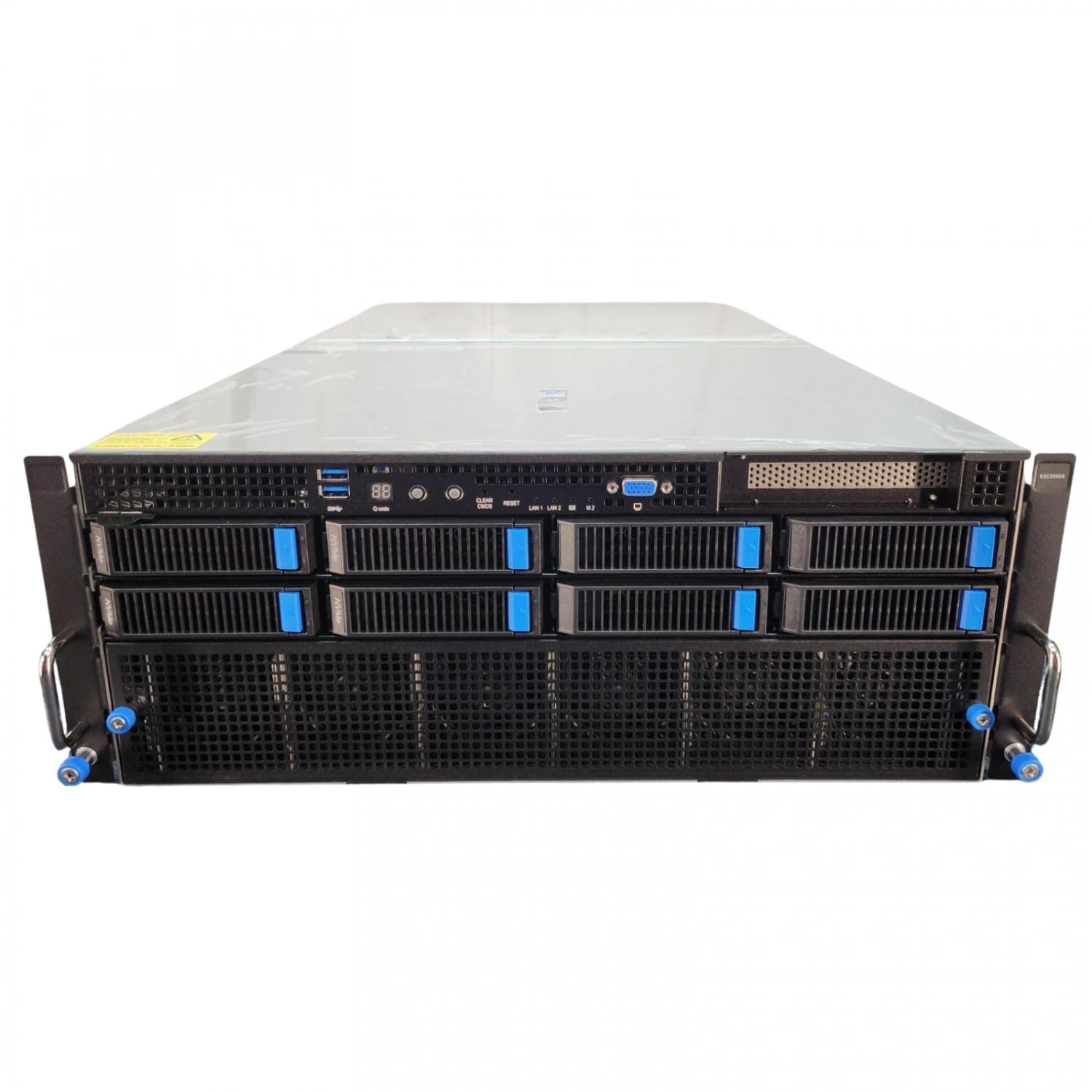
HBM3e, featured in the ASUS Dual AMD EPYC 9004 Series 4U GPU Server (ESC8000A-E12P) with 2x NVIDIA H200 NVL 141GB GPUs, places the memory stacks directly on the GPU package. This proximity enables the H200 to hit bandwidths exceeding 4.8 TB/s. For a model like Llama-4, where every token generated requires a full pass through the weights, this bandwidth advantage translates directly into lower latency. While a GDDR7-based system like the NOVATECH Apex WS9985X AI Workstation is a powerhouse, it is physically constrained by the traces on the PCB, creating a latency floor that HBM-based systems effortlessly clear.

§Local nodes: The multi-GPU 5090 math
For many ML engineers, the path to running Llama-4 locally involves stringing together multiple consumer cards to overcome the 32GB VRAM limit. A single ASUS ROG Astral NVIDIA GeForce RTX 5090 32GB GDDR7 OC Edition Gaming Graphics Card is impressive, but Llama-4's parameter count requires at least three to four of these cards to run in 4-bit quantization without severe offloading to system RAM.
When you scale to a multi-GPU setup, you introduce the "interconnect penalty." Unlike the H200 systems that use NVLink Switch fabrics, consumer workstations like the Cloud Ninjas Iron Bull AI Workstation rely on PCIe Gen 5. While PCIe 5.0 is fast, it remains a fraction of the speed of an HBM3e memory bus.
Wait, there’s an alternative: If you need significant VRAM without the $70k+ price tag of an H200 server, the PNY Technology VCNRTXPRO6000BQ-PB NVIDIA RTX PRO 6000 Blackwell Max-Q Workstation Graphics Card offers 96GB of VRAM. This allows you to fit larger chunks of Llama-4 on a single card, bypassing the interconnect bottleneck that plagues multi-5090 builds.
§Performance Comparison: GDDR7 vs. HBM3e architectures
| Feature | GDDR7 (RTX 5090) | HBM3e (H200 NVL) |
|---|---|---|
| Typical Bandwidth | ~1.5 - 1.8 TB/s | ~4.8 TB/s |
| Max Capacity per GPU | 32GB | 141GB |
| Bus Type | Discrete PCB Traces | On-package TSV |
| Ideal Use Case | 4-bit Quantization, Local Dev | Full-precision Inference, Fine-tuning |
| Cost (MSRP) | ~$4,500 | ~$35,000+ |
§Quantization: The great equalizer?
The "performance gap" isn't just about speed; it's about what you can fit in the pipe. Local ML engineers have become experts at squeezing models into consumer hardware using 4-bit and 6-bit quantization (GGUF/EXL2). Running Llama-4 on a BoxGPT AI Workstation with two RTX PRO 6000 Blackwells is a viable strategy because the 192GB of total VRAM allows for highly efficient quantized inference.
However, quantization comes with a "perplexity tax." While negligible for creative writing, it can be a dealbreaker for medical or legal agents. This is where the ASUS Dual H200 NVL Server shines. With 282GB of combined HBM3e memory, you can run Llama-4 at FP16 or BF16 precision, ensuring the highest possible accuracy without hitting the memory wall.
Why GDDR7 remains the "Value King" for local ML
- Availability: You can actually buy an ASUS ROG Astral RTX 5090 today without a corporate supply contract.
- Power Density: Modern Blackwell consumer cards have improved efficiency, making them easier to cool in a standard mid-tower.
- Versatility: The same hardware used for inference can double as a high-end dev machine for CUDA development and rendering.
- Price-to-VRAM: A quad-5090 setup provides 128GB of VRAM for roughly $18,000, significantly less than a single H200.
§Workstation vs. Server: Choosing your chassis
If you’ve decided on the consumer route, the chassis matters as much as the silicon. Blowout heat is the enemy of GDDR7. Systems like the NOVATECH Apex WS9985X utilize Threadripper PRO platforms to provide the necessary PCIe lanes to ensure every GPU has a direct x16 path to the CPU.
Contrast this with a "budget" AI build where users often mistakenly use consumer CPUs with limited PCIe lanes, forcing the GPUs to run at x8 or even x4. This chokes the GDDR7’s ability to swap data, effectively neutering the performance of a card like the msi Gaming RTX 5090. Check our latest benchmarks to see how lane saturation impacts tokens-per-second in Llama-4.
§The Bottom Line: Which should you buy?
If you are a startup building a production-grade API or a tool that requires zero-compromise precision, the ASUS H200 NVL Server is the only logical choice. The HBM3e bandwidth is a transformative experience for high-concurrency environments.
However, if you are an independent researcher or a developer focusing on local agentic workflows, the performance of GDDR7 in the Blackwell era is staggering. A high-end workstation like the BoxGPT AI Workstation, equipped with RTX PRO 6000 Blackwell units, offers the perfect middle ground between consumer flexibility and enterprise-grade VRAM capacity.
Heads up: AI Hardware Hub may earn a commission when you buy through links on this page. We only recommend gear we'd run ourselves.
FAQ
Can I run Llama-4 on a single RTX 5090?
It depends on the parameter count of the specific Llama-4 variant. For the smaller "8B" or "14B" versions, a single ASUS ROG Astral RTX 5090 32GB will provide incredibly fast inference. For the flagship models, you will need to utilize 4-bit quantization and likely a multi-GPU setup to avoid offloading to system RAM.
Is the PNY RTX 6000 Ada still worth it in 2026?
The PNY NVIDIA RTX 6000 ADA remains a solid choice for those who need 48GB of VRAM in a single-slot-friendly blower design. However, the newer RTX PRO 6000 Blackwell Max-Q offers double the VRAM (96GB), making it the superior "future-proof" option for SOTA models.
How much faster is HBM3e for Llama-4 compared to GDDR7?
In bandwidth-bound scenarios (standard inference), HBM3e is roughly 3x faster than GDDR7. This means if a Cloud Ninjas Iron Bull generates 15 tokens per second on a large model, an H200 system could theoretically hit 45-50 tokens per second for the same model at the same precision.
Verdict
For most local ML engineers, the msi Gaming RTX 5090 represents the hardware sweet spot. It brings 32GB of ultra-fast GDDR7 to the table, and when paired with a robust workstation platform like the NOVATECH Apex WS9985X, it provides enough headroom for both current and upcoming open-source models. Reserve the HBM3e systems for when your compute needs move from the desk to the data center.
Check out more options in our AI GPUs category or find a pre-built solution in AI Workstations.