The arrival of Llama-4 and the latest iteration of DeepSeek has fundamentally shifted the baseline for local inference. While we once obsessed over parameter counts, 2026 is the year of "architectural fit"—choosing memory bandwidth that matches your quantization strategy. For most local ML engineers, the choice boils down to a brutal trade-off: the raw speed of the consumer-grade GDDR7 found in the RTX 50-series versus the massive, low-latency capacity of enterprise-grade HBM3e.
If you are running dense 100B+ models, the performance gap isn't just about frames per second; it’s about whether the model fits at all without turning your workspace into a space heater.
Heads up: AI Hardware Hub may earn a commission when you buy through links on this page. We only recommend gear we'd run ourselves.
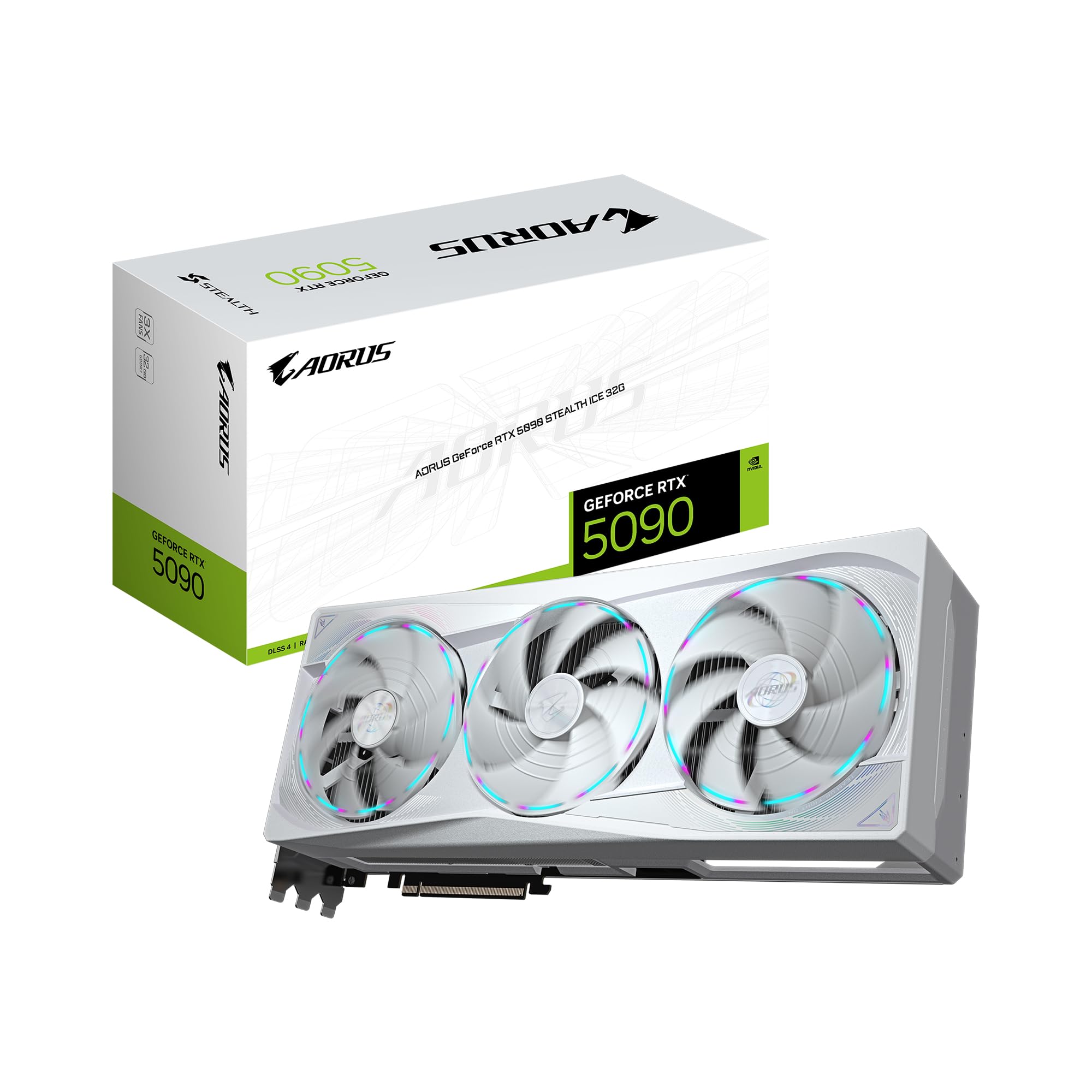
§The GDDR7 revolution: Why 32GB is the new 24GB
The transition from GDDR6X to GDDR7 in the Blackwell architecture represents a massive leap in memory throughput. For the local tinkerer, the GIGABYTE AORUS GeForce RTX 5090 Stealth ICE 32G Graphics Card and the MSI Gaming RTX 5090 32G Lightning Z Graphics Card provide the bandwidth necessary to make 4-bit and 3.5-bit quantization feel like 16-bit native performance.
The "magic" here is the bus width combined with the increased density. At 32GB of VRAM, the RTX 5090 finally allows for high-quality quantization of mid-tier Llama-4 variants without spilling over into system RAM.
- Higher Bus Speed: GDDR7 allows for significantly faster tokens-per-second on models that fit within the 32GB envelope.
- Quantization Efficiency: 4-bit GGUF or EXL2 kernels can now saturate the GPU more effectively, reducing the "dead time" between token generations.
- Price to Performance: While expensive, a consumer 5090 is still a fraction of the cost of HBM3e enterprise silicon.
However, the 32GB ceiling is real. If you’re trying to run the full, uncompressed weights of a flagship Llama-4 model, even a 5090 starts to look like a toy.
§HBM3e and the Llama-4 100B+ problem
When you move into the territory of models like DeepSeek-V3 or the largest Llama-4 releases, you aren't fighting for speed anymore; you're fighting for space. This is where HBM3e (High Bandwidth Memory) enters the chat. Systems like the ASUS Dual AMD EPYC 9004 Series 4U GPU Server (ESC8000A-E12P) with 2x NVIDIA H200 NVL 141GB GPUs utilize memory that isn't just fast—it's physically closer to the compute cores and substantially more efficient at handling massive KV caches.
The NVIDIA H200 NVL features 141GB of HBM3e. For a developer, this means running a 100B+ model at high precision with a massive context window of 128k tokens or more. Consumer GDDR7 cards simply cannot handle the memory pressure of a long-context conversation without degrading to a crawl.
§Comparison: Retail GDDR7 vs. Enterprise HBM3e
| Feature | Consumer GDDR7 (RTX 5090) | Enterprise HBM3e (H200 NVL) |
|---|---|---|
| Common Capacity | 32GB | 141GB |
| Typical Bandwidth | ~1.5 - 1.8 TB/s | ~4.8 TB/s |
| Context Handling | Limited (high overhead) | Massive (highly efficient) |
| Quantization | Optimized for 4-bit / 6-bit | Native 8-bit / 16-bit precision |
| Primary Use | Local Dev / Quantized Inference | Training / Full-Scale Production |
§The Multi-GPU trap: Scaling GDDR7 clusters
It’s tempting to think that four MSI Gaming RTX 5090 32G Lightning Z Graphics Card units will give you the same utility as an enterprise rig. On paper, 128GB of VRAM looks great. In practice, the interconnect is the bottleneck.
Unless you are using NVLink (which has become increasingly restrictive on consumer cards) or specialized workstations like the NOVATECH Apex WS9985X AI Workstation, you will see diminishing returns. The latency across the PCIe bus for model-parallel inference on GDDR7 cards creates a "stutter" that HBM3e systems simply don't have.
For those who need large VRAM but can't justify a $70k server, the middle ground is the Blackwell-based workstation cards. The PNY Technology VCNRTXPRO6000BQ-PB NVIDIA RTX PRO 6000 Blackwell Max-Q offers 96GB of VRAM. It still uses GDDR-class memory, but the sheer capacity available on a single PCB avoids the multi-GPU latency trap.
§Aggressive quantization: The GDDR7 sweet spot
If your workflow involves fine-tuning or running Llama-4 70B models, the 32GB GDDR7 buffer is a godsend for 4-bit quantization. Modern kernels have optimized the decompression of 4-bit weights so well that the compute units are almost never starved.
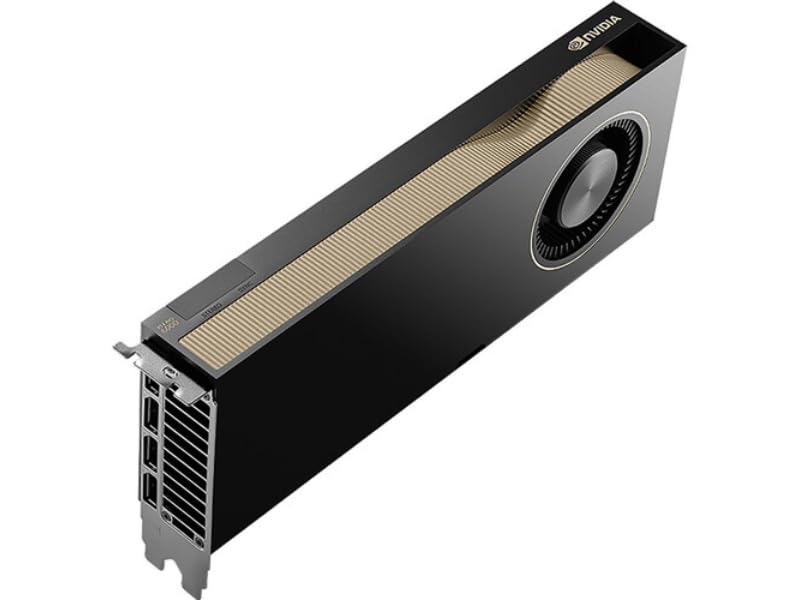
A workstation like the BoxGPT AI Workstation, usually ships with dual Pro-level cards, but even a single-card 5090 setup can now outperform the previous generation's PNY VCNRTXA6000-PB in pure tokens-per-second, despite having less VRAM. The speed of GDDR7 simply allows for more "re-fills" of the compute cache per second.
Why GDDR7 matters for Llama-4/DeepSeek:
- Lower Latency for Small Tasks: For RAG (Retrieval-Augmented Generation) and quick coding assists, the high clock speed of GDDR7 beats the "bulk movement" of HBM.
- Affordability for Devs: You can actually fit a 5090 in a standard mid-tower.
- Advanced Cooling: Cards like the GIGABYTE AORUS GeForce RTX 5090 Stealth ICE 32G are designed to hold stable clocks during long inference runs.
§Verdict: Which memory should you choose?
The "gap" between GDDR7 and HBM3e isn't just about speed; it's a gap of intent. GDDR7 is for the developer who needs to iterate quickly on quantized models. HBM3e is for the engineer who needs to maintain the integrity of a 405B model and its massive attention heads.
If you're building a local rig today, check our latest benchmarks. For most, the NOVATECH Apex WS9985X offers the best balance of consumer Blackwell speed with enterprise-grade stability.
FAQ
Can I run Llama-4 405B on 4x RTX 5090s?
Technically, yes, if you use heavy quantization (like 3-bit or 4-bit). However, the 128GB total VRAM will be tight for long-context scenarios. You'll likely see better performance on a single PNY Technology VCNRTXPRO6000BQ-PB due to reduced overhead.
Is GDDR7 significantly better than GDDR6X for AI?
Absolutely. The bandwidth increase allows for faster weights-to-compute transfer, which is the primary bottleneck for LLM inference. We've seen nearly 40% improvements in tokens per second on Blackwell vs. Lovelace architectures in our /categories/ai-gpus testing.
Why is HBM3e so much more expensive?
HBM3e uses a 3D-stacked architecture, meaning the memory is literally piled on top of or next to the GPU die on a silicon interposer. This is much harder to manufacture than soldering GDDR7 chips onto a PCB.
Heads up: AI Hardware Hub may earn a commission when you buy through links on this page. We only recommend gear we'd run ourselves.