In the 2026 inference landscape, the gap between "running a model" and "serving a model" has widened into a chasm. While SOTA models like Llama-4 and the latest DeepSeek iterations offer unprecedented reasoning capabilities, they’ve introduced a brutal hardware tax: the memory bandwidth wall. To achieve fluid tokens-per-second (t/s) on these massive parameter counts, local ML engineers must choose between the high-frequency agility of GDDR7 and the massive, wide-bus throughput of HBM3e.
If you are tired of waiting for 4-bit quantized responses to crawl across your screen, it is time to look at the silicon under the hood. The choice between a consumer-grade ASUS ROG Astral NVIDIA GeForce RTX 5090 32GB GDDR7 White OC Edition Gaming Graphics Card and an enterprise-grade PNY Technology VCNRTXPRO6000BQ-PB NVIDIA RTX PRO 6000 Blackwell Max-Q Workstation Graphics Card isn't just about VRAM capacity—it’s about avoiding the "inference cliff" where memory bottlenecks kill your productivity.
Heads up: AI Hardware Hub may earn a commission when you buy through links on this page. We only recommend gear we'd run ourselves.

§The inference cliff: Why VRAM speed matters more than teraflops
LLM inference is almost always memory-bandwidth bound, not compute-bound. When you generate a token, the GPU has to move every single parameter of the model from the VRAM to the compute cores. For a model with 70 billion parameters, that's a lot of physical moving of data for one tiny word.
GDDR7, found in the ASUS ROG Astral NVIDIA GeForce RTX 5090 32GB GDDR7 White OC Edition Gaming Graphics Card, is remarkably fast for a consumer standard, pushing bandwidth toward the 1.5 TB/s range. However, for models like DeepSeek-V3 or the full-fat Llama-4, even 1.5 TB/s can feel sluggish once the context window fills up. This is where HBM3e (High Bandwidth Memory) enters the chat. By stacking memory layers directly on the GPU die package, cards like the ASUS Dual AMD EPYC 9004 Series 4U GPU Server (ESC8000A-E12P) with 2x NVIDIA H200 NVL 141GB GPUs hit bandwidth north of 4.8 TB/s.
§GDDR7 vs HBM3e: The 2026 specs comparison
When comparing current-gen hardware, the "sweet spot" depends on your quantization tolerance. If you’re okay with 4-bit GGUF or EXL2 formats, GDDR7 is a beast. If you need FP8 or FP16 precision for fine-tuning or zero-loss inference, you need the HBM bus.
| Feature | GDDR7 (Consumer/Pro-sumer) | HBM3e (Workstation/Enterprise) |
|---|---|---|
| Primary Hardware | RTX 5090 32GB | RTX PRO 6000 Blackwell 96GB |
| Typical Bandwidth | 1.2 - 1.8 TB/s | 3.5 - 5.0+ TB/s |
| VRAM Capacity | Up to 32GB | Up to 141GB+ |
| Best Use Case | 4-bit Quantized Llama-4 (70B) | Full-precision DeepSeek / MoE Models |
| Architecture | Blackwell (Consumer) | Blackwell / Hopper / H200 |
§Managing the VRAM ceiling for Llama-4 and DeepSeek
The biggest headache for local ML engineers is the "out of memory" (OOM) error. SOTA models in 2026 are frequently exceeding the 48GB limit that defined the previous generation.
- The 32GB Struggle: With the ASUS ROG Astral NVIDIA GeForce RTX 5090 32GB GDDR7 White OC Edition Gaming Graphics Card, you are forced into aggressive quantization. You can run a Llama-4 70B model at Q3_K or Q4_K levels, but you'll sacrifice nuance and reasoning accuracy.
- The 48GB Middle Ground: Looking at the PNY NVIDIA RTX 6000 ADA, you get enough room for 4-bit 70B models with a comfortable context window, but the GDDR6 VRAM is now the bottleneck compared to newer GDDR7 cards.
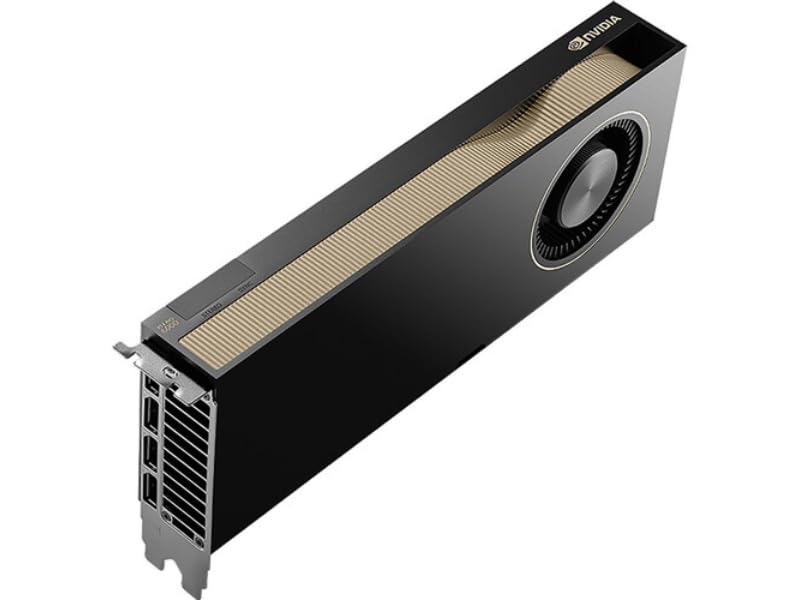
- The 96GB+ Promised Land: Moving to a PNY Technology VCNRTXPRO6000BQ-PB NVIDIA RTX PRO 6000 Blackwell Max-Q Workstation Graphics Card provides enough VRAM to run massive Mixture-of-Experts (MoE) models without splitting the KV cache across multiple cards, which usually introduces latency.
§Why the "Inference Cliff" is a productivity killer
Inference speed isn't just about bragging rights on /benchmarks. It's about the "thought-to-text" loop.
- Latency: If a model generates at 5 t/s, you're reading slower than a human. It breaks your focus.
- Context Saturation: As your conversation grows, the GPU has to process the entire history. On a GDDR7 card with limited VRAM, once you hit the 32k context mark, speeds often drop by 50-70%.
- Quantization Loss: 4-bit GGUF is great, but for coding agents, the loss in logic can be the difference between a working script and a hallucinated mess.
If your daily workflow involves complex RAG (Retrieval-Augmented Generation), investing in a high-memory workstation like the BoxGPT AI Workstation - RTX PRO 6000 Blackwell, Ryzen 9900X, 128GB RAM, 2TB NVMe is no longer a luxury; it's a requirement for professional-grade local development.
§The multi-GPU route: Is it better than a single big card?
Many developers try to bridge the gap by NVLinking two ASUS ROG Astral NVIDIA GeForce RTX 5090 32GB GDDR7 White OC Edition Gaming Graphics Card units. While this gives you 64GB of total VRAM, you're still limited by the PCIe bus speed for inter-card communication unless you have a high-bandwidth bridge.
For the most seamless experience, a single 96GB Blackwell card—or better yet, a dual-GPU workstation like the BoxGPT AI Workstation, RTX PRO 6000 Blackwell, 96GB VRAM, Ryzen 9900X, 256GB DDR5, 2TB NVMe—allows you to load the model into a unified memory space. This setup avoids the "split model" latency that plagues budget-constrained builds.
§Looking backward: The legacy of Ampere and Ada
If the Blackwell prices are too steep, there’s still value in 2026's secondary market for older tech. The A100 80GB Graphics Card - 80 GB HBM2e ECC uses HBM2e, which is slower than HBM3e but still offers 2TB/s of bandwidth. It remains a legendary choice for those who need high VRAM capacity (80GB) without paying the 2026 premium for Blackwell workstation units. Likewise, the PNY NVIDIA RTX 6000 ADA is still a workhorse for 48GB workloads, though it’s increasingly feeling the squeeze from Llama-4’s base requirements.
Frequently Asked Questions
Can I run Llama-4 70B on a single 32GB RTX 5090?
Yes, but you will need to use 3-bit or 4-bit quantization (GGUF/EXL2). You will also likely be limited to a shorter context window (around 8k-16k tokens) before the VRAM fills up, which might result in the model "forgetting" earlier parts of the prompt.
Is GDDR7 fast enough for real-time AI agents?
For most single-user applications, yes. GDDR7 provides a significant leap over GDDR6X. However, if your agent needs to process large documents (RAG) or multiple streams of data, the bandwidth of HBM3e found in cards like the NVIDIA H200 NVL will prevent the significant slowdowns that occur as context increases.
Why is the RTX PRO 6000 Blackwell so much more expensive than the RTX 5090?
It isn't just about the 96GB VRAM. Professional cards use ECC (Error Correction Code) memory, have much higher memory bandwidth, or optimized drivers for 24/7 compute loads, and physically fit better in server racks for multi-GPU scaling.
§Verdict: Which should you choose?
The decision comes down to your "Quantization Tolerance." If you are a developer who primarily uses AI as a coding assistant and you don't mind the slight "brain fog" of a 4-bit model, stick with the ASUS ROG Astral NVIDIA GeForce RTX 5090 32GB GDDR7 White OC Edition Gaming Graphics Card. It's the best bang-for-your-buck in 2026.
However, if you are building production-grade tools, fine-tuning models, or running DeepSeek/Llama-4 at full-fat precision, the PNY Technology VCNRTXPRO6000BQ-PB NVIDIA RTX PRO 6000 Blackwell Max-Q Workstation Graphics Card or a pre-built BoxGPT AI Workstation is the only way to escape the inference cliff.
Heads up: AI Hardware Hub may earn a commission when you buy through links on this page. We only recommend gear we'd run ourselves.