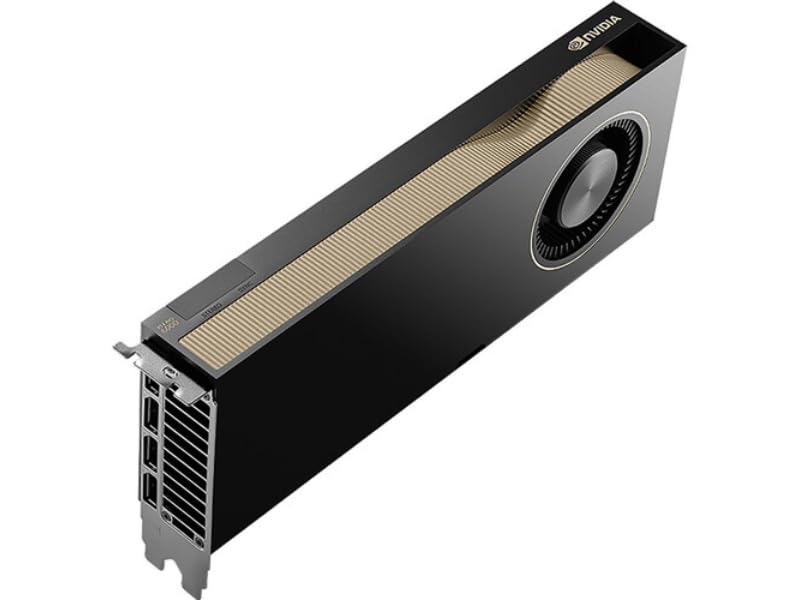
In 2026, the local ML engineer faces a brutal choice: embrace the high clock speeds of consumer GDDR7 or pay the "enterprise tax" for the stability of HBM3e. As Llama-4 and the latest DeepSeek reasoning models push the boundaries of logic, the traditional path of aggressive 4-bit quantization is hitting a literal wall—an accuracy cliff where models lose their "reasoning" capabilities long before they lose their coherence.
To build a future-proof ai-workstation, you have to decide if you’re optimizing for the speed of the token or the integrity of the thought.
Heads up: AI Hardware Hub may earn a commission when you buy through links on this page. We only recommend gear we'd run ourselves.

§The quantization trap: Why 4-bit isn't enough anymore
For years, we survived on 4-bit quantization (GGUF/EXL2) to cram massive models onto consumer cards. But the new class of "Reasoning Models" released this year has changed the math. These models rely on high-precision internal activations to maintain long chains of thought. When you squeeze a Llama-4 70B model down to 4-bit to fit it onto a 24GB ASUS TUF Gaming NVIDIA GeForce RTX 4090 OC Edition Gaming Graphics Card, the "intelligence" degradation is now measurable in benchmarks.
We're seeing a shift toward 6-bit and 8-bit (FP8) as the new standard for local development. This creates a massive memory pressure. A 70B model at 6-bit requires roughly 52GB of VRAM just for the weights, plus a sizable KV cache for long-context windows. This is where the GDDR7 vs HBM3e debate moves from academic to essential.
§GDDR7: The high-speed consumer gamble
The arrival of the ASUS ROG Astral NVIDIA GeForce RTX 5090 32GB GDDR7 OC Edition Gaming Graphics Card has provided a significant boost to local ML enthusiasts. With 32GB of GDDR7, it offers the highest bandwidth ever seen in a consumer card.
The Pros:
- Extreme Bandwidth: GDDR7 allows for lightning-fast token generation on smaller, highly-optimized models.
- Availability: You can find these cards in systems like the NOVATECH Apex WS9965X AI Workstation & Gaming PC.
- Clock Speeds: Better for iterative training and LoRA finetuning where raw compute throughput matters more than massive memory pools.
The Cons:
- Capacity Gap: Even with 32GB, you need two cards to run 6-bit 70B models comfortably.
- Latency Spikes: Under heavy inference loads, GDDR7 can exhibit higher thermal throttling compared to the cooled stacks of HBM.
§HBM3e and the Blackwell revolution
If you are serious about avoiding the accuracy cliff, you need VRAM headroom. This is where the PNY Technology VCNRTXPRO6000BQ-PB NVIDIA RTX PRO 6000 Blackwell Max-Q Workstation Graphics Card changes the game. Featuring a staggering 96GB of memory, it uses High Bandwidth Memory (HBM) architectures that provide a flatter, more consistent latency profile than GDDR.
A single RTX PRO 6000 Blackwell can host a 70B model at near-native precision (FP16 or high-bit quantization) with enough room left over for a 128k context window. This is the difference between a model that "hallucinates a fix" and a model that "reasons through the bug."
| Feature | GDDR7 (RTX 50-Series) | HBM3e (RTX PRO Blackwell / H200) |
|---|---|---|
| Max Capacity per GPU | 32GB | 96GB - 141GB |
| Best Use Case | Fast Inference / LoRA Finetuning | Full Model Pre-training / High-Precision Inference |
| Accuracy Cliff Risk | High (Requires 4-bit for large models) | Low (Supports 8-bit/16-bit for large models) |
| Power Efficiency | Moderate | High (Better Perf/Watt at scale) |
| Typical System | NOVATECH Apex WS9965X | BoxGPT AI Workstation |
§Bridging the gap: Multi-GPU vs. Single-Tower
For many ML engineers, the choice isn't just about the chip, but the chassis. If you can't afford the $13k for a 96GB Blackwell card, you might look at the A100 80GB Graphics Card - 80 GB HBM2e ECC. While it's an older architecture, the 80GB of HBM2e still outperforms consumer cards in reliability and large-batch stability.
However, the modern professional sweet spot has moved to the BoxGPT AI Workstation, RTX PRO 5000 Blackwell, 48GB VRAM. At 48GB, the PRO 5000 Blackwell offers a "Goldilocks" zone—enough VRAM to run 6-bit 70B models without the massive enterprise cost of the 96GB variants or the H200-class servers.
§Why memory architecture affects your code
When you're writing kernels or using libraries like Unsloth and vLLM, memory layout matters. GDDR7’s high frequency is great for "bursty" workloads—think generating a single chat response. But if you’re running a local agentic swarm where multiple models are constantly swapping context, HBM’s wider bus width reduces the "context loading" bottleneck.
If you’re stepping into the enterprise tier, systems like the ASUS Dual AMD EPYC 9004 Series 4U GPU Server (ESC8000A-E12P) with 2x NVIDIA H200 NVL 141GB GPUs represent the final boss of AI hardware. Here, the HBM3e isn't just a luxury; it's the only way to feed enough data to the H200 cores to prevent the CPU from becoming the primary bottleneck.
Strategic Hardware Selection Checklist
- Identify your primary model: If it’s under 30B parameters, stick to GDDR7 and high clock speeds.
- Measure your context needs: If you need 32k+ context on a 70B model, you must cross the 48GB VRAM threshold.
- Evaluate your "Accuracy Floor": If 4-bit quantization breaks your RAG pipeline's logic, HBM-based ai-gpus with higher capacity are mandatory.
§The Bottom Line: GDDR7 for speed, HBM3e for scale
The "accuracy cliff" is real. If you’re building the next generation of AI agents, you can’t afford to let quantization noise ruin your model’s reasoning. For most local developers, a high-end consumer setup like the ASUS ROG Astral RTX 5090 is a fantastic starting point. But for those moving into production-grade local inference, the BoxGPT AI Workstation with RTX PRO 6000 Blackwell is the only way to ensure your model stays as smart as the day it was trained.
FAQ
Does GDDR7 vs HBM3e affect training speed?
Yes. While GDDR7 has very high raw clock speeds, HBM3e has a much wider memory bus (often 4096-bit vs 384-bit or 512-bit). For large-scale training where the bottleneck is moving weights from memory to the tensor cores, HBM3e-equipped cards like the H200 or RTX PRO Blackwell will significantly outperform consumer GDDR7 cards.
Can I run Llama-4 70B on an RTX 5090?
You can run a 4-bit quantized version of Llama-4 70B on a single 32GB RTX 5090, but you will have very little room for context. For a better experience with a 6-bit or 8-bit version (which preserves more reasoning capability), a 48GB or 96GB card is recommended.
Why is the RTX PRO 6000 Blackwell so much more expensive than a 5090?
The price difference reflects the 96GB of VRAM, the enterprise-grade drivers, and the HBM-style architecture optimized for 24/7 AI workloads. You aren't just paying for the chip; you're paying for the ability to run massive models that simply won't fit on consumer hardware without extreme accuracy loss.
Heads up: AI Hardware Hub may earn a commission when you buy through links on this page. We only recommend gear we'd run ourselves.