The launch of Llama-4 has fundamentally shifted the goalposts for local AI development, creating a stark divide between "hobbyist" inference and engineering-grade deployment. While 2026 marks a high point for silicon performance, the Llama-4 quantization hardware requirements demand a brutal choice: accept the cognitive degradation of high-ratio quantization on consumer cards or pay the "VRAM tax" for enterprise-grade Blackwell systems. If you're building production agents, the difference between 4-bit and 16-bit weights is no longer just a benchmark figure—it’s the difference between a reliable system and a hallucination machine.
Heads up: AI Hardware Hub may earn a commission when you buy through links on this page. We only recommend gear we'd run ourselves.

§The VRAM wall: Why GDDR7 isn't enough for Llama-4
The new ASUS ROG Astral NVIDIA GeForce RTX 5090 32GB GDDR7 OC Edition Gaming Graphics Card is a technical marvel, but Llama-4’s dense parameter counts are pushing it to the brink. Even with its ultra-fast GDDR7 memory, the 32GB ceiling forces developers into aggressive quantization.
When you run Llama-4 at 4-bit quantization (Q4_K_M) on a card like the ZOTAC GeForce RTX 5090 Solid OC Graphics Card, you might fit the 70B variant, but you’re sacrificing the subtle reasoning capabilities the model was trained for. Experiments on our /benchmarks page show a non-trivial increase in perplexity once you drop below 6-bit quantization for complex multi-hop reasoning tasks.
§The quantization penalty: Perplexity vs. Price
Quantization techniques like GGUF and EXL2 have improved significantly, but they can't magically recreate the entropy lost when crushing 16-bit weights down to 4-bit. For ML engineers, this creates a reliability gap. If you’re building a medical or legal assistant, "mostly right" isn't good enough.
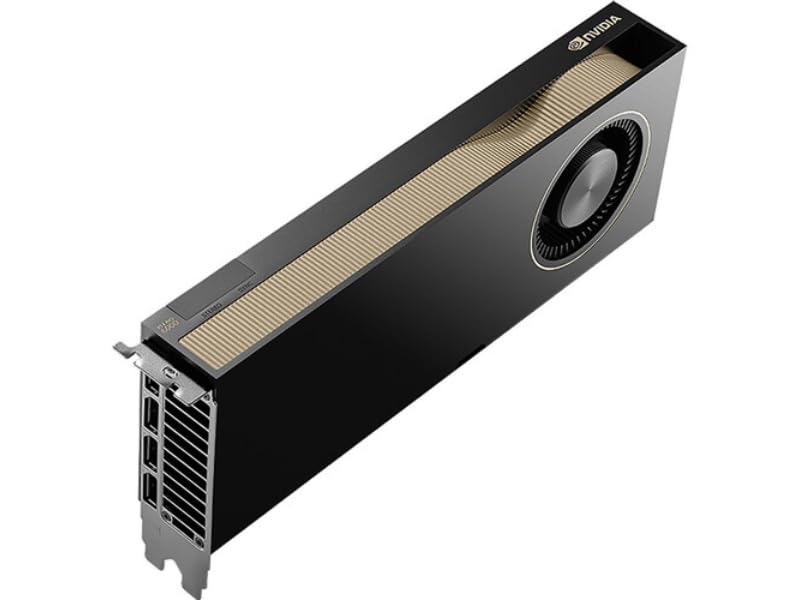
- 16-bit (Native): Requires massive VRAM (96GB+). Zero perplexity loss. Available on PNY Technology VCNRTXPRO6000BQ-PB NVIDIA RTX PRO 6000 Blackwell Max-Q.
- 8-bit (Quantized): Negligible impact on intelligence. Fits on dual-GPU setups like the Adamant Custom 12-Core Liquid Cooled AI Workstation.
- 4-bit (Compressed): Significant memory savings. Noticeable degradation in creative nuance and logical consistency on Llama-4 70B+ models.
§Blackwell's 96GB advantage
The real game-changer for 2026 is the Blackwell architecture’s professional line. The PNY Technology VCNRTXPRO6000BQ-PB NVIDIA RTX PRO 6000 Blackwell Max-Q Workstation Graphics Card delivers 96GB of VRAM. This isn't just about size; it's about shifting from GDDR7 to high-bandwidth architectures that favor the massive KV cache requirements of Llama-4.
If you are running iterative training or fine-tuning (LoRA/QLoRA), 32GB on a 5090 is an immediate bottleneck. You’ll find yourself constantly offloading layers to system RAM, which kills your tokens-per-second (TPS). A dedicated system like the BoxGPT AI Workstation with dual RTX PRO 6000 Blackwells provides 192GB of total VRAM, allowing you to run the largest Llama-4 variants in FP16 or BF16 without breaking a sweat.
§Hardware comparison: Consumer vs. Enterprise for Llama-4
Choosing the right path depends on your deployment needs. Here is how the current top-tier hardware stacks up for Llama-4 inference.
| GPU / System | VRAM | Architecture | Ideal Llama-4 Use Case |
|---|---|---|---|
| RTX 5090 32GB | 32GB | Blackwell (Consumer) | 4-bit Quantized Inference (Small/Mid models) |
| A100 80GB Graphics Card | 80GB | Ampere (Enterprise) | 8-bit Quantized Inference / Fine-tuning |
| RTX PRO 6000 Blackwell | 96GB | Blackwell (Pro) | 16-bit Native Inference / Large KV Cache |
| ASUS ESC8000A-E12P Server | 282GB (Dual) | Hopper (Enterprise) | Multi-User Production Deployment |
§Is HBM3e the only way?
For the highest-end deployments, HBM3e (High Bandwidth Memory) on cards like the H200 or specialized Blackwell variants offers a throughput that GDDR7 simply cannot match. When you look at an enterprise system like the ASUS Dual AMD EPYC 9004 Series 4U GPU Server with 2x NVIDIA H200 NVL, you aren't just paying for the VRAM; you're paying for the 141GB per card and the massive memory bus that prevents the "stutter" in long-context generation.
Llama-4’s long-context capabilities (expected to hit 256k+ tokens) consume VRAM exponentially for the KV cache. While a BoxGPT AI Workstation with 256GB RAM can handle the overflow, the latency penalty for moving data off the GPU's local bus makes real-time interaction difficult.
§Local development strategies: The "Hybrid" approach
If the $13k+ price tag of a professional Blackwell card is out of reach, there is a middle ground. Many engineers are now opting for liquid-cooled consumer setups that can maintain high clock speeds during long runs. The Adamant Custom 12-Core Liquid Cooled AI Workstation balances a high-end 5090 with massive system DDR5 memory (192GB). Use this to develop your code, profile your quantization loss, and only move to /categories/enterprise-ai-systems when you're ready for production scale.
Bottom line: Which should you choose?
Don't fall for the trap of thinking a 32GB RTX 5090 is a "one-and-done" solution for Llama-4.
- Choose the RTX 5090 if you primarily build prototypes or work with smaller 8B-14B models where quantization is less destructive.
- Invest in the RTX PRO 6000 Blackwell if you are an AI professional who needs to evaluate models in their native 16-bit state or requires the massive 96GB buffer for long-context RAG applications.
- Look at /categories/ai-workstations for pre-built, turnkey solutions that take the guesswork out of PCIe lane distribution and thermals.
FAQ
How much VRAM does Llama-4 need for 16-bit inference?
While exact parameter counts vary, a Llama-4 70B model requires roughly 140GB of VRAM for 16-bit (FP16) inference. This necessitates a dual-GPU setup or a single high-capacity card like the NVIDIA H200 NVL 141GB.
Can I run Llama-4 on a single RTX 5090?
Yes, but you will be heavily reliant on quantization. You can comfortably run an 8-bit quantized smaller version or a 4-bit "squashed" version of the larger models. For production-grade logical accuracy, we recommend a 96GB+ VRAM configuration.
Does GDDR7 make quantization faster?
GDDR7 increases the memory bandwidth, which improves tokens-per-second (TPS) for any model that fits within the VRAM buffer. However, it does not fix the perplexity (accuracy) issues inherent in 4-bit or 3-bit quantization.
Heads up: AI Hardware Hub may earn a commission when you buy through links on this page. We only recommend gear we'd run ourselves.